


A reader at a party should be an optional activity with clear terms—not a surprise test of guests’ beliefs or a promise about their future. Plan the booking, timing, privacy and boundaries before you confirm the event.
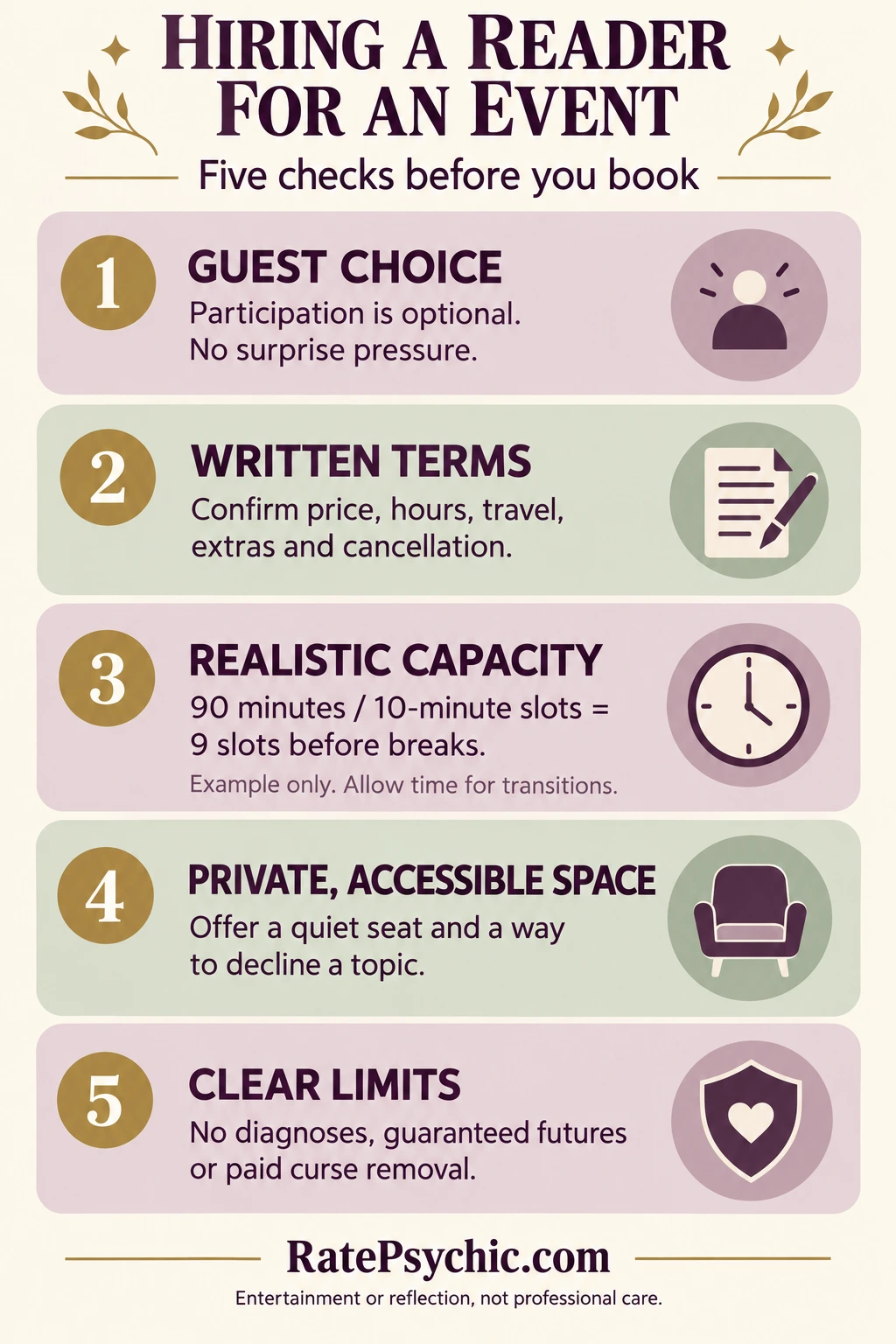
Five checks before you book
1. Guest choice
Describe the activity as entertainment or reflection and make participation optional. Do not call someone out, reveal private concerns to the reader or arrange a surprise personal reading. Offer a comfortable alternative activity.
2. Written terms
Confirm the total price, working hours, travel, setup, equipment, breaks, overtime, cancellation and rescheduling arrangements. Ask what the reader will actually provide. A testimonial, portrait or friendly message is not a substitute for a written offer.
3. Realistic capacity
Example only: 90 minutes divided by 10-minute slots equals 9 slots before breaks. Transitions, questions and breaks reduce that capacity. Confirm a workable schedule with the reader; do not promise every guest a session without enough time.
4. Private, accessible space
Ask about seating, table, access and equipment needs. Keep the area comfortable and separate enough that guests can speak without a crowd listening. Decide how people can wait, skip a turn or decline a topic.
5. Clear limits
Agree that the activity will not include diagnoses, guaranteed futures, accusations about absent people or paid curse removal. Health, legal and financial decisions need suitable qualified support, not party readings.
The Federal Trade Commission’s review guidance recommends considering sources and warns that fake or manipulated reviews can be difficult to identify. Look for specific event-service details, not stars alone. See what review details can show and checking the full cost.
Save the host checklist
Keep the boundaries during the event
- No unwanted spotlight: guests can stop or decline without an explanation.
- No assumed recording: discuss photos and audio/video recording beforehand, and respect a refusal.
- No private-data handoff: do not supply guest records, private messages or personal stories to manufacture a surprising reading.
- No surprise sales: agree on any extra-service sales in advance and keep guests free to decline.
- No distress as a performance: stop if someone is uncomfortable; let them choose support without a crowd or spiritual explanation.
If children will be present, agree on an appropriate participation policy and the venue’s requirements in advance. Do not use a reading as a clinical or developmental assessment. This guide is not a statement of local event regulations.
Compare the event offer, not the claim of special power
Ask about the method, format and service limits. An event reader should not need you to promise that guests will feel amazed or become believers. The host’s job is to plan a respectful optional activity—not to endorse accuracy.
Use the method and privacy guide, third-party reading boundaries and payment-pressure warning signs when comparing offers.
If plans change
Contact the provider promptly and refer to the agreed cancellation, refund or rescheduling terms. Save the written booking and any changes. A disappointing event does not automatically establish fraud or guarantee a refund; describe the specific service problem and use the appropriate complaint route.
Frequently asked questions
1. What should I confirm before hiring a reader for an event?
Confirm the service, guest participation, full price, working hours, travel, equipment, breaks, extra charges and cancellation terms in writing.
2. Is a party reading a guarantee of future events?
No. Present the activity as optional entertainment or reflection, not verified predictions or professional care.
3. Should guests be told about the activity in advance?
Yes. Describe it plainly so guests can choose whether to participate without being surprised or singled out.
4. Can guests decline without explanation?
Yes. Keep participation optional and offer another activity or an ordinary place to wait.
5. How many readings can one reader fit into an event?
Calculate the available time divided by agreed slot length, then allow for breaks and transitions. Confirm a realistic schedule with the reader rather than promising every guest a session.
6. What does the example calculation mean?
Ninety minutes divided by ten-minute slots is nine slots before breaks. It is an illustrative planning maximum, not a promised event capacity.
7. What space should I provide?
Ask about equipment and accessibility needs. Provide a comfortable quiet seat or table with enough separation for private conversation.
8. Can readings be given publicly?
Only choose that format when the participant understands it and agrees. Do not announce private interpretations or invite the crowd to pressure someone into disclosure.
9. Should I photograph or record a guest’s reading?
Do not assume permission. Discuss photography and recording before the session and respect a refusal or request to stop.
10. What topics should be kept out of party readings?
Set boundaries around diagnoses, death predictions, accusations about absent people and major health, legal or financial decisions.
11. Can the reader sell extra services at the event?
Agree on any sales arrangements before booking. Avoid pressure, threats or surprise fees, and do not let a guest feel obliged to buy anything.
12. Do reviews prove the reader is accurate?
No. Reviews may describe service experiences and can be manipulated. Check specific conduct and event details rather than treating stars as proof.
13. What if a guest becomes uncomfortable?
Stop that session, let the guest choose what support they want and do not describe distress as spiritual progress or demand further participation.
14. What about events with children present?
Agree on an appropriate participation policy and venue requirements in advance. Do not present readings as health or developmental assessments of children.
15. What should I do if the event changes?
Use the written booking terms to discuss timing, cancellation, refunds or rescheduling promptly. Do not assume verbal flexibility or guaranteed refunds.
While I appreciate the attempt to bring levity to this subject, I find it utterly ridiculous that people still rely on psychics for guidance. It’s all a charade!
What a fascinating perspective on celebrating birthdays! I never thought to include a psychic in my plans. It’s such a unique way to add depth to the occasion.
The points raised here about managing expectations and relaxing during a psychic reading are quite astute. Many people overlook the psychological aspect of such encounters.
“If all goes wrong, DIY”—now that’s the advice I didn’t know I needed! Why consult experts when you can just summon spirits with your friends over pizza?
This article is utterly ridiculous. Consulting psychics? Really? It’s just a ploy for money, and I can’t believe people actually fall for it.
While the idea of seeing a psychic may seem unconventional, there is an element of introspection that can be beneficial. People often overlook how our subconscious can guide us in understanding ourselves better.
Introspection is valuable, but relying on someone claiming to predict your future is fraught with delusion. We should seek wisdom from within rather than from charlatans.
“Get a co-sign”—are we signing contracts now before consulting with Ms. Cleo? What’s next, notarizing our intentions for life decisions?
(Insert obligatory eye-roll) So, DIY spiritualism now? Next, they’ll be suggesting we consult our houseplants for life decisions!
I take issue with the notion that one should be cautious about their psychic’s insights. Aren’t we just encouraging self-deception? The mind should question everything, even mystical claims.
‘Just relax’? Sure! I’m sure my anxiety will melt away while staring at tarot cards and hoping they won’t reveal my impending doom!
This article provides a wonderfully nuanced perspective on a topic that often gets overly simplified. I appreciate the emphasis on caution and mindfulness when engaging with psychics. A commendable read!
‘Take it with a grain of salt’? More like take it with an entire salt shaker! The level of credulity some exhibit is simply astounding!
‘Astounding’ is an understatement! It’s like asking for life advice from a fortune cookie.
‘If all goes wrong, DIY’? Really? Because nothing screams ‘spiritual awakening’ like a half-baked Ouija board session with friends!
‘Take it with a grain of salt’—that’s an understatement! If we’re so skeptical about psychics, why even entertain the thought? Shouldn’t we promote rational thinking instead?
‘Half-baked’ is right! I can just picture it now: ‘Let’s summon spirits after our pizza party!’