


Jump to a section
A useful psychic review explains the service: how booking worked, whether the price was clear, how communication went and whether your boundaries were respected. You do not need to publish the private story that led you to book.
The difference matters because readings often involve intimate things. A review written while you feel delighted or disappointed can reveal details about a breakup, family conflict, health concern, or a financial difficulty that wouldn’t normally be made public. Other people mentioned in the reading might not have agreed to appear in your review at all.
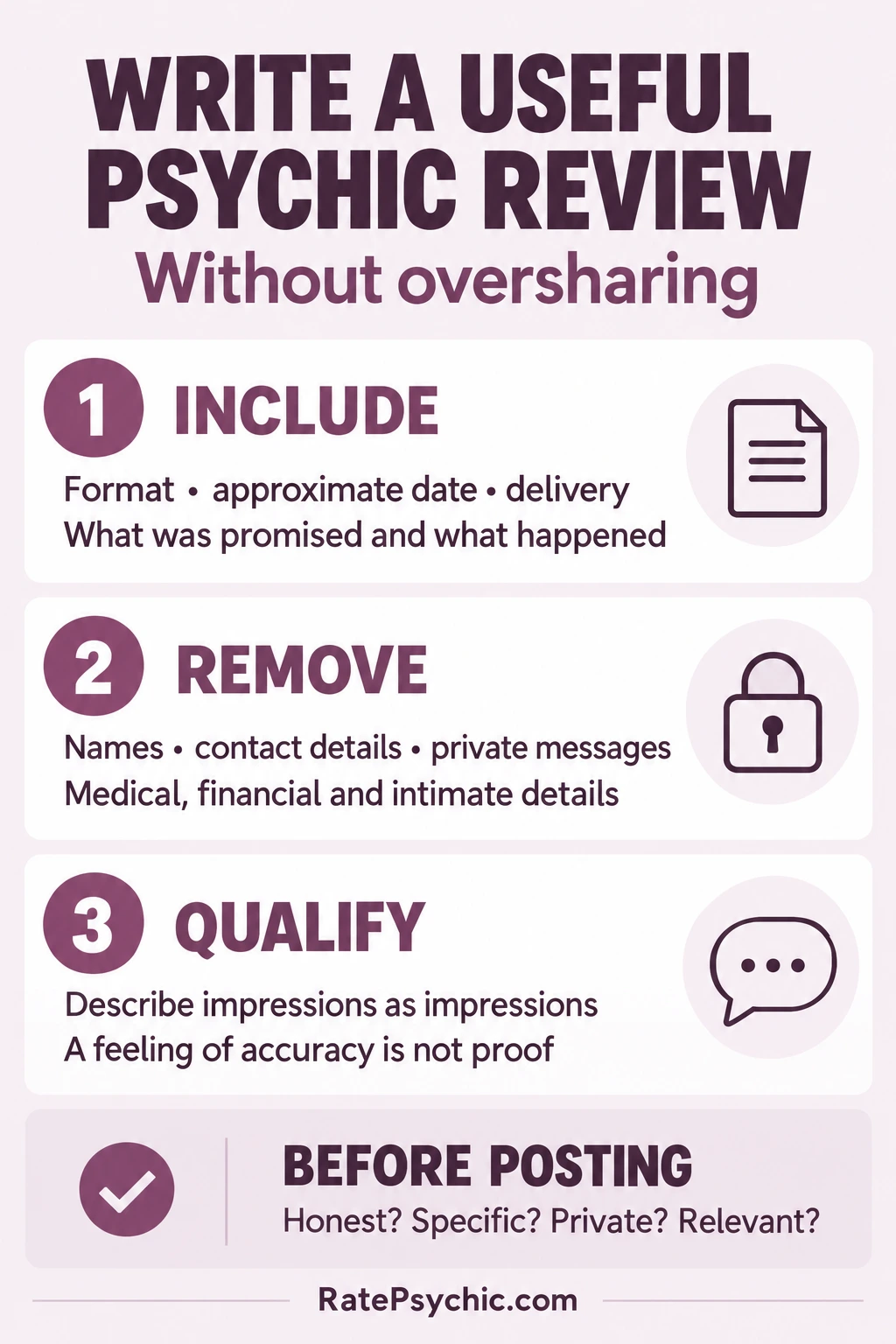
Three checks before posting
- Keep: format, delivery, billing clarity and observed conduct.
- Remove: names, private messages, identifying details and payment records.
- Qualify: impressions, uncertain memories and predictions you cannot verify.
Writing a helpful review means choosing details that explain the service. You should be honest, specific, and useful while keeping things private, like names, messages, and history, out of the review.
Decide What Clients Should Know
Before you draft your review, imagine if someone is trying to decide if the service fits their needs. They might need to know if the appointment started on time and if the advertised format matched the experience, and if the reader allowed questions. These details help them to decide if they want to make a purchase or not.
They probably don’t need to know your former partner’s place of work, a relative’s diagnosis, and the exact questions that you asked. These kinds of details explain why the reading felt important to you, but they don’t describe the service fairly.
Start with three notes including what was booked, what happened, and how the experience felt. You might say, “I booked a short reading about a relationship question. The reader explained the time limit and answered questions I had. I felt listened to.” This is a good review without giving a full description of your private life.
You can write a positive review without recommending the reader for each person or each problem. You can write a critical review without claiming to know the reader’s motives. Stay close to what you observed.
Experience Vs. Proof
A statement that felt meaningful is worth describing as your experience, but this is different from trying to prove that a reader can predict future events. The interpretation should give you a new question to consider instead of saying that the reader knew your real destiny.
A prediction that didn’t happen should be described without turning it into a conclusion about every reading the person has ever given. You can say that the event didn’t happen in the period of time they said it would.
If you aren’t sure if you gave a detail or not, don’t act like it’s something the reader couldn’t have known. Memory for a flowing conversation can be confusing. A review does not need to make impressive accuracy claims to be valuable.
For someone evaluating reviews, our guide to verifying psychic reviews explains why concrete details and transparency matter. Our after-reading reflection guide helps separate meaning from checkable claims.
The FTC’s advice on evaluating online reviews reminds consumers that reviews can be misleading or manipulated. As a reviewer, you can help by making your own account concrete, limited to your experience, and clear about uncertainty.
Focus Your Review on What Actually Happened
When you write a review of a psychic reader or platform, focus on what you directly observed. Was the full price clear before the reading started? Did the reading stay within the amount of time you agreed to? Did the reader answer the question you asked? You can also mention if the reader was respectful, listened to you, and made you feel comfortable speaking up when something didn’t connect.
If your reading was supposed to include something extra, such as a recording or written summary, mention whether you received it as promised. The same goes for technical problems. If the call disconnected or the video stopped working, you can explain what happened and how the reader or platform handled it. Details like these can help someone understand what the actual service was like.
Try not to base the entire review on how you felt when the reading ended. You might leave a reading feeling comforted but still have problems with unexpected charges or confusing prices. On the other hand, you might not agree with much of what a reader told you but still recognize that they were respectful, professional, and gave you the amount of time you paid for. It’s okay for a review to include things you liked and things you didn’t.
You don’t have to tell the entire story of your reading either. Pick a few details that mattered most when deciding how you felt about the experience. A shorter review that explains two or three specific things can sometimes be much more helpful than a long review where someone has to search through your personal story to figure out what you thought about the reader or service.
Protect Your Privacy When Writing a Review
Protecting your privacy means thinking about more than just leaving out your full name. Sometimes a combination of smaller details can make it surprisingly easy for someone who knows you to figure out who wrote the review. Your town, job, dates, family relationships, and details about an unusual situation might not identify you individually, but putting all of them together could.
Before posting, read your review and look for personal details that really don’t need to be there. Instead of explaining exactly which family member was involved and what happened between you, you might simply say, “I asked about a family situation.” Instead of naming your employer and explaining that you secretly applied for another position, you could say, “I asked about a career decision.” You can still explain your experience without sharing the private story behind every question.
Take a look at the profile you’re using to post the review too. Your username, profile picture, or accounts connected to the profile might reveal more about you than the review itself. If the website lets you use a display name, pick something you’re comfortable having other people see while still following the platform’s rules. Just remember that using a different name doesn’t necessarily make you completely anonymous.
It’s also a good idea to only post details that you’re comfortable having stay online. Even if you delete a review later, someone could have already taken a screenshot, quoted it, or shared it somewhere else. You don’t need to be afraid to write an honest review. Just make sure the personal information you include is information you’re comfortable making public.
Protecting Other People’s Privacy When Writing a Review
A partner, ex, child, co-worker, or relative shouldn’t be identifiable just because you booked a reading that involved them. Leave out their names, contact information, pictures, or private communications when doing a review.
Don’t post a transcript to prove the review’s accuracy when it has another person’s information. Write a short description about the service. If a platform needs more evidence for a complaint, use the private support to share what is necessary.
Be careful with children and details involving health, sexuality, finances, or allegations of wrongdoing. Even a good review can disclose information another person wants to keep private.
You can talk about your own feelings without explaining someone else’s private situation.
Rewrite Private Details as Service Details
A hypothetical first draft might name an ex’s employer, describe an argument and quote a prediction about reconciliation. Those details expose a private situation without explaining the booking, price or conduct of the reading.
A better thing to say would be, “I booked a relationship reading by phone and the price was clear; the reader let me ask follow-up questions. Some statements were predictions that I can’t verify and so I’m reviewing the communication and booking experience on its own.”
The revised version separates the service experience from private information. If the reviewer also felt pressured, they could add that behavior as well.
The goal isn’t to make the reviews sound more formal or neutral, and your own voice can be warm, disappointed, or mixed. Editing should preserve your honest reaction while making the service details clear and removing unnecessary personal information.
Positive and Critical Reviews
You might say, “I booked an email reading about a personal decision. The response came in the stated window and addressed the questions I asked. I found this reflection helpful, and I appreciated that no extra purchases were suggested.”
A mixed review could say, “The reader was nice and explained terms that I was unfamiliar with. But the chat moved slowly, and I reached my spending limit before I got to my second question. I would check the billing and question scope more carefully before I make another booking.”
A critical review could say, “The advertised package included a written summary, but it had not arrived by the promised deadline. I contacted support and will update this review when I receive a response.” If the matter is resolved later, an update can say so without erasing the original experience.
These are hypothetical examples, not real customer testimonials. Write only about your own experience; do not copy an example in a way that implies those events happened to you.
Transparency
If you got a free reading, a discount, or something else for a review, make this clear. The same applies if you work with the provider or have personal connections that could affect how the clients understand your recommendation.
The FTC’s Endorsement Guides explain disclosure principles in the United States. Requirements depend on context, and platforms may have their own rules. A simple, visible disclosure is more useful than wording hidden where readers are unlikely to notice it.
An incentive does not justify invented praise or hidden concerns. Check the platform’s rules before accepting it; some platforms prohibit incentivized reviews even when disclosed. Decline any arrangement that requires a positive rating.
You can decline to do a review. A good appointment doesn’t create a debt of public gratitude. Your private thanks or your decision to get another reading can be a valid response.
Billing Disputes and Reviews
A review can describe a billing problem, but it is not a substitute for a support request. Contact the platform or provider through its official support route if you want the charge investigated. You can still describe your experience honestly without waiting for permission to review.
Don’t publish transaction numbers, card details, addresses, or screenshots. A public audience doesn’t need to have that information to understand that a charge was disputed. Keep the evidence for the people who need to investigate it.
In the United States, the Consumer Review Fairness Act guidance from the FTC explains protections against certain contract terms restricting honest reviews. The protection has limits and does not make unlawful or confidential content acceptable. Other jurisdictions have different rules.
If you get a legal threat or have serious disputes, get advice that is appropriate to your location instead of just general ideas. For the review, facts and privacy should be starting points.
Writing Emotional Reviews
There is no required cooling-off period for an honest review, but rereading a draft before posting can help. Ask whether you would still be comfortable seeing those details online tomorrow and whether you can support each factual statement.
Distinguish “I felt rushed” from an accusation about the reader’s intent. Describe the observable behavior—for example, repeated requests to buy more time—so other readers can assess the concern without relying on speculation.
Avoid promises or universal verdicts such as “this will change your life” or “no one should ever book.” You can recommend a service or advise caution while explaining the experience and limits behind your conclusion.
Read the platform’s posting rules before you submit your review. If a review is removed, don’t just think you know the reason without checking it. It might involve privacy, prohibited content, verification requirements, or another policy. Use the appeal process or contact support.
Make the Star Rating Match Your Written Account
If a platform asks for star ratings, pick the rating that reflects the service that you’re describing. A review that gives the highest rating while reporting serious problems that aren’t solved can cause other clients to be confused, just like a low rating with no explanation leaves them without a way to evaluate what went wrong.
You don’t have to have a scoring formula, and you can consider the things that mattered most to you and then explain why briefly. If kindness was a strength but delivery was a problem, describe both. If you can’t assess an advertised follow-up because the deadline hasn’t passed, don’t say it’s missing.
The written explanation gives the rating context. Your rating is one person’s assessment of a certain purchase and not a universal measurement of spiritual abilities or predictions for every future client’s experience.
Update the Review When the Facts Change
If a missing response comes or a billing issue gets resolved, an update can help other readers to understand the full situation. Keep it short and factual. You don’t need to delete a fair review just because the reader later addressed it.
Don’t repeatedly change a review just because your emotions feel different or because you get a new interpretation. A review is important when it describes a stable account of the service instead of a public place to talk about your personal situation.
Before you post, make one final check and ask if a stranger can understand what you bought, what you saw, and why you reviewed it the way that you did without giving the personal details about your life. If so, you have found a good balance.
Sharing your service experience can inform other readers without making your private life public. A good review respects your privacy, the privacy of others, and the next person’s ability to make their own choices.
For an apparent prediction hit, use our prediction-evaluation guide. Before making another booking, compare the service terms that reviews cannot replace.
Frequently asked questions
1. What should I include in a psychic review?
Describe the format, approximate timing, price clarity, delivery and conduct you directly observed. Explain what mattered to your assessment without retelling your private situation.
2. Do I need to share the question I asked?
No. A broad topic such as a personal decision or relationship question is usually enough to explain the service.
3. Can I review a reading without claiming psychic accuracy?
Yes. Communication, delivery and respect for boundaries are useful service details even when predictions cannot be verified.
4. Should I post screenshots of the reading?
Avoid posting screenshots containing personal messages, account details or information about other people. Keep necessary evidence for the provider’s appropriate private support channel.
5. Does a display name guarantee anonymity?
No. Your profile, photo and combination of details may still identify you. Follow the platform’s rules and remove unnecessary identifying information.
6. Can I mention another person from the reading?
Keep the description general and leave out names, contact details, private messages and identifying circumstances. Booking a reading does not authorize publishing someone else’s private information.
7. How should I describe a prediction that did not happen?
State the wording and timeframe only as specifically as your record supports, without exposing private details. Do not turn one outcome into a claim about every reading.
8. What if I do not remember exactly what was said?
Make the uncertainty clear or omit the disputed detail. Do not present an uncertain memory as an exact quotation or verified fact.
9. Can a review include both praise and criticism?
Yes. Describe the strengths and problems separately so the reader understands your rating.
10. Do I have to write a positive review after a good reading?
No. You can choose not to review. A pleasant appointment does not create an obligation to publish praise.
11. Should I disclose a free reading or discount?
Disclose relevant incentives or connections clearly and check the platform’s rules. Some platforms prohibit incentivized reviews; decline arrangements requiring a positive rating.
12. Will posting a review resolve a billing dispute?
Not by itself. Contact official support to request investigation, and keep payment records and transaction identifiers out of the public review.
13. Must I wait for a cooling-off period?
This guide does not impose a waiting period. Rereading your draft can help you check factual statements and privacy before posting.
14. Should I update a review after a problem is resolved?
A dated, factual update can clarify the outcome without erasing a fair account of the original experience.
15. What should I check immediately before submitting?
Check that the account is honest, specific, relevant and privacy-conscious. Read the platform’s posting rules and make sure the rating matches the written explanation.