

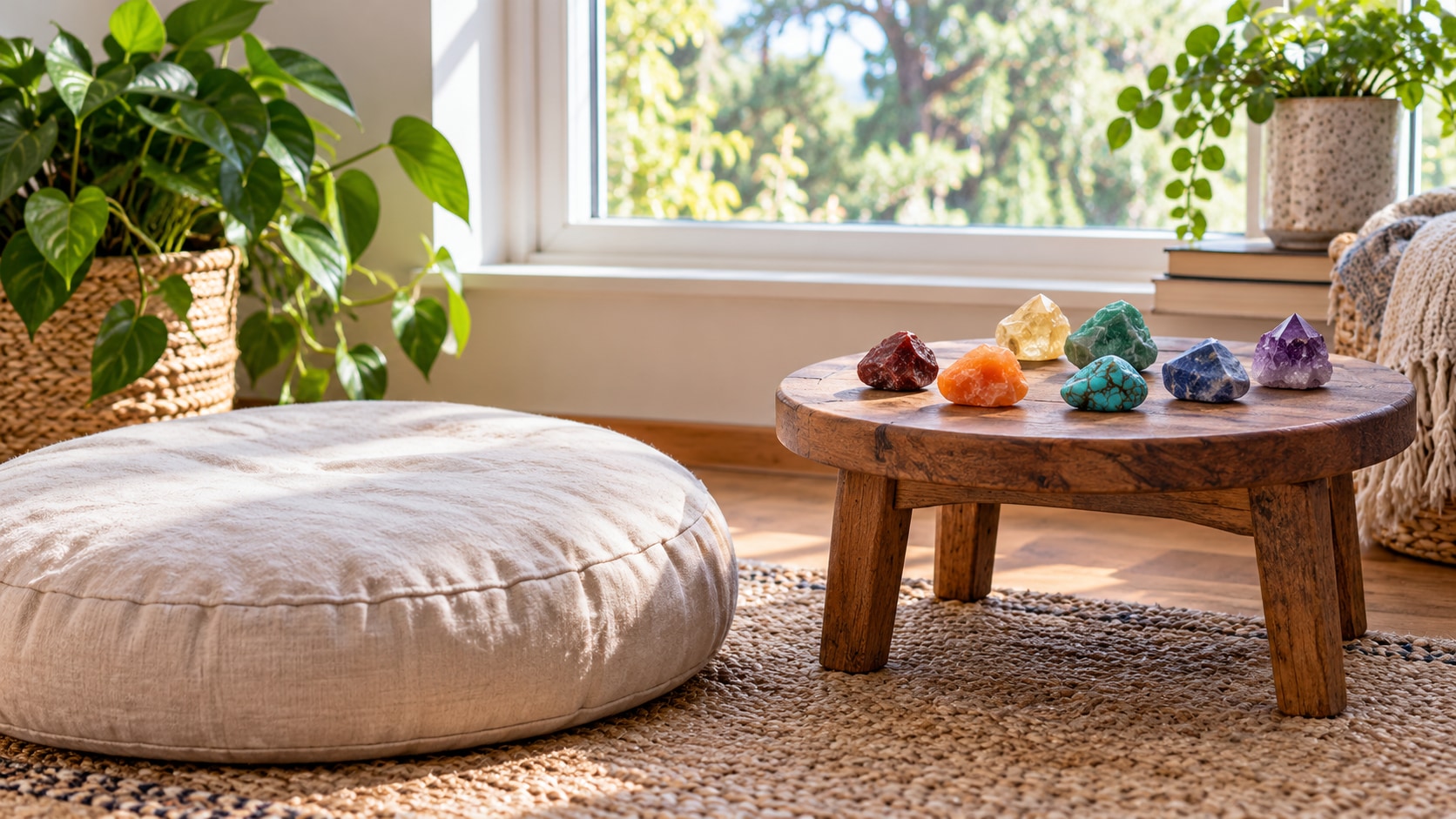
You can use a brief meditation to notice where your attention goes without claiming that it activates psychic powers. If chakra colors or symbolic objects are meaningful to you, treat them as optional imagery—not proof of an energy change, a diagnosis or access to hidden information.
Know the limits before you begin
The National Center for Complementary and Integrative Health explains that meditation approaches vary, evidence needs careful interpretation and unwanted experiences can occur. It advises against replacing or postponing conventional care with meditation. Benefits studied in health contexts do not establish psychic ability.
Do not use this exercise while driving or during any activity that needs your attention. If you feel distressed or uncomfortable, stop; you do not have to continue to prove openness or spiritual progress.
Five optional attention steps
1. Choose a comfortable setting
Use an ordinary supported seat or another comfortable position. There is no requirement to sit on the floor, remove shoes or arrange special objects.
2. Pick one ordinary point of attention
Try a visual object, a nearby sound or the contact of your body with the chair. Choose something that feels comfortable; eyes can stay open.
3. Leave breathing unforced
No counted breath-holding or forced deep breaths are needed here. If attending to breathing is uncomfortable, choose another point or end the exercise.
4. Notice without turning it into a verdict
If attention wanders, acknowledge it and return if you want. A thought, color or image can be noticed without deciding that it is a prediction or message.
5. End and reconnect with the room
Look around, notice an ordinary detail and decide whether to stop or continue another time. One minute is an optional starting point, not a prescribed dose or a performance target.
For other comfortable options, see trying mindfulness today. If a practice repeatedly leaves you unsettled, seek appropriate support rather than increasing its intensity.
Use colors as a personal reminder, not a body test
You may choose a color or word associated with a quality you want to reflect on, such as patience or steadiness. You can also leave spiritual imagery out entirely. The earlier article’s seven-color sequence should not be treated as a clinical map or a way to check whether your body is “clear.”
The stones in the cover image are decorative; no purchase is required. For related context, read crystals as optional reminders rather than protection guarantees and using a mantra as a practical reminder.
Write an impression separately from a fact
What I noticed
“I imagined changing my work schedule.” Keep that as a description of an impression—not evidence that a change will be approved.
What I can check
“I can review the written schedule policy and prepare a question.” A practical check does not depend on an image feeling vivid or meaningful.
Do not use a meditation impression to diagnose illness, decide someone’s hidden intentions or take a financial risk. Read noticing an impression and then checking it and examining a gut feeling for related reflection exercises.
Stop judging the practice by “powers”
A useful record can be simple: what you noticed, what remains uncertain and whether there is one ordinary next step worth taking. No vision, energy sensation or paid spiritual service is necessary. You may choose a different activity or decide not to meditate.
Frequently asked questions
1. Does meditation awaken psychic abilities?
The exercise here is for noticing attention and impressions, not demonstrating psychic powers. Feeling focused does not establish supernatural access to information.
2. Must I use chakra imagery?
No. You can choose an ordinary visual point, a sound or the feeling of contact with a chair instead.
3. Are the colored stones required?
No. They are optional decorative reminders. You do not need to buy crystals or equipment to try a brief attention exercise.
4. Do I need to hold my breath?
No. This exercise does not use timed breath-holding, forced deep breathing or a required breathing pattern.
5. Must my eyes be closed?
No. Keep your eyes open or softly focused if that is more comfortable, and stop if the exercise is unpleasant.
6. Must I sit cross-legged or barefoot?
No. Choose a supported position that is comfortable for you. There is no required floor posture or footwear rule.
7. How long should I try it?
Choose a brief period you are comfortable with; one minute is an optional starting point, not a therapeutic dose or a test to pass.
8. What if my attention wanders?
Notice the change and return to the chosen point if you want. Wandering attention is not evidence of spiritual failure.
9. Does a vivid image prove a message from spirit?
No. Record it as an impression and distinguish it from facts you know independently.
10. Should I act on an impression immediately?
No. Check relevant facts and practical risks first, especially when the choice affects other people, money, health or safety.
11. Can this cleanse anxiety or depression?
It is not a cure or a substitute for appropriate care. Seek suitable professional support for ongoing or worsening distress.
12. What if I become anxious or uncomfortable?
Stop rather than treating discomfort as required progress. Return attention to the ordinary surroundings and seek appropriate support if distress persists.
13. Do I have to practice every day?
No. The exercise is optional. You can shorten it, change the focus, skip it or choose another way to reflect.
14. How should I use an affirmation?
Treat it as a reminder of a chosen action, not a factual statement that psychic powers have been activated.
15. What is a useful outcome to record?
Record what you noticed, what remains uncertain and one practical fact or next step to check. Do not score success by visions or promised predictions.
“Just breathe and visualize colors” – because that’s all it takes to become ‘psychic.’ Next, they’ll tell us that thinking happy thoughts will cure world hunger. What a magical solution!
‘Grounding’ yourself sounds delightful, but what about grounding theories with scientific evidence? Let’s not forget the importance of rationality in spiritual practices.
A lovely piece of writing, though it remains purely anecdotal. I find it hard to swallow such claims without rigorous validation.
“I am becoming more psychic in every way in every day.” How beautifully poetic! However, one must ponder whether this affirmation leads to genuine insight or simply reinforces wishful thinking devoid of substance.
This article is an enlightening guide for those seeking to deepen their spiritual journey. The step-by-step instructions provide a clear path to awakening one’s psychic abilities. I wholeheartedly recommend it!
This article brilliantly encapsulates the essence of chakra work. The visualization techniques are especially profound, providing a pathway to deeper self-awareness.
‘Just breathe in colors!’ What a revolutionary idea! Next, I suppose we’ll be meditating on rainbows and unicorns too!
It’s interesting how subjective experiences can shape our understanding of energy and consciousness; perhaps we should explore these concepts further.
Another article promoting mystical nonsense. Chakras and psychic abilities? Please, let’s stick to scientifically proven methods for self-improvement.
‘Cleansing breaths filled with love’? Sign me up for this colorful experience! While I might not fully buy into the psychic aspect, who wouldn’t enjoy a little daily meditation amid swirling rainbow energies?
While I appreciate the attempt to blend spirituality with mindfulness, this seems more like a fanciful exercise than a legitimate practice. Can we really ‘turn on’ psychic abilities through breathing techniques? It feels rather dubious.
While the ideas presented here are intriguing, they veer dangerously close to pseudoscience without any empirical support.
“I am becoming more psychic in every way in every day.” This mantra is both inspiring and empowering! Just what I needed to uplift my daily routine.
‘Breathe in blue for psychic powers?’ At this rate, I might just start inhaling paint! Who knew art supplies could enhance my spiritual journey?
‘Breathe in the colors’? What are we, artists? This kind of pseudoscience masquerading as self-help just perpetuates ignorance. It would be more beneficial to focus on empirical methods of self-improvement.
Inspiration is great, but motivation without methodology can lead us astray; let’s not forget critical thinking!
While affirmations are helpful, combining them with practical steps would yield more substantial results.
The description of chakra energies is fascinating! It’s intriguing how each chakra corresponds with specific emotions and physical states. This knowledge can be transformative if applied correctly. Let’s not underestimate the power of intention in our lives.
“Envision swirling energy” sounds like something out of a bad sci-fi movie! If only life were as simple as breathing and imagining colors… though I must admit, it does sound oddly therapeutic!
The connection between emotional states and chakra energies is truly compelling; it’s fascinating how ancient practices align with modern psychology.