

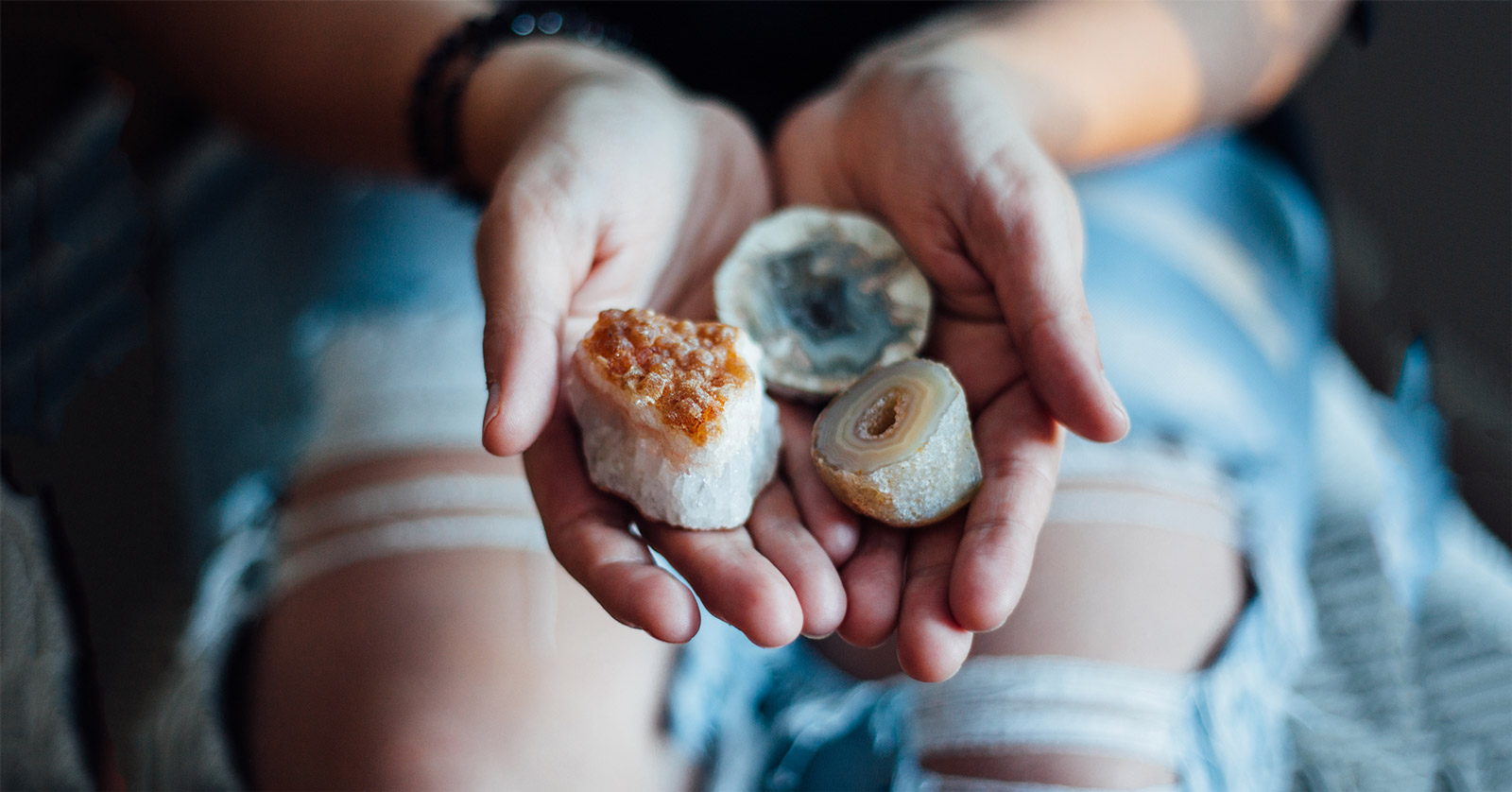
A stone can be a meaningful reminder, but it is not a diagnosis, a treatment or proof that your body’s energy is blocked. Use chakra associations as optional symbols—not explanations for illness or hardship.
Meaning is different from medicine
Modern crystal practices often connect colors and stones with chakra themes. The associations below are examples of that symbolic approach. They do not establish that stones strengthen organs, correct hormones, cure depression or remove the effects of trauma.
What “chakra stones” means here
People may use crystals in spiritual practice, as decorative objects or as reminders of an intention. Those uses can have personal meaning without requiring a claim about invisible anatomy. There is no single required stone list, and you do not need to interpret a difficult emotion as a malfunction.
For a clearer distinction between a spiritual framework and health care, see chakra reflection after trauma. You are not responsible for an illness or another person’s behavior because a chakra supposedly failed.
Seven optional themes—not a body diagnosis
These are familiar color-based associations found in contemporary practice. Choose a theme that is useful to you, skip the rest and adapt the question. The examples are not a prescription or an exhaustive mineral guide.
Root: steadiness
Symbol: red jasper or a red object.
Question: What would make my next step more manageable?
Sacral: creativity
Symbol: carnelian or an orange object.
Question: What small creative activity would I like to try?
Solar plexus: choice
Symbol: citrine or a yellow object.
Question: Which decision is mine, and what information do I need?
Heart: kindness with boundaries
Symbol: rose quartz or a green object.
Question: How can I be kind without abandoning a boundary?
Throat: expression
Symbol: blue lace agate or a blue object.
Question: What do I want to say plainly?
Third eye: perspective
Symbol: amethyst or an indigo object.
Question: What am I assuming, and what can I check?
Crown: meaning
Symbol: clear quartz or a violet object.
Question: Which value do I want my actions to reflect?
A simple reflection with no purchase required
- Choose one theme. You can write its name without using a stone.
- Notice the object, if you have one. Keep your eyes open if that is more comfortable. There is no need to wait for a special sensation.
- Answer the question briefly. Use ordinary language rather than searching for a diagnosis.
- Choose an action. A reminder becomes useful through what you do, not through a guaranteed energy effect.
- Stop when you want. If the exercise feels distressing or compulsory, set it aside.
If movement appeals to you, the chakra-themed yoga guide explains how to choose suitable instruction without treating a class as medical care.
What evidence can—and cannot—tell you
A 2025 randomized study of rose quartz and a visually matched placebo did not find a specific anxiety benefit from the crystal beyond the comparison object. One study does not settle every possible question, but it does not support selling rose quartz as an anxiety treatment.
Enjoying a ritual, noticing a sensation or hearing a positive testimonial is not the same as demonstrating a medical effect. Ask what was measured, what the comparison was and whether the claim exceeds the evidence.
Our review-checking guide explains why ratings and stories cannot establish supernatural accuracy. The same distinction is useful when stones or services are promoted through testimonials.
Keep the practical boundaries clear
- Do not ingest stones, make crystal drinking water with unidentified minerals or use crystals in place of care.
- Keep small objects out of reach of children and pets, and avoid sharp or damaged pieces.
- Minerals differ: check specific care instructions rather than assuming every stone can go in salt or water.
- Do not let a seller’s “blocked energy” assessment pressure you into an expensive purchase.
- Ask consent before involving another person; a private belief does not authorize treating them.
You can appreciate an object and still reject unsupported health promises. If symptoms or emotional difficulties concern you, seek qualified help rather than trying to identify a stone that supposedly corrects them.
Frequently asked questions
1. Can chakra stones heal a medical condition?
Do not use stones to diagnose or treat a condition. Symbolic meanings are not clinical evidence, and health concerns need qualified care.
2. Are chakras organs or glands?
No. Chakra language is a spiritual framework, not an anatomical map of organs, glands or disease.
3. Does feeling anxious mean a chakra is blocked?
No. Anxiety is not proof of a blocked chakra. Seek qualified support if symptoms concern you rather than diagnosing an energy problem.
4. Do all chakra practices use the same colors?
No. Lists and associations vary. The examples here describe a familiar contemporary color-based approach, not a universal rule.
5. Must I buy seven different stones?
No. You can use one object, a color card or no object at all. A costly collection is not required for reflection.
6. Can I choose a stone just because I like it?
Yes. Appearance or personal association can be enough. You do not need to claim that it has a healing power.
7. What does rose quartz represent in this guide?
It is an optional symbol for kindness and boundaries. That meaning does not establish an effect on the heart or relationships.
8. Do I need to activate a crystal?
No measurable activation procedure is required for this reflection exercise. Setting an intention simply means choosing what you want to consider.
9. What if I do not feel anything while holding a stone?
Nothing is wrong with you. A sensation is not required, and the absence of one does not show a spiritual blockage.
10. Should I put crystals in drinking water?
Do not put unidentified minerals or decorative stones in drinking water or ingest them. Their composition and treatments may be uncertain.
11. Can I place stones on another person?
Ask permission and accept a no. Do not put stones on someone who is asleep or cannot consent, or present the practice as treatment.
12. How can I clean a stone safely?
Check reliable care information for the specific mineral before using water, salt, heat or chemicals. A decorative object does not need a ritual cleansing to be safe for reflection.
13. Should I replace therapy or medication with crystal practice?
No. Continue appropriate care and discuss treatment changes with your qualified clinician.
14. How do I recognize pressure to buy more stones?
Be cautious about claims that you are damaged, cursed or unsafe until you buy a special item. You can decline and leave without proving your beliefs.
15. What is a useful way to end a reflection?
Choose one ordinary action, such as asking for support, stating a boundary or taking a manageable next step. The object does not need to control the outcome.
‘Chakra stones as healing tools’—an interesting concept indeed! However, one must be cautious of attributing too much power to these stones without rigorous studies to back their effectiveness.
‘Just hold a stone and your problems disappear’? Sounds like my last relationship! Maybe I should’ve just gotten some Selenite instead!
#Blessed to find this article! Finally, someone who appreciates the power of crystals. Can’t wait to stock up on my chakra stones and align my energies!
‘Chakra stones’? Sounds like a magical treasure hunt! I might just start collecting these colorful gems to feel a little more ‘balanced’—whatever that means!
It’s essential to note that chakra healing and energy fields, although popular in alternative medicine, often require more scientific validation. However, the psychological benefits of belief in such practices shouldn’t be dismissed.
This article raises some intriguing points about energy work and chakras, yet it lacks empirical evidence to support its claims. I wonder how proponents would address skepticism from a scientific standpoint.
An enlightening read! The connection between our energy fields and physical well-being is profound. I’m particularly fascinated by the historical significance of chakras across various cultures. This article beautifully encapsulates that.
‘Energy fields’ and ‘spinning wheels’—how poetic! However, one must wonder if this is merely a metaphorical representation of complex human experiences rather than an objective reality.
‘Using stones for healing’? Ah yes, because nothing says wellness like shiny rocks! Next up: healing with forks? They do conduct energy too!
While I appreciate the effort to blend ancient wisdom with modern wellness trends, it seems this article falls into the trap of pseudoscience. Chakras are not recognized by any credible scientific community, and promoting them as healing tools is misleading.
‘Balancing energies’? This reads like a blend of self-help jargon and mysticism. I’d rather invest my time in something tangible, like actual therapy or fitness!
Empirical evidence is subjective when discussing metaphysical concepts like chakras. It’s essential to acknowledge that personal experiences can also hold value in understanding our health.
While the notion of chakras is intriguing, it lacks empirical evidence. It’s troubling that such pseudoscientific ideas are perpetuated without rigorous scrutiny.
I love how you’ve managed to mix ancient wisdom with modern wellness trends—it’s like yoga pants for the soul! Who knew balancing chakras could be so fashionable?
This article provides a fascinating overview of chakras and their connection to our physical and emotional well-being. I particularly appreciate the historical context given—tying it back to ancient cultures adds depth to the discussion. Well done!
Fashionable or not, I’d still prefer a good diet and exercise over crystals any day!
‘Personal experiences’ can often lead us astray if not grounded in reality. Just because something resonates on an emotional level doesn’t make it scientifically valid.
I agree! The interdisciplinary approach here really enriches our understanding of how these concepts have evolved.
‘Invisible energy fields’? It’s amusing how some ideas persist despite lacking any basis in reality. Just because something sounds good doesn’t mean it’s worth pursuing.
‘Chakras can be affected even from childhood’? So basically, my childhood was a cosmic dumpster fire? Great… now I need crystals for therapy too!