
A lucky charm can be a keepsake, a cultural symbol or a reminder of something you value. It does not need to be a promise that an object will control your future.
People experience surprises and coincidences without a charm causing them. Winning a prize or finding money is not, by itself, evidence of supernatural luck. The useful question is what an object means to you—and whether the way you use it supports sensible choices.
Common symbols: recognize the meaning, not a guarantee
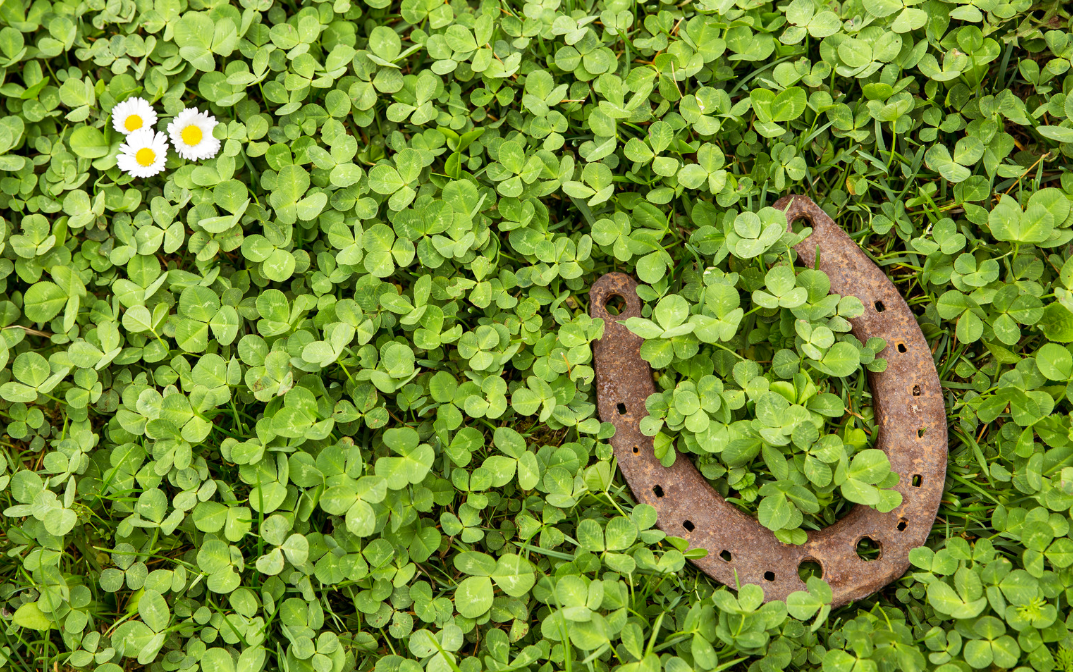
Horseshoes, four-leaf clovers, horns of plenty and wishbones have been used as good-luck motifs in celebratory designs. Smithsonian Gardens’ horseshoe floral-frame record describes these symbols in arrangements for openings, graduations and other occasions. That record documents symbolism, not evidence that the objects cause luck.
Four-leaf clover
A familiar token of good wishes. You could keep a picture as a reminder to notice opportunities. Do not infer that finding one predicts a particular outcome.
Horseshoe
A decorative good-luck motif. Display customs vary; there is no single evidence-based direction that captures luck. If you hang a heavy object, secure it safely.
Horn of plenty
A symbol commonly associated with abundance. It can express gratitude or a wish for enough, without promising business income, fertility or a healthy pregnancy.
Wishbone
A symbol connected with wishing. You can use a drawing or a manufactured version; a wish does not compel events or require an animal part.
These examples are not a universal dictionary. Meanings can change between communities, families and individuals. Avoid explanations that assign one belief to an entire culture or present an uncertain origin story as settled history.
Numbers, found coins and personal keepsakes
A number may remind you of an anniversary or carry meaning in a spiritual tradition. A coin may remind you of someone you miss. A small gift may represent encouragement. You do not have to dismiss those associations to recognize their limits.
Finding a coin does not establish that an angel left it. Seeing repeated numbers does not establish that money or love is on the way. Nor does a number’s popularity change the probability of a game or draw. Keep the interpretation separate from the decision you are considering.
For a more careful way to review a forecast, use the prediction-assessment guide.
Give the object a job you can actually describe
If you like a charm, use it as a prompt rather than a shortcut. An ordinary item you already own is enough.
- Name the meaning. “This reminds me to prepare,” rather than “This guarantees I will succeed.”
- Attach one action. Prepare a question, check a date or send a message you have chosen to send.
- Leave room for reality. Other people’s choices, access, chance and practical constraints still matter.
- Review without blame. A disappointing result is not proof that you used the object incorrectly or attracted bad luck.
Example: a keepsake before an interview
You might carry a small gift from a friend because it reminds you of their support. Separately, check the interview time, prepare examples and write down what you want to ask. The keepsake does not establish whether you will receive an offer.
For more planning ideas, read 27 ways to turn an intention into action. If your interest is in crystals, see stones, spiritual symbolism and health-claim limits.
What a charm should not replace
- Healthcare: an emerald, quartz or other object should not be presented as a way to prevent illness, treat depression, protect a pregnancy or cure a toothache.
- Consent: a charm cannot make another person love you or override their wishes.
- Safety: a protective symbol does not replace precautions, repairs or appropriate support.
- Probability: a lucky feeling does not change gambling odds or justify risking money.
You can value an object while obtaining qualified help for the problem in front of you. Choosing practical support does not invalidate a personal spiritual practice.
Before buying: separate the item from the promise
Ask what you are paying for: materials, craftsmanship, a collectible or a seller’s service. A higher price, “activation” or secrecy does not prove an ability to change events. Look at the full cost and return terms, and give yourself time to decide.
Be cautious about claims that only a specific seller can remove bad luck, that refusing a purchase will harm you or that repeated payments are needed to keep protection working. You do not have to buy a remedy for an unverified threat.
Respect the context of objects from traditions other than your own. Seek information from people knowledgeable about that specific tradition, and do not assume sacred items are interchangeable “luck boosters.” Consider a simple personal keepsake if you are unsure.
Lost, broken or no longer meaningful?
An object can break or disappear for ordinary reasons. That is not a forecast. Repair it if you want, keep a photograph, choose a new reminder or let it go. You do not owe a replacement ritual, and you do not have to keep something because a seller says discarding it is dangerous.
If the practice is creating pressure rather than comfort, pause. You can explore reflection without forced positivity or simply return to the next ordinary task you can manage.
Frequently asked questions
1. Do good-luck charms guarantee good outcomes?
No. A charm can hold personal meaning, but it does not guarantee a job, relationship, lottery win, health improvement or protection from harm.
2. Why do people keep lucky objects?
An object may remind someone of a person, a milestone, a tradition or an intention. Those meanings are different from proof that the object causes good events.
3. Are four-leaf clovers used as lucky symbols?
Yes. Four-leaf clovers appear as good-luck symbols, including in celebratory floral designs documented by Smithsonian Gardens. Their symbolism does not change the probability of an event.
4. Does a horseshoe have to face a particular direction?
People follow different customs about display. There is no evidence that a direction controls your luck, and a decoration should be secured safely.
5. Does seeing a number predict money or romance?
A number can have symbolic meaning to you, but repeatedly noticing it does not establish a forecast of wealth, romance or another event.
6. Is finding a penny a message from an angel?
Some people interpret it that way as a spiritual belief. Finding a coin alone cannot establish where a message came from or whether a prediction is true.
7. Can a lucky charm improve gambling odds?
No. A personal symbol does not alter a lottery draw, a game’s rules or its probabilities. Do not treat a feeling of luck as a reason to risk money.
8. Can crystals treat depression or prevent illness?
Do not use a charm or crystal as treatment or a substitute for qualified healthcare. Claims that an object prevents illness or cures depression need reliable clinical evidence.
9. Can I use an ordinary object as a personal symbol?
Yes. A small keepsake, a drawing or an object you already own can serve as a reminder without buying a product.
10. Do I have to buy an expensive or activated charm?
No. Price, an activation claim or a seller’s promised ritual does not establish that an object can influence future events.
11. What if my lucky object breaks or gets lost?
It is not evidence that something bad will happen. You can repair it, keep a photograph, choose another reminder or stop using one.
12. Should I use an animal part as a charm?
You do not need an animal part. A drawing or manufactured symbol avoids that concern and can still express a personal meaning.
13. Can a charm make another person love me?
No object can establish another person’s feelings or replace their consent. Respect a refusal or a request for space.
14. How can I respect a symbol from another tradition?
Learn about its specific context from knowledgeable sources rather than assuming every community uses it the same way. Avoid treating sacred items as generic accessories or guaranteed protection.
15. What should I do if a seller threatens bad luck unless I pay?
Pause and do not let the threat set your deadline. An alleged curse or penalty for refusing a purchase is not evidence that you need the seller’s service.
‘Finding a penny brings good luck’? If only I could find enough pennies to pay off my student loans! Maybe I should start carrying around a dandelion for wishes instead!
‘Luck’ is an interesting concept when dissected philosophically. It raises questions about free will, destiny, and our understanding of chance versus choice in our lives.
‘Number eight symbolizes wealth’? Shouldn’t we just invest in stock markets instead? It’s far more reliable than waiting for rabbits or ladybugs to bless us!
This article offers a fascinating glimpse into the cultural significance of luck and its charms across various societies. The connections between symbols and their meanings reveal much about human psychology.
‘Good luck’ seems like just another term for ‘I hope you get lucky.’ Maybe I should start wearing garlic around my neck—who knew combating vampires could lead to prosperity?
While the discussion on luck is intriguing, it largely falls into the realm of superstition. Evidence-based reasoning suggests that what we often attribute to ‘luck’ is simply randomness and coincidence.
Isn’t it ironic? We cling to these charms for luck while simultaneously dismissing the sheer randomness of life. Perhaps if I just keep a horseshoe above my door, I can finally win that elusive lottery?
I absolutely adore this exploration of luck! It’s delightful to see how different cultures interpret good fortune. The charm of the four-leaf clover has always held a special place in my heart.