

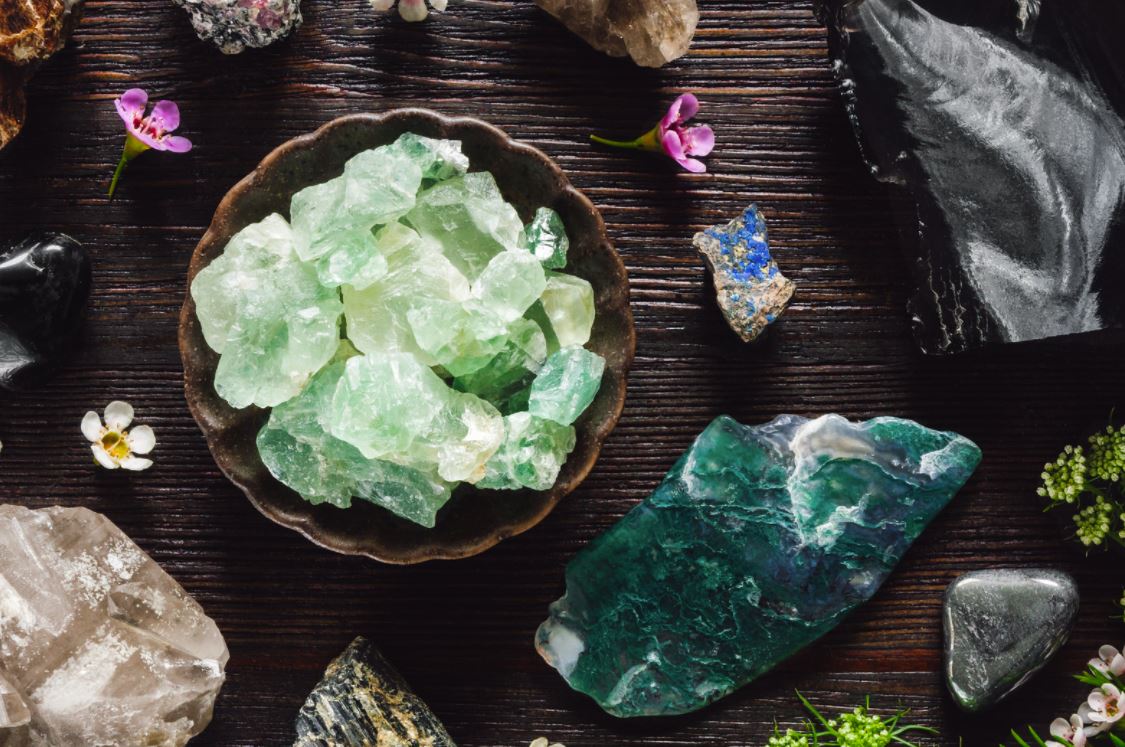
If you use “empath” to describe being strongly affected by other people’s feelings, a crystal can be an optional personal reminder to pause. It is not a protective shield, proof that you absorb someone’s energy or a treatment for distress.
You do not need a particular stone—or any purchase—to practice a boundary. The useful question is what you want the reminder to help you do in ordinary life.
Five stones, five questions you can choose
The questions below are suggestions for your own practice, not established properties of the minerals. Swap the stones, use another object or write a note instead.
Hematite: pause before agreeing
“Do I have the time and willingness for this request?” Use the reminder to check your capacity rather than assume the stone makes you safe.
Fluorite: separate observation from assumption
“What did the other person actually say, and what am I adding?” A feeling about someone is not access to their private thoughts.
Black tourmaline: state a limit
“What boundary do I want to communicate?” The action is a clear request or decision—not carrying a stone in place of ordinary safety precautions.
Amethyst: finish the conversation
“Is this a suitable point to stop and take a break?” You can leave time for rest without needing the stone to promise calm or good sleep.
Malachite: choose practical support
“What help would be useful, and who can appropriately provide it?” A decorative object does not supply professional care or establish someone’s qualifications.
A reminder only helps if you choose an action
Imagine a friend repeatedly calls during time you have reserved for yourself. Instead of trying to identify whether their energy is “negative,” decide what you are willing to offer.
A clear example
“I cannot talk tonight. I can spend 20 minutes catching up tomorrow afternoon, if that works for you.”
You may keep a meaningful object nearby when composing the message. The boundary comes from your words and choices, not a protective effect of the object.
A boundary is not a promise that the other person will agree. If an interaction raises a real safety concern, prioritize appropriate help rather than a crystal or energy-reading explanation. For a different everyday choice, try the small-step decision worksheet.
Keep other people’s feelings separate from your conclusions
Someone may look quiet, tired or upset without wanting you to explain their inner state. Ask whether they want to talk, respect a refusal and avoid diagnosing their energy. Caring about a person does not require taking responsibility for every feeling they have.
Choose and care for an object without cure claims
- Set a spending limit. An expensive or rare stone is not evidence of stronger protection. You can use something you already own.
- Ask what you are buying. Check the material description, size, treatments and return terms. Appearance alone does not verify a seller’s claims.
- Follow material-specific care. Do not assume every stone tolerates water, heat or the same cleaning method. Ask a knowledgeable seller or gem specialist about the actual item.
- Keep display separate from consumption. This guide is about an object on a table or suitable jewelry, not swallowing stones, powders or homemade crystal drinks.
Sunlight is not required to “recharge” amethyst. The Gemological Institute of America’s amethyst care guide notes that prolonged intense light can fade some amethyst and abrupt temperature changes can cause fractures. Its physical care guidance is separate from spiritual claims.
For another optional use of a meaningful object, see crystal-assisted reflection on purpose. For chakra symbolism without medical diagnoses, explore the heart-chakra reflection guide.
You do not need protection purchases
Pause if a seller or reader insists that you must buy a particular stone or urgent “clearing” service to prevent harm. You can decline. If distress persists or affects daily life, seek appropriate qualified support rather than treating it as evidence of psychic sensitivity.
If you choose a paid reading, use the service-check guide to confirm costs, privacy and limits first.
It’s fascinating how different cultures have utilized crystals for healing over centuries. The connection between emotions and physical objects is worthy of a deeper psychological exploration.
The idea that intuition guides us in choosing crystals is delightful! It sounds like an enchanting adventure in a mystical land where rocks reign supreme—imagine that!
‘Crystals can help you to be grounded’—a noble sentiment, but isn’t grounding more a function of mindfulness rather than mineral presence? Let’s not confuse correlation with causation.
I love how people talk about crystals as if they’re magical beings. I mean, I’ve met some ‘crystal healers’ who could use a good dose of reality-checking! 😂
This article brilliantly encapsulates the transformative power of crystals! As an avid user, I’ve experienced firsthand how Hematite has helped me maintain my emotional balance. Thank you for shedding light on this topic!
Absolutely! It would be intriguing to conduct a study on the placebo effect of crystal usage among empaths versus non-empaths.
“Correlation doesn’t imply causation” is indeed a crucial reminder in discussions like these. Yet, could the ritualistic aspect of using crystals contribute to their perceived efficacy?
*Insert dramatic gasp* The emotional power of stones?! What a revelation! Next thing you know, we’ll have support groups for emotionally distressed rocks!
‘Just hold this rock and your life will magically improve!’ What’s next? A guide on how to train your pet rock? The absurdity is both amusing and perplexing.
While I appreciate the enthusiasm surrounding crystals, I must question the scientific validity of these claims. Are we really attributing emotional stability to mere stones? Seems a tad far-fetched.