

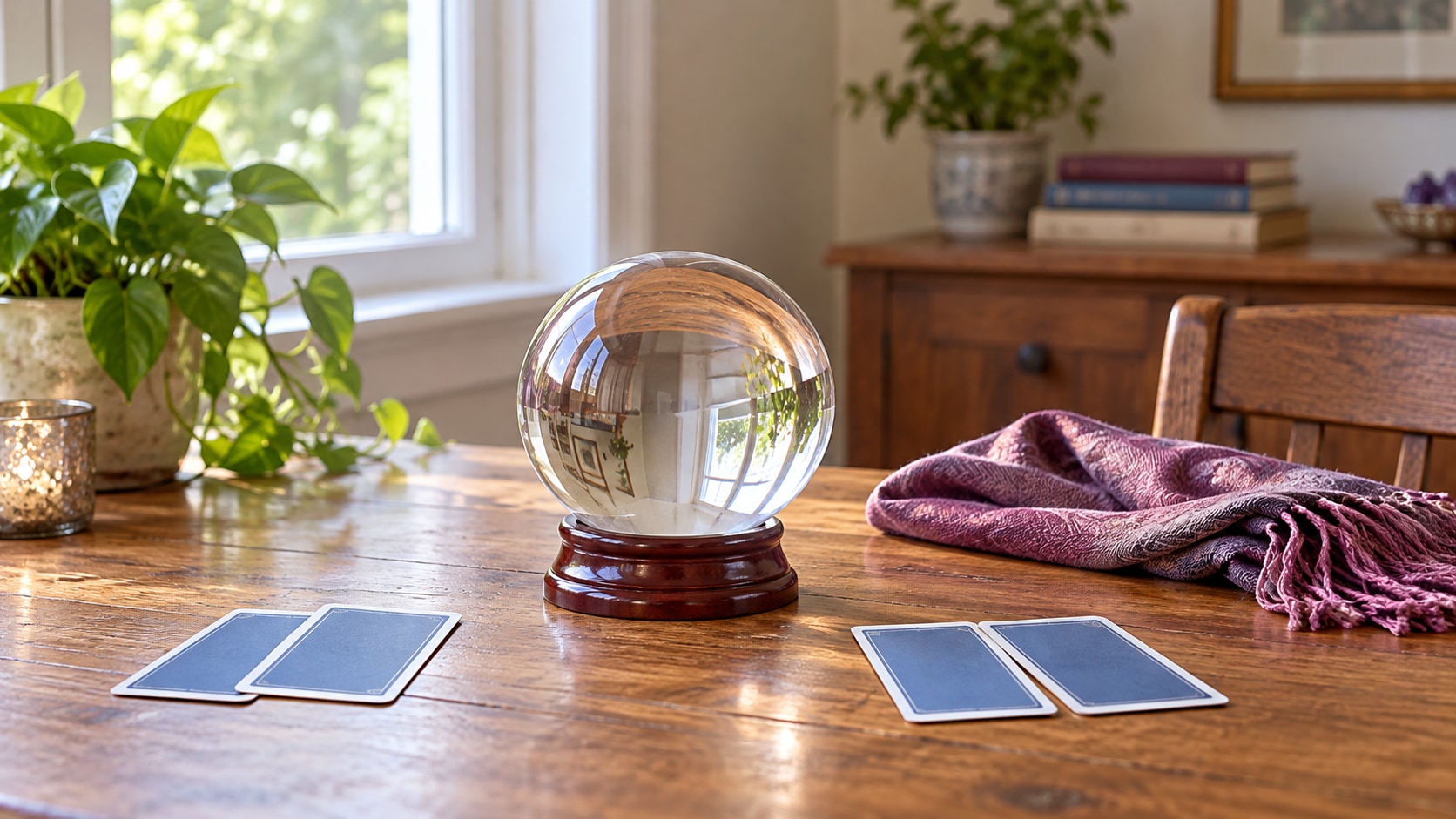
A convincing television story, a meaningful coincidence and a claim of psychic ability are different things. You can enjoy a fictional portrayal or value a personal experience without treating it as independent evidence that a reader can access hidden information.
Three kinds of account to separate
A fictional scene
Within a scripted story, the writer can make a character’s prediction correct and reveal why it mattered. That establishes what happened in the story, not how a real-world reading would perform.
A meaningful personal experience
An impression, dream or coincidence may feel significant. Record what happened and what it meant to you without assuming that significance identifies a supernatural source.
A claim that can be examined
If someone says they knew a specific fact or predicted an event, ask what was stated before the outcome, what information was available and what did not fit. Keep uncertainty rather than forcing a conclusion.
The American Psychological Association’s dictionary describes extrasensory perception as alleged awareness beyond known sensory channels and notes that its existence remains controversial. A familiar feeling is not, by itself, a demonstration of that ability.
Ask what “real” means in the claim
- Is a person offering a service? That is a question about the actual offer, terms and conduct.
- Does the person sincerely believe their interpretation? Sincerity is different from whether a particular statement is true.
- Did a conversation help someone reflect? Possible personal usefulness is different from predictive accuracy.
- Was hidden information obtained independently? That needs more than a testimonial, dramatic story or later reinterpretation.
A spiritual description may be meaningful within a belief system, but words such as “energy” do not by themselves explain or verify how information was obtained. Read claims, conduct and evidence and keeping a useful claim record.
Different reading labels describe different offers—not proven powers
A provider may describe card interpretation, astrology, mediumship or claimed direct impressions. Ask what the chosen method involves rather than assuming all labels mean the same service. The description does not establish that an absent person’s thoughts or a future event are accessible.
Use methods, formats and privacy limits and third-party reading boundaries. Do not use a fictional portrayal as a reason to ignore real-world safety or qualified support.
Disagreement does not require a personal label
A skeptic is not necessarily uninformed, and a believer is not automatically dishonest or foolish. You can discuss the claim without diagnosing another person’s motives or requiring them to change beliefs.
See respectful disagreement about psychic beliefs for practical conversation examples.
Keep a service choice practical
If you choose a reading, confirm the scope, full price, privacy and cancellation terms. Keep interpretation separate from facts you can check. You may disagree, stop or decide not to buy another session.
No absence of guarantees, screening badge or favorable review certifies psychic ability. Read warning signs versus proof and realistic expectations. If pressure or escalating fees appear, use the payment-warning guide.
‘They too, unfortunately will consider themselves to be ‘psychics’.’ How charmingly naive! Perhaps we should just label every fortune cookie as an oracle while we’re at it.
“With great power comes great responsibility… or just some really vague advice on love and finances!”
‘Real psychics are very real’—how delightfully paradoxical! Perhaps next we’ll discuss how unicorns are real too. After all, if one believes hard enough…
An intriguing perspective indeed! The author eloquently articulates the distinction between various forms of psychic ability. However, it would be prudent to further explore the scientific community’s stance on these phenomena.
This article is a brilliant exposition on the nuances of psychic abilities! It skillfully differentiates between real intuitives and charlatans, which is refreshing. Kudos to the author for shedding light on such a misunderstood profession!
While I appreciate the author’s personal journey, I can’t help but feel this post glorifies pseudoscience. It’s imperative we maintain a healthy skepticism towards claims that lack empirical evidence.
‘Things that were once portrayed as ‘woo-woo’…’ Ah yes, because nothing says credibility like primetime television drama! I’m sure Hollywood has never exaggerated anything in its quest for ratings!
‘All people have varying degrees of this ability.’ A profound statement that raises questions about human perception and consciousness. If we all possess some form of intuition, does that not imply a collective psychic experience?
“If psychics are real, why can’t they predict the lottery?” I guess those intuitive folks need better luck charms! Maybe they should consult their crystal balls before buying tickets!