Home Blog Page 12

Meditation, Chakra Imagery and Psychic Claims: A Grounded Attention Practice

Plain floor cushion beside seven small colored decorative stones on a low home table by a window.

You can use a brief meditation to notice where your attention goes without claiming that it activates psychic powers. If chakra colors or symbolic objects are meaningful to you, treat them as optional imagery—not proof of an energy change, a diagnosis or access to hidden information.

Know the limits before you begin

The National Center for Complementary and Integrative Health explains that meditation approaches vary, evidence needs careful interpretation and unwanted experiences can occur. It advises against replacing or postponing conventional care with meditation. Benefits studied in health contexts do not establish psychic ability.

Do not use this exercise while driving or during any activity that needs your attention. If you feel distressed or uncomfortable, stop; you do not have to continue to prove openness or spiritual progress.

Five optional attention steps

1. Choose a comfortable setting

Use an ordinary supported seat or another comfortable position. There is no requirement to sit on the floor, remove shoes or arrange special objects.

2. Pick one ordinary point of attention

Try a visual object, a nearby sound or the contact of your body with the chair. Choose something that feels comfortable; eyes can stay open.

3. Leave breathing unforced

No counted breath-holding or forced deep breaths are needed here. If attending to breathing is uncomfortable, choose another point or end the exercise.

4. Notice without turning it into a verdict

If attention wanders, acknowledge it and return if you want. A thought, color or image can be noticed without deciding that it is a prediction or message.

5. End and reconnect with the room

Look around, notice an ordinary detail and decide whether to stop or continue another time. One minute is an optional starting point, not a prescribed dose or a performance target.

For other comfortable options, see trying mindfulness today. If a practice repeatedly leaves you unsettled, seek appropriate support rather than increasing its intensity.

Use colors as a personal reminder, not a body test

You may choose a color or word associated with a quality you want to reflect on, such as patience or steadiness. You can also leave spiritual imagery out entirely. The earlier article’s seven-color sequence should not be treated as a clinical map or a way to check whether your body is “clear.”

The stones in the cover image are decorative; no purchase is required. For related context, read crystals as optional reminders rather than protection guarantees and using a mantra as a practical reminder.

Write an impression separately from a fact

What I noticed

“I imagined changing my work schedule.” Keep that as a description of an impression—not evidence that a change will be approved.

What I can check

“I can review the written schedule policy and prepare a question.” A practical check does not depend on an image feeling vivid or meaningful.

Do not use a meditation impression to diagnose illness, decide someone’s hidden intentions or take a financial risk. Read noticing an impression and then checking it and examining a gut feeling for related reflection exercises.

Stop judging the practice by “powers”

A useful record can be simple: what you noticed, what remains uncertain and whether there is one ordinary next step worth taking. No vision, energy sensation or paid spiritual service is necessary. You may choose a different activity or decide not to meditate.

Frequently asked questions

1. Does meditation awaken psychic abilities?

The exercise here is for noticing attention and impressions, not demonstrating psychic powers. Feeling focused does not establish supernatural access to information.

2. Must I use chakra imagery?

No. You can choose an ordinary visual point, a sound or the feeling of contact with a chair instead.

3. Are the colored stones required?

No. They are optional decorative reminders. You do not need to buy crystals or equipment to try a brief attention exercise.

4. Do I need to hold my breath?

No. This exercise does not use timed breath-holding, forced deep breathing or a required breathing pattern.

5. Must my eyes be closed?

No. Keep your eyes open or softly focused if that is more comfortable, and stop if the exercise is unpleasant.

6. Must I sit cross-legged or barefoot?

No. Choose a supported position that is comfortable for you. There is no required floor posture or footwear rule.

7. How long should I try it?

Choose a brief period you are comfortable with; one minute is an optional starting point, not a therapeutic dose or a test to pass.

8. What if my attention wanders?

Notice the change and return to the chosen point if you want. Wandering attention is not evidence of spiritual failure.

9. Does a vivid image prove a message from spirit?

No. Record it as an impression and distinguish it from facts you know independently.

10. Should I act on an impression immediately?

No. Check relevant facts and practical risks first, especially when the choice affects other people, money, health or safety.

11. Can this cleanse anxiety or depression?

It is not a cure or a substitute for appropriate care. Seek suitable professional support for ongoing or worsening distress.

12. What if I become anxious or uncomfortable?

Stop rather than treating discomfort as required progress. Return attention to the ordinary surroundings and seek appropriate support if distress persists.

13. Do I have to practice every day?

No. The exercise is optional. You can shorten it, change the focus, skip it or choose another way to reflect.

14. How should I use an affirmation?

Treat it as a reminder of a chosen action, not a factual statement that psychic powers have been activated.

15. What is a useful outcome to record?

Record what you noticed, what remains uncertain and one practical fact or next step to check. Do not score success by visions or promised predictions.


Can a Psychic Read Someone Else Through You? Privacy, Consent and Limits

Woman with black rectangular glasses resting a finger on her chin in an ordinary home setting.

Do not treat a psychic reading as verified access to another person’s private thoughts, health or future. If your concern involves someone else, keep the focus on what you can ask, offer or decide yourself. Caring about a person does not give a reader permission to speak for them.

Interpretation is not access to a private mind

The American Psychological Association’s dictionary describes extrasensory perception, including telepathy and clairvoyance, as alleged forms of awareness whose existence remains controversial. A reading about an absent person is not independent confirmation of what that person thinks.

Information you provide about a relationship can shape the response. A vivid interpretation or a familiar detail does not turn a guess into a verified fact. See how to distinguish claims, conduct and evidence.

Change the question to something you can own

From accusation to conversation

Instead of “Is my partner secretly cheating?” ask, “What concerns do I need to discuss directly, and what boundaries matter to me?” A reading cannot establish evidence for an accusation.

From prediction to support

Instead of “What will happen to my adult child?” ask, “What practical help can I offer, and how can I ask whether it is wanted?” Their choices remain theirs.

From spiritual repair to appropriate care

Instead of asking to clear someone’s distress or change their future, ask who can provide suitable practical or professional support. Do not use an energy interpretation to decide treatment.

These are illustrative question rewrites, not client accounts or promises about the outcome. For preparation, use the focused-question plan.

Keep permission specific and privacy intact

  • Ask before involving someone. A surprise gift does not require them to attend, agree or share private information.
  • Do not presume permission from silence. The reader’s claimed spiritual consent is not the person’s stated choice.
  • Limit what you share. Avoid another person’s medical records, private messages, identifying documents or unnecessary personal details.
  • Respect a change of mind. Participation should remain optional; a reading is not a reason to ignore a request to stop.

If someone cannot communicate permission, do not interpret that as access to their “soul-level” agreement. Keep support grounded in appropriate caregiving and qualified guidance, not psychic intervention. This article does not determine legal authority, capacity or guardianship.

Offer practical help before buying an interpretation

  1. Ask whether the person wants to talk about the concern.
  2. Offer one specific task, such as finding a contact or accompanying them to an appointment if they want you there.
  3. Check relevant facts with the appropriate person or organization.
  4. Respect privacy and a decision not to discuss the issue.

The National Institute of Mental Health describes psychotherapy as treatment generally provided by licensed mental health professionals. Psychic or energy-clearing claims are not a substitute for suitable care.

If both people want a reading

Agree on what you are each comfortable discussing and check the service’s format, price and privacy arrangements. Even a mutually chosen session cannot establish someone’s hidden intentions. Either person can disagree with the interpretation.

Read service methods, privacy and limits and keeping conversation boundaries. If a prediction or fee is being used to pressure you, pause and review payment-pressure warning signs.

Frequently asked questions

1. Can a psychic read someone else through me?

Do not treat a third-party interpretation as verified access to that person’s thoughts or future. Keep the question focused on your own choices and independently checkable facts.

2. Does knowing someone closely make their private thoughts readable?

No. Your familiarity supplies ordinary information about the person; it does not establish psychic access to their mind.

3. Does good intent replace their permission?

No. Wanting to help does not mean someone has agreed to participate or have private details shared.

4. Is soul-level permission a substitute for consent?

No. A reader’s claimed spiritual permission is not the person’s expressed agreement.

5. Can a reading prove a partner is cheating?

No. Do not use an interpretation as proof for an accusation. Discuss your concerns and seek appropriate support for the actual situation.

6. What can I ask about a relationship instead?

Ask about your own expectations, boundaries or next conversation, rather than requesting hidden information about someone else.

7. Should I share a person’s private messages?

Avoid sharing another person’s private messages, records or identifying details for a reading. Their privacy is separate from your desire for an answer.

8. Can I book a surprise reading as a gift?

Ask whether the person wants it before arranging participation. They should be free to decline without pressure.

9. What if someone cannot communicate consent?

Do not presume spiritual permission or use a reading to decide treatment. Focus on practical support and appropriate caregivers or qualified professionals.

10. Can chakra clearing treat someone’s distress?

Do not rely on a reading or energy-clearing claim as treatment. Health concerns belong with suitable qualified care.

11. Can a child’s chart diagnose their needs?

No. A chart is not a clinical or developmental assessment. Use observations and suitable qualified guidance for a child’s needs.

12. Can a joint reading confirm shared feelings?

Even when both people choose to participate, an interpretation is not proof of private feelings or future conduct.

13. Does declining a third-party reading mean I do not care?

No. Practical help, listening and respectful communication can support someone without a reading.

14. What if the reader says permission is unnecessary?

You can decline that approach. Keep private details out of the session and do not let the interpretation override another person’s wishes.

15. How can I help without buying a reading?

Ask what support the person wants, offer a specific practical task and use appropriate professional resources when needed. Respect a choice not to discuss the issue.

Can You Test a Psychic Reader? Claims, Records and Practical Checks

Small bubble-filled glass sphere held toward the camera, with its reader softly out of focus in an ordinary home.

Trusting a reader is not the same as establishing accuracy. A quick quiz, a familiar detail or a pleasant conversation cannot settle whether a person has psychic abilities. If you want to assess a claim, keep a clear record and distinguish what was said from what you later made of it.

A quiz can be discussed without becoming proof

Asking about a childhood pet or another personal detail can reveal what the reader is willing to claim. Agree on the service beforehand, and do not pretend that a single correct detail proves a supernatural source—or that a single mistake tells you everything about the provider’s intentions.

A reader may decline a question that is outside the offered service. That boundary does not establish accuracy either. You can decide not to book if the actual offer is not what you want.

Keep four distinctions in your notes

The exact statement

Write down the words and any timeframe while they are fresh. “A change is coming” is different from a specific event with a clear date and outcome.

The information already available

Note what you shared, what the reader asked and what could be public. A detail repeated after you supplied it is not independently obtained information.

What actually happened

Keep what matched, what did not and what remains too vague to assess. Do not quietly remove missed statements from the record.

What remains uncertain

A personal record can clarify your experience, but it is not a controlled test of psychic ability. Keep alternative explanations in view rather than declaring the result proven.

You do not need to create a paid experiment or repeatedly purchase readings to complete these checks. For broader context, read claims, conduct and evidence.

Evaluate the actual service on its own terms

  • Scope: does the provider describe the method, format and limits in plain language?
  • Cost: are the full price, included questions and optional extras clear?
  • Boundaries: can you disagree, decline a topic or stop without threats?
  • Privacy: are information handling and recordings explained rather than assumed anonymous?
  • Problems: are cancellation, refund and complaint arrangements available?

These checks can help you compare service conduct; they do not measure psychic ability. Use the methods and privacy guide and credential-verification questions.

Read reviews without treating them as an accuracy certificate

The Federal Trade Commission advises evaluating review sources, looking across more than one source and not assuming you can reliably identify a fake review by appearance alone. Positive or negative reviews may be manipulated.

Look for concrete service details rather than a star total alone. See what psychic-review details can and cannot show.

Keep the spending limit yours

For a timed service, confirm how billing starts and ends and set a spending limit before the session. Ask how you can end the call or chat; do not rely on an assumption that the provider will notice your budget. The reader remains responsible for explaining their terms.

You may pause, decline or choose no reading. Disagreement, uncertainty or emotional distress is not a reason to be blamed for the outcome. Keep health and safety needs with appropriate qualified support.

Before booking, use the full-cost comparison guide. If you hear threats or escalating-fee demands, review payment-pressure warning signs. An unclear or disappointing session does not require another purchase.

Hiring a Psychic Reader for an Event: A Practical Host Checklist

Four adult women gathered around normal-sized glass sphere and tarot cards on a home table.

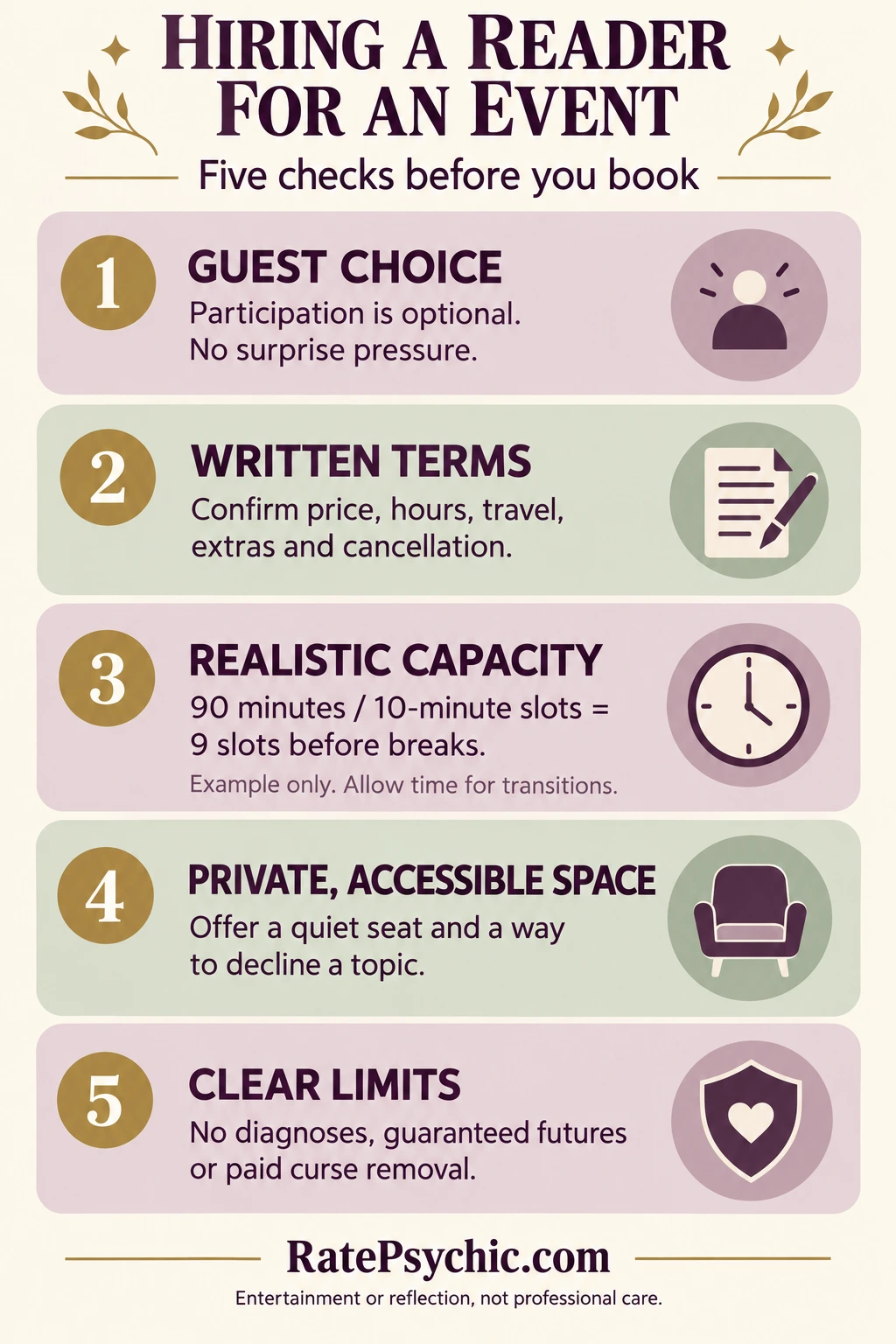
A reader at a party should be an optional activity with clear terms—not a surprise test of guests’ beliefs or a promise about their future. Plan the booking, timing, privacy and boundaries before you confirm the event.

Five checks before you book

1. Guest choice

Describe the activity as entertainment or reflection and make participation optional. Do not call someone out, reveal private concerns to the reader or arrange a surprise personal reading. Offer a comfortable alternative activity.

2. Written terms

Confirm the total price, working hours, travel, setup, equipment, breaks, overtime, cancellation and rescheduling arrangements. Ask what the reader will actually provide. A testimonial, portrait or friendly message is not a substitute for a written offer.

3. Realistic capacity

Example only: 90 minutes divided by 10-minute slots equals 9 slots before breaks. Transitions, questions and breaks reduce that capacity. Confirm a workable schedule with the reader; do not promise every guest a session without enough time.

4. Private, accessible space

Ask about seating, table, access and equipment needs. Keep the area comfortable and separate enough that guests can speak without a crowd listening. Decide how people can wait, skip a turn or decline a topic.

5. Clear limits

Agree that the activity will not include diagnoses, guaranteed futures, accusations about absent people or paid curse removal. Health, legal and financial decisions need suitable qualified support, not party readings.

The Federal Trade Commission’s review guidance recommends considering sources and warns that fake or manipulated reviews can be difficult to identify. Look for specific event-service details, not stars alone. See what review details can show and checking the full cost.

Save the host checklist

Event-reader booking checklist: guest choice, written terms, realistic capacity, private accessible space and clear limits. Example: 90 minutes divided by 10-minute slots is nine slots before breaks.
Planning example, not a promised capacity or psychic-accuracy guarantee. Open the larger host checklist.

Keep the boundaries during the event

  • No unwanted spotlight: guests can stop or decline without an explanation.
  • No assumed recording: discuss photos and audio/video recording beforehand, and respect a refusal.
  • No private-data handoff: do not supply guest records, private messages or personal stories to manufacture a surprising reading.
  • No surprise sales: agree on any extra-service sales in advance and keep guests free to decline.
  • No distress as a performance: stop if someone is uncomfortable; let them choose support without a crowd or spiritual explanation.

If children will be present, agree on an appropriate participation policy and the venue’s requirements in advance. Do not use a reading as a clinical or developmental assessment. This guide is not a statement of local event regulations.

Compare the event offer, not the claim of special power

Ask about the method, format and service limits. An event reader should not need you to promise that guests will feel amazed or become believers. The host’s job is to plan a respectful optional activity—not to endorse accuracy.

Use the method and privacy guide, third-party reading boundaries and payment-pressure warning signs when comparing offers.

If plans change

Contact the provider promptly and refer to the agreed cancellation, refund or rescheduling terms. Save the written booking and any changes. A disappointing event does not automatically establish fraud or guarantee a refund; describe the specific service problem and use the appropriate complaint route.

Frequently asked questions

1. What should I confirm before hiring a reader for an event?

Confirm the service, guest participation, full price, working hours, travel, equipment, breaks, extra charges and cancellation terms in writing.

2. Is a party reading a guarantee of future events?

No. Present the activity as optional entertainment or reflection, not verified predictions or professional care.

3. Should guests be told about the activity in advance?

Yes. Describe it plainly so guests can choose whether to participate without being surprised or singled out.

4. Can guests decline without explanation?

Yes. Keep participation optional and offer another activity or an ordinary place to wait.

5. How many readings can one reader fit into an event?

Calculate the available time divided by agreed slot length, then allow for breaks and transitions. Confirm a realistic schedule with the reader rather than promising every guest a session.

6. What does the example calculation mean?

Ninety minutes divided by ten-minute slots is nine slots before breaks. It is an illustrative planning maximum, not a promised event capacity.

7. What space should I provide?

Ask about equipment and accessibility needs. Provide a comfortable quiet seat or table with enough separation for private conversation.

8. Can readings be given publicly?

Only choose that format when the participant understands it and agrees. Do not announce private interpretations or invite the crowd to pressure someone into disclosure.

9. Should I photograph or record a guest’s reading?

Do not assume permission. Discuss photography and recording before the session and respect a refusal or request to stop.

10. What topics should be kept out of party readings?

Set boundaries around diagnoses, death predictions, accusations about absent people and major health, legal or financial decisions.

11. Can the reader sell extra services at the event?

Agree on any sales arrangements before booking. Avoid pressure, threats or surprise fees, and do not let a guest feel obliged to buy anything.

12. Do reviews prove the reader is accurate?

No. Reviews may describe service experiences and can be manipulated. Check specific conduct and event details rather than treating stars as proof.

13. What if a guest becomes uncomfortable?

Stop that session, let the guest choose what support they want and do not describe distress as spiritual progress or demand further participation.

14. What about events with children present?

Agree on an appropriate participation policy and venue requirements in advance. Do not present readings as health or developmental assessments of children.

15. What should I do if the event changes?

Use the written booking terms to discuss timing, cancellation, refunds or rescheduling promptly. Do not assume verbal flexibility or guaranteed refunds.

When to Stop Seeing a Psychic Reader: Boundaries, Records and Support

Illustrative reader portrait at a home table with normal-sized tarot cards and a pendulum.

You can stop using a reading service because you no longer want it. You do not need to prove that the reader is fake or justify your decision spiritually. If the situation involves threats, misleading charges or pressure to pay more, preserve the practical records and seek suitable outside support.

The cover portrait is illustrative; it does not identify a provider accused of wrongdoing.

Separate dissatisfaction from pressure

The service is not useful to you

A vague response, a poor fit or a changed preference can be enough to decline another booking. Disappointment alone does not establish fraud. Use the agreed terms to raise a specific service issue.

The interaction crosses your limits

Pause if you are told that disagreement proves spiritual failure, pressured to discuss private material or discouraged from seeking appropriate support. You do not owe continued participation.

The payment request depends on fear

Threats of harm, secrecy demands, escalating “removal” fees or claims that only the reader can protect you are reasons to stop and get outside perspective—not reasons to make another purchase.

For more specific examples, read payment-pressure warning signs. A large roster, a person’s appearance or spiritual language alone is not evidence of wrongdoing.

Four practical next steps

1. Decline new purchases

You can say, “I do not want another session or extra service.” If a live call or chat is continuing, request that it end and use the platform’s normal controls. Check how billing stops. Existing booking or cancellation terms are a separate practical issue.

2. Save the relevant record

Keep the original offer, terms, dates, messages, invoices, receipts and transaction references. Note any new-fee demands or threats using the actual words. Save records before deleting messages or changing contact settings, if safe to do so.

3. Use verified support channels

The Federal Trade Commission’s recovery guidance recommends promptly contacting the company used to send payment and asking about available options. Use independently verified contact information. A reversal or refund is not guaranteed.

4. Bring in suitable outside support

A trusted person can help organize records or compare the written terms. For suspected fraud in the United States, use ReportFraud.ftc.gov. Seek appropriate local consumer or law-enforcement support for the issue; if danger is immediate, contact local emergency services.

Do not buy a guaranteed “rescue” afterward

The FTC warns about refund and recovery scams that target people who have already lost money. Be wary of unexpected contacts promising recovery for an upfront fee or requesting private financial information. Verify the claimed organization independently, not through the caller’s supplied number.

You also do not need to pay another spiritual service to undo a frightening reading. Keep care needs with appropriate qualified support; another prediction is not required to decide what to do next.

Describe facts without shaming yourself or others

A useful complaint identifies what was offered, what happened, the amount involved and what resolution you requested. Avoid diagnosing the reader’s motives or exposing private information. If you choose to write a review, separate your documented experience from claims you cannot verify.

For related guidance, see writing a useful psychic-service review, options after a disappointing reading and small next steps and suitable support. You may choose no further reading.

Frequently asked questions

1. Do I need a serious reason to stop seeing a reader?

No. You can decide that the service is no longer useful or wanted. Check any existing booking or cancellation terms separately.

2. Does a disappointing reading prove fraud?

Not by itself. Describe the specific service problem and distinguish it from misleading charges, threats or other evidence of deception.

3. What pressure signals should make me pause?

Threats, secrecy demands, escalating fees, guaranteed rescues, isolation from support or claims that only the reader can protect you are reasons to stop and seek outside perspective.

4. Must I pay to remove a curse before leaving?

Do not treat a spiritual threat as a reason to buy another service. Seek trusted practical support rather than paying for reassurance under pressure.

5. Can I end a live call or chat?

Tell the provider you want to end the session and use the service’s normal ending controls. Check how billing stops and retain the relevant record.

6. What if I already have another appointment?

Review the agreed cancellation or rescheduling terms and send a clear factual request through the provider’s official channel.

7. What records should I keep?

Keep the offer, booking terms, dates, messages, invoices, receipts and transaction references, including any new-fee or threat statements.

8. Should I delete messages immediately?

Save relevant records first if safe to do so. You can then use appropriate privacy and contact controls without losing useful evidence.

9. Can I get my money back?

Recovery is not guaranteed. Contact the payment company promptly through a verified channel and ask what options apply to your transaction.

10. Where can I report suspected fraud in the United States?

The FTC accepts reports at ReportFraud.ftc.gov. You can also seek appropriate local consumer or law-enforcement support for the specific issue.

11. Should I pay someone who promises to recover the money?

Be wary of unexpected recovery contacts demanding upfront fees or personal information. Verify the organization independently rather than using the caller’s supplied contact details.

12. What if I feel threatened?

Prioritize safety. If danger is immediate, contact local emergency services; do not arrange a confrontation to prove your point.

13. Should I publish my accusation online?

Keep any complaint factual and limited to your own documented experience. Do not expose private data or present an unverified allegation as an established finding.

14. Can a friend help without taking over?

Yes. A trusted person can help you organize records, compare written terms or contact suitable support while respecting your choices.

15. Do I need another reading to undo the first?

No. You can choose no further purchase. Practical support and appropriate professional care do not require a spiritual reversal session.

Avoiding Psychic-Service Payment Pressure: Seven Checks Before You Pay

Unlit candles, a small card deck, beaded bracelet and closed notebook on an ordinary home table.

Before paying for a reading, check the written offer and how the provider responds to ordinary questions. No checklist can certify psychic accuracy or eliminate every risk. It can help you spot unclear terms, protect private information and decline pressure before another charge is made.

Seven checks before you pay

1. Describe the service in plain language

Ask what format, duration and questions are included. “Transformation,” “healing” or “reuniting a relationship” does not explain what will be delivered. A reading cannot guarantee another person’s choices.

2. Confirm the full written price

Check the currency, billing unit, minimum time, included questions and optional follow-up charges. A cheap or expensive offer is not automatically honest or dishonest. Use the full-cost comparison guide.

3. Keep fear out of the payment decision

Do not treat a threat about a curse, dark energy or harm as a reason to buy another service. Pause if the requested price keeps increasing or you are told that only this reader can protect you.

4. Check practical identity and terms

Find the provider’s business contact route and cancellation, refund and complaint arrangements. A website or profile is useful information to examine, not proof of accuracy or trustworthiness. See credential and scope checks.

5. Limit personal information

Do not share passwords, payment credentials, identity documents or unnecessary private records for a reading. Check who can access or store messages and recordings. A platform may need ordinary billing details, but that does not mean every detail belongs with the reader.

6. Keep a usable payment record

Retain the original offer, receipt, dates and transaction reference. Understand the payment method and where you would ask about a problem. Do not assume a payment method guarantees a refund or that verbal promises are enough.

7. Preserve the option to decline

You can ask a question, pause or choose no purchase. Pressure to keep secrets, abandon outside support, prove belief or pay immediately is a reason to reconsider. You do not owe a positive reaction.

A simple request before booking

“Please confirm the total price, session format and length, included questions, any optional follow-up fee, cancellation and refund terms, and how private information or recordings are handled. I do not want extra services added without my agreement.”

This is an example you can adapt, not a contract or a guarantee of legal protection. If the response avoids basic details, you can decline. For broader context, read methods, privacy and service limits.

Do not mistake a method or title for evidence

Tarot cards, crystals, astrology, a display name or a spiritual title do not by themselves show fraud—or honesty. Review the specific offer and conduct. Equally, a confident prediction or a precise date is not confirmation that the event will happen.

Use the claim-recording guide to keep supplied information, apparent matches and misses separate. For reviews, examine specific service details rather than a star total.

If you already paid and suspect a problem

Save relevant messages, terms, invoices and transaction references, and identify what specifically happened. The Federal Trade Commission recommends contacting the company used to send payment promptly to ask about recovery options. Use a verified channel; a reversal or refund is not guaranteed.

Do not assume that a judge will automatically favor either side, or publish an unverified accusation as an established finding. Seek appropriate advice for legal questions. See ending contact and preserving records and payment-pressure warning signs for practical next steps.

What to Expect From a Psychic Reading—and What Not to Assume

Ordinary clear glass sphere resting on a palm above a wooden home table.

Expect a clearly described service, not a guaranteed answer about your life. A reading can offer an interpretation or a conversation, but its format, cost, privacy arrangements and limits should be explained before you commit.

Four expectations to separate

Clear service—not a guaranteed future

Reasonable to ask: what method, format, duration and questions are included?

Do not assume: a predicted date or vivid interpretation confirms what will happen.

Respectful interaction—not agreement

Reasonable to ask: can you clarify a statement, decline a topic or end the session?

Do not assume: you must be calm, open or convinced for the reader to be accountable.

Written privacy terms—not automatic confidentiality

Reasonable to ask: who can access messages, whether recordings are made and how records are handled?

Do not assume: every reader or platform follows the same policy.

A stated price—not compulsory extras

Reasonable to ask: what is the full charge and what clarification is included?

Do not assume: you need another purchase to unlock the first answer or remove a threat.

For the practical details behind these checks, read methods, privacy and service limits and the seven-check pre-payment guide.

Before the session: choose scope and spending

  1. Name one topic. Write the decision or reflection question you want to explore, without asking for a final verdict on your life.
  2. Check the actual offer. A platform’s screening or profile badge is not independent proof of psychic ability.
  3. Confirm the full terms. Check duration, billing, questions, optional fees, cancellation and refund arrangements.
  4. Limit private detail. Avoid passwords, payment credentials, identity documents, medical records and another person’s private messages.
  5. Choose what you will decline. Decide which topics and extra services are outside your limits.

A general reading is optional, not a requirement when you have no clear question. You can also choose no session. Use the focused-question plan and the full-cost comparison guide.

During the session: an answer can remain uncertain

Ask for clarification within the agreed terms. You do not have to reinterpret a vague response until it fits, and a difficult answer is not automatically more truthful than a reassuring one. Notice what information you supplied and what the reader said independently.

Respect goes both ways: the provider may set service limits, and you may disagree or stop. Read keeping conversation boundaries and recording claims without treating a quiz as proof.

Health and ongoing distress need suitable care

The National Institute of Mental Health describes psychotherapy as treatment generally provided by licensed mental health professionals. A psychic-reading profile is not that qualification. Do not treat an interpretation as a diagnosis or replace appropriate care with repeated readings.

If repeated purchases are straining your budget or you feel unable to make decisions without another answer, pause and seek trusted or qualified support. This article does not diagnose an addiction or prescribe a treatment program.

After the session: keep reflection separate from facts

  • What idea, if any, helped me describe my own priorities?
  • Which factual claims still need independent checking?
  • Were the agreed terms and my boundaries respected?
  • Is there an ordinary next step I can take without another reading?

A follow-up is optional; there is no universal schedule you must follow. An unclear or disappointing session does not mean you failed. See options after an unhelpful reading.

If you suspect misleading charges or pressure, save the terms and transaction record and use the ending-contact and support guide. Refund or reversal options depend on the transaction and provider; do not assume any payment company guarantees recovery.

Guaranteed Psychic Results? Examine Promises About Health, Love and Money

Illustrative reader in white blouse and layered jewelry at a home table with a clear sphere and tarot cards.

A promise to cure an illness, make someone love you or deliver financial success goes far beyond a reflective reading. Before paying, ask what is actually being offered and what evidence supports the outcome. You do not need to buy a stronger ritual when an earlier promise fails.

The cover portrait is illustrative and does not identify a provider accused of wrongdoing.

Three promise types to examine carefully

1. A guaranteed cure

Do not rely on a psychic or spiritual-service claim to diagnose or treat a health condition, or to replace appropriate care. A comforting experience is different from demonstrated treatment effectiveness.

For example, the National Center for Complementary and Integrative Health states that Reiki has not been clearly shown effective for health-related purposes and that evidence does not support its proposed energy field. That finding concerns Reiki; it does not evaluate every other practice mentioned in the earlier article.

2. Control over another person’s love or choices

A paid interpretation or ritual is not a reliable way to make someone return, agree or fall in love. Another person’s expressed wishes and boundaries matter. Keep the focus on your own conversation, expectations and next step.

See privacy and consent in third-party reading questions.

3. A guaranteed job, windfall or escape from debt

A psychic statement is not confirmation of an offer, lottery outcome or financial result. Check actual documents, risks and available practical help. Do not pay extra because success is said to depend on buying a special object or ritual.

Use the small-next-step planning guide to turn a broad promise into something you can check.

Ask for an actual service description

  • What will you deliver? A session, written interpretation and ritual are different offers.
  • What is the full price? Ask whether any follow-up, materials or extra time costs more.
  • What supports the claim? A testimonial, confident tone or personal title is not independent verification.
  • What happens if the result does not occur? Read the written terms rather than accepting a new promise of a stronger service.
  • Can I decline? You should not be threatened, blamed or isolated from other support.

Not making guarantees does not certify psychic ability. It simply removes one type of overclaim. Compare reasonable service expectations, claims and evidence and checks before paying.

When the promised solution becomes more expensive

If a failed promise leads to another fee, pause before agreeing. Save the original wording, invoice, terms and later messages. Describe what was offered and what changed, without assuming motives you cannot document.

A curse threat, secret deadline or claim that only this provider can help is not a reason to keep purchasing. Read payment-pressure warning signs and ending contact and preserving records. Refund and recovery are not guaranteed.

You can choose reflection without buying a guarantee

If you want a reading, keep its interpretation separate from factual confirmation. You can also choose a trusted conversation, practical information or appropriate qualified support. No further spiritual purchase is required to decide what matters to you.

An Unsolicited Psychic Message Says You’re Cursed: Pause Before Responding

Woman holding a yellow telephone receiver with a surprised expression.

An unexpected message claiming that a curse is blocking your love, money or health is not evidence about your life. If it leads to a payment request, pause. You do not need to answer, defend your beliefs or purchase a ritual to be safe from the sender’s claim.

Look at what the message asks you to do

The important issue is not whether the language sounds spiritual. Look for a frightening personal claim followed by urgency, secrecy, a fee, an unfamiliar link or a request for private information. A claimed deadline does not make the spiritual assertion true.

A sender using your name or referring to a familiar concern does not establish psychic perception. Do not send more private details to “test” the person or explain why the message seems wrong.

Four response checks

Pause the conversation

Do not make a new purchase just to relieve fear from the message. You can leave it unanswered and ask a trusted person to help you review what is actually being requested.

Verify a claimed connection independently

If the sender claims to represent a service you know, contact that service through a website or number you already know is genuine—not a contact supplied in the unexpected message.

Keep credentials and records private

Do not share passwords, security codes, banking details, identity documents or private medical material. Do not use an unexpected link to update payment information or log in.

Preserve useful evidence, then use contact controls

If safe, retain the sender details, message, fee request and dates before reporting or blocking through the platform’s normal tools. Do not arrange a confrontation.

The Federal Trade Commission’s phishing guidance explains how unexpected messages can seek personal or financial information and recommends verifying known companies independently. Links and attachments may carry harmful software; familiar-looking branding is not enough.

A spiritual threat is not a reason to blame yourself

A difficult relationship, financial setback or distress does not demonstrate a curse, spiritual damage or a personal failure. You do not need to “fix your vibration” to deserve help. Name the actual issue and seek the information, practical assistance or qualified care it needs.

For an ordinary next step, use the small-step and support guide. If you choose spiritual reflection separately, keep it optional and distinct from factual confirmation or treatment.

If you already replied or paid

Stop supplying additional information and save relevant records. Follow the FTC’s response guidance for possible information exposure or harmful software. If money was sent, contact the payment company promptly through a verified channel and ask what options apply; recovery is not guaranteed.

For United States fraud reports, use ReportFraud.ftc.gov. If threats place you in immediate danger, contact local emergency services. Do not pay an unexpected “recovery” contact to undo the situation.

Keep the next decision practical

You can choose no further reading. To review a specific payment request, read payment-pressure warning signs, checks before paying and ending contact and preserving records. These guides address conduct and practical support, not whether a belief tradition is right or wrong.

Online Romance Scams: Money Requests, Identity Limits and Practical Next Steps

Woman in a burgundy top reading indistinct messages on a normal laptop at a home table.

An online relationship becomes a safety concern when affection is used to push you into sending money, sharing private information or moving funds for someone else. Focus on the request and what can be verified—not a stereotype about where the person lives or how they look.

Watch where the conversation is leading

The FBI describes romance scams as false identities used to gain affection and trust, then manipulate or steal. Pressure to move communication quickly, avoid meeting, isolate you from others or use your account can be part of that pattern.

An urgent payment request

A ticket, medical emergency or fee is presented as something only you can solve. A convincing story is not independent confirmation.

Romance turns into investment instructions

The contact starts directing your savings toward a wallet or platform. The FTC warns that romance approaches can lead to cryptocurrency investment scams. Do not use the relationship as evidence for the investment.

Your boundary becomes a loyalty test

You are asked to keep secrets, ignore concerned friends or prove affection with a transfer. You can refuse without debating whether the feelings are real.

You are asked to move their money

The person wants access to your account or asks you to receive and forward funds. The FBI warns that requests to use your bank account can involve other theft or fraud schemes.

Identity checks have limits

The FTC’s romance-scam guide advises against sending money or gifts to a sweetheart you have not met in person and suggests checking profile images. A reverse image search may reveal conflicting identities; no result does not certify someone.

Neither a photo nor a call verifies every claim or makes a payment request safe. Do not arrange an unsafe meeting to “prove” the person is real. A psychic reading is not identity verification or evidence about an absent person’s intentions.

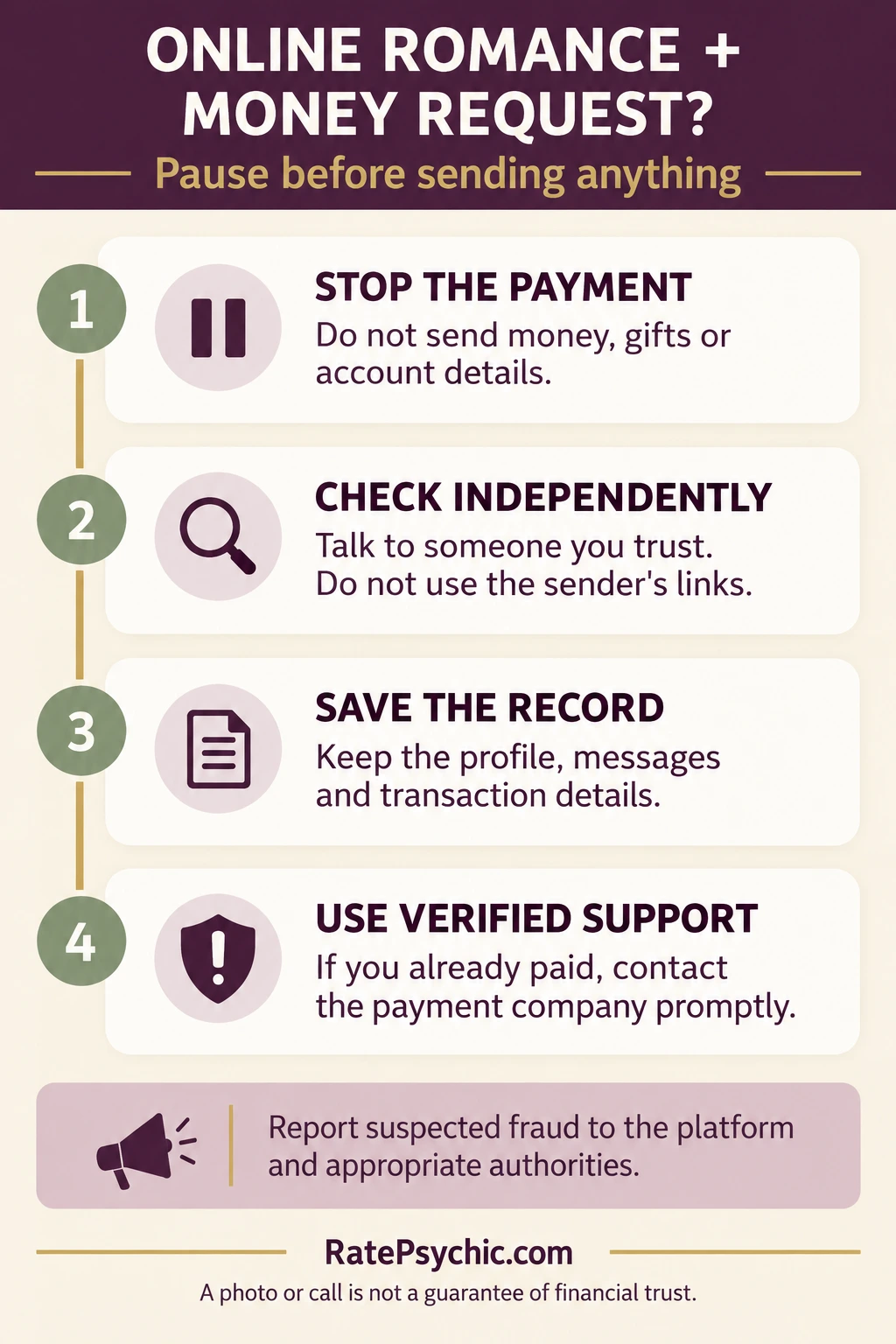
Four practical response steps

  1. Stop the payment: do not send money, gifts, credentials or account details to resolve the pressure.
  2. Check independently: speak with someone you trust and verify claimed organizations through known contact routes, not the sender’s links.
  3. Save the record: retain profile details, messages, dates, requests, receipts and transaction references if safe to do so.
  4. Use verified support: if you paid, contact the payment company promptly and report the suspected fraud to the platform and suitable authorities.

The FTC’s recovery resource explains options by payment method. Ask what applies to your transaction; a reversal or refund is not guaranteed. Do not pay an unexpected contact promising recovery for a fee.

Save the response flow

Online romance money-request response: stop payment, check independently, save records and use verified support. Report suspected fraud; a photo or call does not guarantee financial trust.
A practical pause-and-support flow, not an identity test or recovery guarantee. Open the larger response infographic.

Reporting and support

In the United States, report suspected fraud through ReportFraud.ftc.gov or the FBI’s Internet Crime Complaint Center, and notify the platform. Outside the United States, use the appropriate local consumer or law-enforcement channel. If you are in immediate danger, contact local emergency services.

Keep passwords, security codes, financial information and intimate material private. If information was exposed, follow the FTC’s information-exposure guidance for the specific issue. You do not need to confront the sender or publish private information to report a concern.

Support someone without shaming them

Focus on the specific payment request and offer help organizing records or contacting appropriate support. Ridicule can make a difficult conversation harder. A person who was deceived deserves practical assistance, not blame.

For related boundaries, read third-party privacy and reading limits, responding to unsolicited messages and ending pressured contact.

Frequently asked questions

1. What is a romance scam?

A person uses a false identity or relationship to gain trust and seek money, private information or help with fraudulent transactions.

2. Does living abroad prove someone is a scammer?

No. Location alone is not proof. Examine the payment requests, inconsistencies, pressure and information you can verify independently.

3. What if the person asks for emergency money?

Do not send money or gifts to an online love interest you have not met in person. Urgency and affection do not verify an emergency.

4. Should I follow their cryptocurrency investment advice?

Do not use a new online relationship as a basis for transferring money into a platform or wallet they recommend. Romance approaches can lead into investment fraud.

5. Does a video call make a payment request safe?

No. A call does not establish financial trust or verify every claim. Do not treat it as permission to send money.

6. What can a reverse image search show?

It may reveal that a profile image appears under another name or conflicting details. No search result does not certify the person or the relationship.

7. Should I give them my account to receive money?

No. Someone met online asking to use your bank account may involve you in other fraud. Do not act as a money-transfer intermediary.

8. Do I have to leave the dating platform immediately?

No. You can keep communication where you are comfortable and review the service’s reporting tools. Pressure to leave quickly is worth questioning.

9. What private information should I avoid sharing?

Keep passwords, security codes, financial details, identity documents and intimate material private. Do not use disclosure as proof of affection.

10. What records should I save?

Keep the profile details, messages, dates, payment requests, receipts and transaction references if safe to do so.

11. What if I already sent money?

Contact the payment company or financial institution promptly through a verified channel and ask about available options. Recovery is not guaranteed.

12. Where can I report suspected fraud in the United States?

Notify the platform and use ReportFraud.ftc.gov or the FBI’s Internet Crime Complaint Center at ic3.gov.

13. Should I pay someone who offers to recover the money?

Do not trust an unexpected recovery guarantee or upfront-fee demand. Verify any claimed organization independently.

14. Can a psychic confirm whether the person is genuine?

A reading is not independent identity verification or evidence of someone’s intentions. Use practical records and suitable official support.

15. How can I help someone who may be caught in a scam?

Listen without ridicule, focus on the specific request and offer practical help reviewing records or contacting support. Avoid blaming them for trusting someone.