


An online relationship becomes a safety concern when affection is used to push you into sending money, sharing private information or moving funds for someone else. Focus on the request and what can be verified—not a stereotype about where the person lives or how they look.
Watch where the conversation is leading
The FBI describes romance scams as false identities used to gain affection and trust, then manipulate or steal. Pressure to move communication quickly, avoid meeting, isolate you from others or use your account can be part of that pattern.
An urgent payment request
A ticket, medical emergency or fee is presented as something only you can solve. A convincing story is not independent confirmation.
Romance turns into investment instructions
The contact starts directing your savings toward a wallet or platform. The FTC warns that romance approaches can lead to cryptocurrency investment scams. Do not use the relationship as evidence for the investment.
Your boundary becomes a loyalty test
You are asked to keep secrets, ignore concerned friends or prove affection with a transfer. You can refuse without debating whether the feelings are real.
You are asked to move their money
The person wants access to your account or asks you to receive and forward funds. The FBI warns that requests to use your bank account can involve other theft or fraud schemes.
Identity checks have limits
The FTC’s romance-scam guide advises against sending money or gifts to a sweetheart you have not met in person and suggests checking profile images. A reverse image search may reveal conflicting identities; no result does not certify someone.
Neither a photo nor a call verifies every claim or makes a payment request safe. Do not arrange an unsafe meeting to “prove” the person is real. A psychic reading is not identity verification or evidence about an absent person’s intentions.
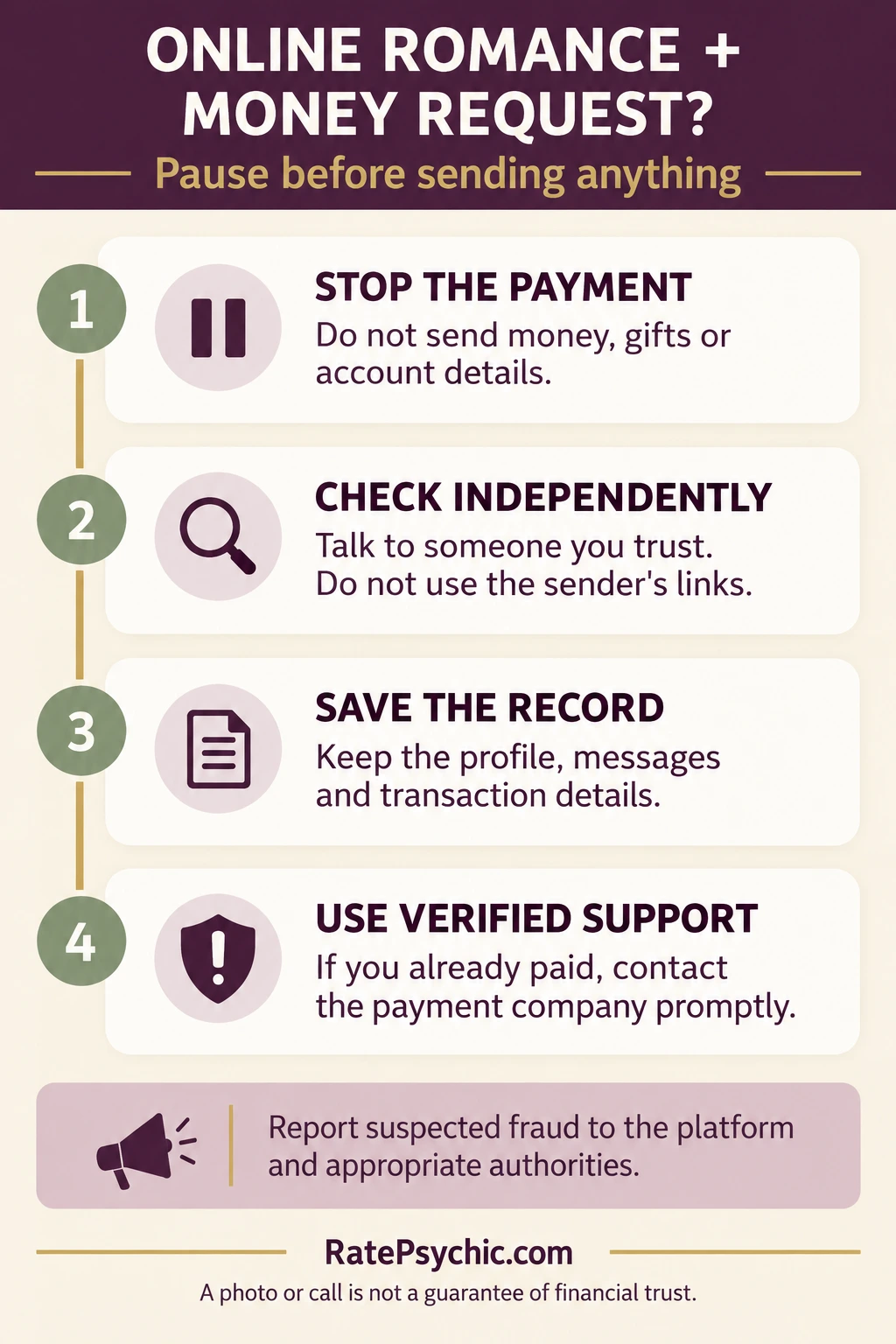
Four practical response steps
- Stop the payment: do not send money, gifts, credentials or account details to resolve the pressure.
- Check independently: speak with someone you trust and verify claimed organizations through known contact routes, not the sender’s links.
- Save the record: retain profile details, messages, dates, requests, receipts and transaction references if safe to do so.
- Use verified support: if you paid, contact the payment company promptly and report the suspected fraud to the platform and suitable authorities.
The FTC’s recovery resource explains options by payment method. Ask what applies to your transaction; a reversal or refund is not guaranteed. Do not pay an unexpected contact promising recovery for a fee.
Save the response flow
Reporting and support
In the United States, report suspected fraud through ReportFraud.ftc.gov or the FBI’s Internet Crime Complaint Center, and notify the platform. Outside the United States, use the appropriate local consumer or law-enforcement channel. If you are in immediate danger, contact local emergency services.
Keep passwords, security codes, financial information and intimate material private. If information was exposed, follow the FTC’s information-exposure guidance for the specific issue. You do not need to confront the sender or publish private information to report a concern.
Support someone without shaming them
Focus on the specific payment request and offer help organizing records or contacting appropriate support. Ridicule can make a difficult conversation harder. A person who was deceived deserves practical assistance, not blame.
For related boundaries, read third-party privacy and reading limits, responding to unsolicited messages and ending pressured contact.
Frequently asked questions
1. What is a romance scam?
A person uses a false identity or relationship to gain trust and seek money, private information or help with fraudulent transactions.
2. Does living abroad prove someone is a scammer?
No. Location alone is not proof. Examine the payment requests, inconsistencies, pressure and information you can verify independently.
3. What if the person asks for emergency money?
Do not send money or gifts to an online love interest you have not met in person. Urgency and affection do not verify an emergency.
4. Should I follow their cryptocurrency investment advice?
Do not use a new online relationship as a basis for transferring money into a platform or wallet they recommend. Romance approaches can lead into investment fraud.
5. Does a video call make a payment request safe?
No. A call does not establish financial trust or verify every claim. Do not treat it as permission to send money.
6. What can a reverse image search show?
It may reveal that a profile image appears under another name or conflicting details. No search result does not certify the person or the relationship.
7. Should I give them my account to receive money?
No. Someone met online asking to use your bank account may involve you in other fraud. Do not act as a money-transfer intermediary.
8. Do I have to leave the dating platform immediately?
No. You can keep communication where you are comfortable and review the service’s reporting tools. Pressure to leave quickly is worth questioning.
9. What private information should I avoid sharing?
Keep passwords, security codes, financial details, identity documents and intimate material private. Do not use disclosure as proof of affection.
10. What records should I save?
Keep the profile details, messages, dates, payment requests, receipts and transaction references if safe to do so.
11. What if I already sent money?
Contact the payment company or financial institution promptly through a verified channel and ask about available options. Recovery is not guaranteed.
12. Where can I report suspected fraud in the United States?
Notify the platform and use ReportFraud.ftc.gov or the FBI’s Internet Crime Complaint Center at ic3.gov.
13. Should I pay someone who offers to recover the money?
Do not trust an unexpected recovery guarantee or upfront-fee demand. Verify any claimed organization independently.
14. Can a psychic confirm whether the person is genuine?
A reading is not independent identity verification or evidence of someone’s intentions. Use practical records and suitable official support.
15. How can I help someone who may be caught in a scam?
Listen without ridicule, focus on the specific request and offer practical help reviewing records or contacting support. Avoid blaming them for trusting someone.
‘They only send one picture’? Sounds like an art project gone wrong! Maybe it’s time we embrace creativity instead of labeling it as deceitful behavior!
‘You could lose money or get your heart broken.’ Well, at least you’re likely saving on dinner dates until things heat up! It’s always wise to be cautious but perhaps we shouldn’t throw out the baby with the bathwater.
An astute observation on the perils of online dating! The red flags you mentioned are indeed crucial for anyone navigating this digital landscape. It’s vital to remain vigilant and prioritize safety above all else.
‘If they can’t video chat, they’re probably lying’? Sounds like a setup for a bad rom-com where the protagonist is just trying to keep their identity hidden due to an embarrassing secret! Classic plot twist!
While I appreciate the cautionary tone, this article seems overly dramatic. Not every online connection is a scam; many have blossomed into genuine relationships. This blanket warning could dissuade someone from pursuing a potentially rewarding connection.
‘They say they’re a celebrity?’ Ah yes, because every famous person has nothing better to do than troll the internet for love! Maybe next time they’ll claim to be an astronaut looking for a partner on Mars.
The points raised are quite informative and grounded in reality. The emphasis on verifying identities through technology is particularly relevant in today’s climate of misinformation. Readers should heed this advice seriously.
‘Video chat or it didn’t happen’ seems a bit harsh, don’t you think? What if someone has legitimate reasons for not wanting to share their face? Perhaps we should also allow for some level of privacy in these digital interactions.
‘They won’t give you their number’? Quite the assumption! Many people value their privacy and may not be ready to share personal information immediately. Let’s not jump to conclusions too quickly.