Keen connects people with spiritual advisers for conversations about love, life direction, tarot and other personal questions. If you value intuitive guidance, the choice is more specific than whether a platform is famous: which adviser, which format and what total cost work for the conversation you want?
This overview helps you compare the service, prepare a reading and understand the distinction between a meaningful experience and a guaranteed prediction. You can appreciate spiritual interpretation while keeping control of your money, privacy and decisions.
What you can do on Keen
Keen’s public service information describes phone and chat readings, with adviser profiles and categories to help people choose. Categories include love and relationships, tarot, spiritual readings, astrology and mediumship. A category explains an adviser’s advertised approach; it does not verify supernatural access or make every reader suitable for every question.
For an adviser who is not available immediately, Keen describes callback and appointment options. Check the actual reader’s availability and connection method. An always-accessible website is different from a promise that your preferred adviser will answer at any hour.
Phone or chat: choose for the conversation
Phone
A spoken conversation can feel natural if you want to ask a follow-up aloud. Choose a private place and monitor the time. Keen’s call help says billing uses the adviser’s displayed per-minute rate and whole minutes.
Chat
Written questions can help you stay focused and review wording. Consider how comfortable you are typing and reading during paid time. Check transcript access and privacy settings rather than assuming a permanent record is included.
Keen also describes paid email readings in its help material. Check whether an individual adviser offers that option, the quoted scope and the agreed price. Do not assume that a live per-minute quote and a written-answer quote purchase the same thing.
Check rates and offers before connecting
Adviser rates vary. Read the current listing and checkout instead of relying on an old article’s rate range. Introductory offers can have eligibility rules, participating readers and a limited number of minutes. Know what happens when the promotional part ends and the ordinary rate applies.
A hypothetical example illustrates why that matters: at $5 per minute, eight paid minutes total $40 before any separately disclosed charges. This is arithmetic, not a quoted Keen rate or offer. If an introductory deal covers part of a session, calculate the remaining paid time separately and confirm how the actual service bills it.
Keen’s international help states that location can affect platform fees within the displayed rate and that prices are shown in USD. Check the rate shown for your account, your payment provider’s currency conversion and any checkout charges. Keep a spending limit that does not depend on winning a later credit.
Free reading-cost worksheet
Displayed rate and currency: ____ per minute.
Eligible promotion: What exactly is included, and when does it end?
Planned paid minutes: ____ × rate ____ = ____.
Other disclosed charges: ____.
My total limit: ____; my stop point is ____.
For a fixed-price written reading, replace the minute calculation with the quoted price and scope. This worksheet does not start a reading, purchase credits or control a service’s billing.
Understand what the satisfaction policy provides
Keen’s published satisfaction policy, checked October 31, 2026, allows a request for one unsatisfactory conversation in a 30-day period, up to $25, submitted within 72 hours. The remedy is Keen account credit, not a refund to the original payment method. Promotional funds and free minutes are excluded from that credit calculation.
Check the applicable policy again before purchasing or making a claim. Keep the date, transaction details and a concise description of the issue. A service credit policy does not guarantee that predictions are accurate or that every request will qualify.
Read adviser profiles and reviews with a clear purpose
Choose a reader whose methods and communication style match your question. Look for a description of scope and boundaries, a visible price and concrete review details. A long profile, many conversations or a strong star average cannot establish what a reader knows about your future.
Our guide to trustworthy psychic conduct discusses costs, boundaries and pressure. Our review-checking guide can help you assess specificity, incentives and rating patterns. If you later leave feedback, describe your actual experience without exposing someone else’s private story.
Prepare one useful question
Instead of asking a reader to settle someone else’s feelings, explore your own choices: “What do I need to consider before talking about commitment?” or “What am I overlooking in this transition?” You can ask about the reader’s approach and say when an interpretation does not fit.
Separate a symbolic insight from a factual claim that needs checking. A reading cannot establish a partner’s consent, diagnose a condition or replace practical advice about a consequential decision. Fear-based demands for repeated payments, guaranteed reunions or urgent curse removal are reasons to stop and reassess.
Compare alternatives using the same questions
PsychicOz: Start with our PsychicOz service review and compare the available formats, individual reader and current terms.
Nebula: Our Nebula love-chat guide explains how to distinguish a live chat from reports and subscription purchases.
Other networks: Purple Garden, Kasamba and California Psychics are additional names you may encounter. Compare their actual checkout, available communication method and service policy rather than carrying over an old promotional claim.
Keen offers several ways to approach a spiritual conversation. The strongest reason to choose a particular session is a clear match between your question, the adviser’s style, the available format and a cost you understand. Leave room for reflection and keep your next real-world decision in your own hands.
Frequently asked questions
1. What is Keen?
Keen is a platform connecting people with spiritual advisers. Check the individual listing for methods, format, availability and price.
2. Can I use phone or chat?
Keen describes both formats. The available option depends on the adviser and current listing.
3. Are email readings the same as live chat?
No. Keen describes paid email as a separate reading option. Check its quoted price, scope and availability rather than applying live-chat assumptions.
4. Is a specific adviser available all the time?
No. Check the adviser’s status and any callback or appointment options. Website availability does not guarantee that a chosen person is online.
5. What does a reading cost?
Use the rate shown on the current listing and checkout. Adviser rates and offers vary; an old quoted range is not a reliable budget for your session.
6. Will an introductory offer cover my whole reading?
Only if your session fits its actual terms. Check eligible readers, included minutes and the rate that applies afterward.
7. How can I estimate a per-minute cost?
Multiply planned paid minutes by the displayed rate, then account for any separately disclosed charges. Confirm the actual billing rules and currency.
8. Are international costs identical?
Do not assume so. Keen’s international help describes location-related fees within displayed rates and USD pricing; check your account and payment conversion.
9. Is the satisfaction policy a cash refund?
The published policy checked for this guide provides eligible Keen account credit, not a refund to the original payment method. Review the current terms before relying on it.
10. When must I request satisfaction credit?
The policy checked October 31, 2026 states 72 hours after the conversation, with one eligible request in 30 days up to $25. Promotional funds and free minutes are excluded. Recheck current terms.
11. Do high ratings prove predictions?
No. Ratings can describe customers’ experiences but do not guarantee your result or verify access to the future.
12. Can I challenge an interpretation?
Yes. You can say that it does not fit, ask for clarification or stop. You do not have to agree to make a reading meaningful.
13. Can a love reading confirm someone’s consent?
No. Consent and private feelings need direct communication from the person. A spiritual interpretation cannot replace that.
14. What details should I keep private?
Avoid sharing passwords, payment credentials and unnecessary sensitive information about yourself or other people. Review account and transcript privacy settings.
15. What should I compare with another platform?
Compare the actual reader, available format, total cost, promotional limits, privacy and support policy using the same criteria each time.
Nebula offers online spiritual guidance, including love readings through chat. For someone who likes time to phrase a question and read a reply, a written conversation can be an appealing way to explore dating, a breakup or uncertainty about a relationship.
The useful question is what a particular reader, format and purchase actually provide. A large app audience or an enthusiastic review does not establish that a prediction about your love life will be correct. Choose a conversation that leaves you with perspective and freedom to make your own decisions.
What Nebula offers for love questions
AskNebula lists love readings alongside services such as tarot, astrology and numerology. These describe different approaches to a spiritual conversation. Check the individual profile for the reader’s methods, language and style, rather than assuming every adviser works in the same way.
The chat format lets you write a focused question and consider the answer. It can be convenient in a setting where a voice call would not be comfortable, but your screen, notifications and account still need privacy. A platform being accessible at different hours does not mean a specific reader is always online.
Separate the reading from the purchase
Reader and chat rate
Nebula’s help centre says advisers have individual per-minute prices, shown on profiles and in the chat interface. In the app, the rate may be expressed in credits. Check how the credit price translates into your currency.
Report or subscription
A compatibility report, trial subscription and live adviser chat can be different products. The web FAQ describes subscription features and cancellation instructions. Read the exact checkout terms for the product you select.
Before paying, identify the initial charge, renewal amount and interval, what credits or minutes are included, any additional purchases and how to cancel. Do not assume that downloading or deleting an app changes a separately purchased web subscription. Keep the receipt and use the cancellation method associated with your purchase.
Choose a reader beyond the headline
Look for a clear description of the reading, a rate you can afford and a willingness to work within your limits. Read several specific reviews for details about communication and billing. A claim that advisers are screened is not a guarantee that an individual can verify someone else’s feelings or predict an outcome.
Our guide to checking psychic reviews helps you distinguish useful service details from vague praise. Pay attention to how a reader handles uncertainty, disagreement and the end of your paid time.
Ask a love question you can use
“What should I reflect on before discussing commitment?” gives you more to work with than asking for a guaranteed wedding date. You might explore your own needs, a communication pattern or how to approach a difficult conversation. Let the reading prompt reflection; use direct conversation and observable behaviour to understand a partner.
Dating: What am I looking for, and what am I overlooking in my own expectations?
A relationship: What could I communicate more clearly?
A breakup: What would help me regain steadiness and make choices for myself?
A reading cannot provide another person’s consent or require you to contact someone who has declined contact. The love-reading assessment guide offers practical ways to review what you received.
Free love-chat preparation card
My question: One sentence about something I can reflect on or act on.
My limit: The total I can afford and the point at which I will stop.
The purchase: Chat, report or subscription; initial and recurring charges.
My privacy: Details I will keep out of the conversation.
Afterward: What was useful, what remains uncertain and one practical next step.
You can answer mentally or keep a private note. You do not need to share a partner’s identifying details to explore your own choices.
Compare another route before deciding
Start with our PsychicOz service review if you want another platform to consider. Compare the available reader, format, total cost and service terms using the same checklist. Our Keen overview explores phone and chat options. No platform name replaces checking the specific offer in front of you.
Nebula’s love chat can suit someone who prefers a written spiritual conversation. Take time over the purchase, keep your question focused and judge the exchange by clarity, respect and usefulness rather than a promise that someone else’s future is settled.
Frequently asked questions
1. Does Nebula offer love readings?
Yes. Its website lists love readings and adviser chat. Check an individual profile for methods, style, language and availability.
2. Is love chat a new feature?
It is an established listed service. Older announcements describing a launch should not be treated as current news.
3. Is every Nebula product a live reading?
No. A report, app subscription, web subscription and live chat may be different purchases with different terms.
4. How are chats priced?
Nebula’s help centre describes individual per-minute adviser rates. Check the displayed rate and, where credits are used, their cost in your currency.
5. Does a subscription mean unlimited chat?
Do not assume that. Check exactly what credits, minutes or other features your selected plan includes and what requires another purchase.
6. What should I check about a trial?
Read the initial charge, trial length, renewal amount, billing interval, included features and cancellation deadline before agreeing.
7. How do I cancel?
Use the process for the place and product you purchased, such as a web subscription or app-store subscription. Keep confirmation and contact support about unresolved billing.
8. Does deleting an app cancel every subscription?
Do not rely on deleting the app. Follow the cancellation instructions for the actual purchase and verify that cancellation was confirmed.
9. Can I choose a particular love reader?
Browse relevant profiles and check the reader’s current availability and rate. Category membership does not make every adviser interchangeable.
10. Are high ratings proof of psychic accuracy?
No. Reviews can describe someone’s experience of communication, billing and perceived usefulness, but cannot guarantee your outcome.
11. Can a reader confirm my partner’s private feelings?
A reading cannot establish thoughts or consent that the person has not shared. Use it to explore your own questions and communication.
12. What is a useful question after a breakup?
Ask what would help you reflect, regain steadiness or choose a next step within your control, rather than relying on a guaranteed reunion date.
13. Can I keep identifying details private?
Yes. Share only what is necessary and comfortable. Avoid payment credentials, account passwords and another person’s sensitive information.
14. Must I continue if the reading feels uncomfortable?
No. You can stop, keep your spending limit and use the service’s support process for a specific problem.
15. Should I book repeated readings until I feel certain?
Repeated purchases may not resolve uncertainty. Pause when the exchange is adding pressure, costing more than planned or replacing decisions you need to make yourself.
If you believe in psychic insight, choosing a reader still deserves care. You want someone who explains their approach, treats your question respectfully and lets you decide freely what to do with the reading.
There is no simple badge or personality trait that proves psychic ability. Trust is better assessed through things you can observe: accurate service descriptions, clear terms, respectful conduct and an honest response when an interpretation does not fit.
Separate spiritual claims from service promises
A psychic may describe receiving intuitive impressions, reading tarot or working with mediumship. Ask what that means during an actual session. Will they explain the cards, talk through impressions or deliver a written response? What kind of question do they usually address?
Specific information about the service helps you choose. A promise of a guaranteed reunion, financial win or exact future is much harder to justify. The UK ASA’s guidance on psychic services addresses unsupported advertising claims; it is not a certification of individual readers.
Look for a profile that explains the experience
Detail
What it helps you decide
A useful question
Method
Whether the approach interests you
Do you use cards, intuitive impressions or another practice?
Specialty
Whether your question fits the service
Which subjects do you handle, and which do you decline?
Communication
Whether the conversation suits your needs
Is your style direct, reflective or conversational?
Format and time
What you are buying
How long is the session, and are follow-ups included?
Privacy
What you are comfortable sharing
Are sessions recorded or stored, and who can access them?
A beautiful portrait, expensive website or dramatic spiritual title does not answer these questions. Nor does a plain presentation automatically mean poor service. Look at the information and conduct behind the appearance.
Use reviews to learn about conduct
Look for descriptions of the conversation: whether the reader explained their method, respected the time limit, accepted disagreement and handled a billing issue. Read recent and less favourable accounts as well as praise.
A reviewer saying that an answer felt accurate describes their experience. It does not, by itself, establish what was originally said, what the reader already knew or how later events unfolded. Keep those questions separate from warmth and satisfaction.
Ask what platform screening actually covers
If a service says its readers are screened, look for a description of the process. An interview, sample reading, identity check and conduct review are different activities. Do not assume that the word “screened” means every future statement has been verified.
Policies and available readers can change. Check the current provider’s own information rather than relying on an unexplained comparison score. A platform can make booking and support easier while your experience still depends on the particular reader and session.
During the reading, notice how questions are used
A few questions may be part of a conversational reading. Asking about your topic is not automatically a sign of dishonesty. The concern is whether a reader promises a minimal-information session, gathers extensive details and later presents those details as independent discoveries.
Share relevant context without giving an entire history. If you already mentioned a job change and it returns in the reading, note that you supplied it. You can be open to the conversation while keeping an accurate record of how it developed.
A trustworthy response leaves room for correction
Try a plain sentence: “That part does not fit my experience.” The reader can explain the interpretation, reconsider it or leave it unresolved. You should not have to invent a connection or accept blame for disagreeing.
A direct style can still be respectful. A challenging observation can still leave you free to think. What matters is whether you can ask for clarification and retain your boundaries rather than being pressured into agreement.
Meaningful insight and factual accuracy need different records
A metaphor may help you recognise a pattern or put a feeling into words. You can value that experience without turning it into evidence about another person’s private thoughts.
If a specific prediction matters to you, record its original wording and date before the outcome. Keep uncertain statements and misses alongside apparent matches. Changing the meaning later makes it difficult to judge what was actually predicted.
Know the signs that justify ending a session
Threats of harm unless you purchase a service.
Pressure to borrow, hide payments or exceed your agreed limit.
Continuing to charge after you ask to stop.
Claims that only this reader can protect you.
Instructions to ignore appropriate medical, legal or financial support.
You do not need several warning signs before acting on a clear threat or ignored boundary. Our article on personal-sounding readings and payment pressure explains why an impressive detail does not make a demand acceptable.
Review the experience without feeling obliged to return
Afterwards, compare the charge, duration and conduct with what you agreed to. Write one useful insight, one uncertain point and any practical next step you choose. A satisfying reading does not require an immediate follow-up or loyalty to one advisor.
Trust grows from behaviour you can observe over time; it does not require repeated purchases to prove your openness. Choose a reader whose approach fits your interests and whose service leaves your judgement intact.
Frequently Asked Questions
1. Is there a single test that proves a psychic is genuine?
No simple test or badge proves psychic ability. Assess the service’s claims and conduct separately.
2. Does a high rating prove accurate predictions?
No. Ratings usually describe customer experiences; specific predictions require their own records and later evidence.
3. What should a trustworthy profile explain?
The method, specialties, format, price, limits and what a client can expect during the session.
4. Are clarifying questions a warning sign?
Not by themselves. Consider the advertised format and whether information you supplied is later misrepresented.
5. Can I tell a reader that an impression does not fit?
Yes. You can disagree or leave a statement unresolved without being blamed.
6. Does platform screening prove every reader’s claims?
No. Ask what the process covers; screening and verification of individual claims are different things.
7. Are expensive readers more trustworthy?
Price alone does not establish honesty, conduct or predictive accuracy.
8. What should I look for in reviews?
Specific descriptions of communication, boundaries, billing and support, considered across several sources.
9. Can a reader guarantee that my ex will return?
No service can guarantee another person’s choices. Treat that promise as a reason for caution.
10. Must I accept an interpretation because it feels emotional?
No. You can find a moment meaningful while keeping its interpretation uncertain.
11. How do I keep track of a prediction?
Write the exact wording and date before the outcome, and retain misses and unclear statements too.
12. Should I share passwords or identification documents?
Do not provide such material as context for a psychic question. Use relevant, limited information.
13. What if a psychic says I must buy protection?
You are not obliged to pay because of a threat or a claim that only that reader can keep you safe.
14. Can I stop a reading that ignores my boundaries?
Yes. You can end the conversation and save relevant messages and transaction records.
15. Must I return to a reader after a good session?
No. A useful experience leaves you free to decide whether another appointment serves a purpose.
A useful psychic review explains the service: how booking worked, whether the price was clear, how communication went and whether your boundaries were respected. You do not need to publish the private story that led you to book.
The difference matters because readings often involve intimate things. A review written while you feel delighted or disappointed can reveal details about a breakup, family conflict, health concern, or a financial difficulty that wouldn’t normally be made public. Other people mentioned in the reading might not have agreed to appear in your review at all.
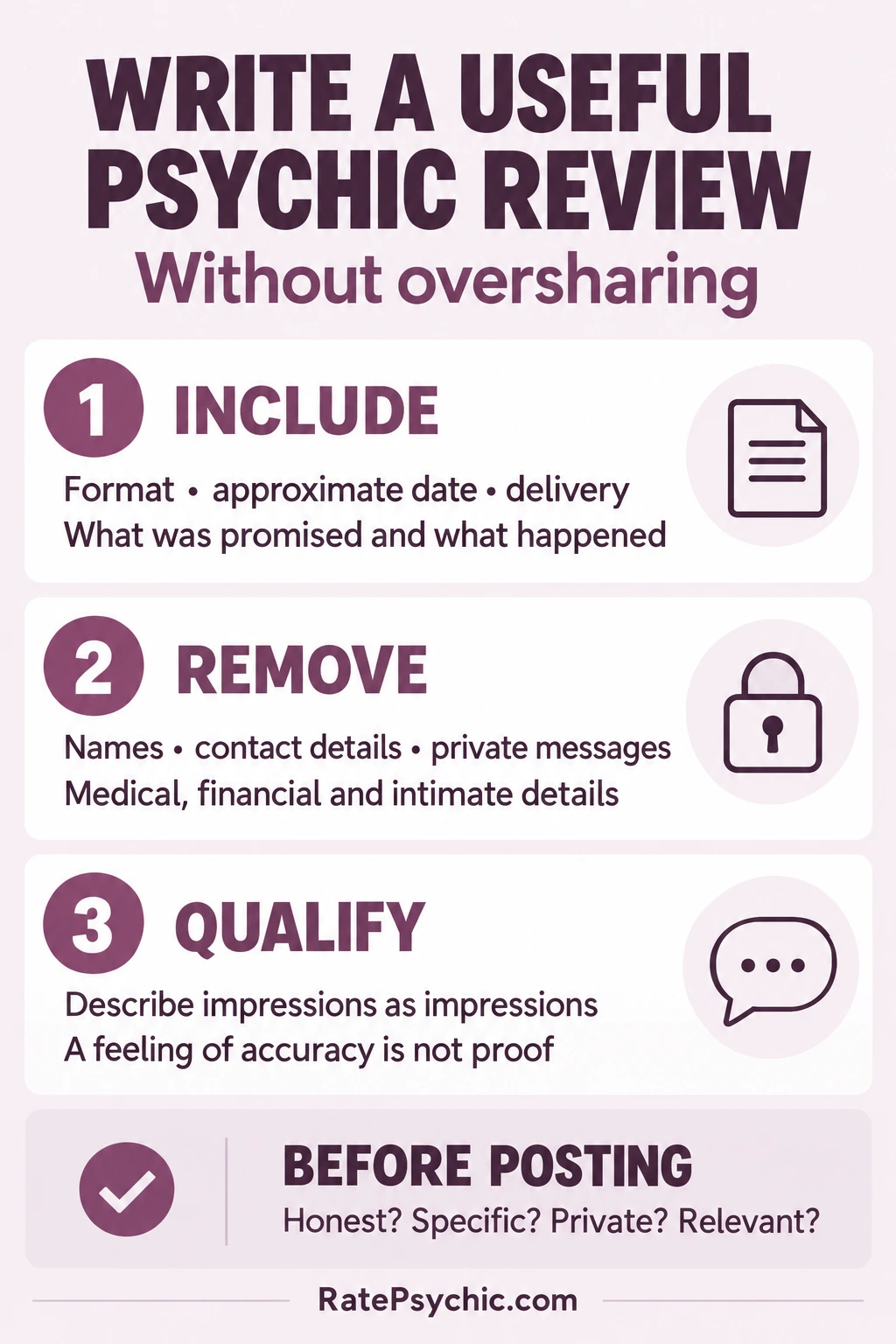
Three checks before posting
Keep: format, delivery, billing clarity and observed conduct.
Remove: names, private messages, identifying details and payment records.
Qualify: impressions, uncertain memories and predictions you cannot verify.
Writing a helpful review means choosing details that explain the service. You should be honest, specific, and useful while keeping things private, like names, messages, and history, out of the review.
A quick editing check: describe the service, protect private details and separate impressions from proof. Open the image for the full-size checklist.
Decide What Clients Should Know
Before you draft your review, imagine if someone is trying to decide if the service fits their needs. They might need to know if the appointment started on time and if the advertised format matched the experience, and if the reader allowed questions. These details help them to decide if they want to make a purchase or not.
They probably don’t need to know your former partner’s place of work, a relative’s diagnosis, and the exact questions that you asked. These kinds of details explain why the reading felt important to you, but they don’t describe the service fairly.
Start with three notes including what was booked, what happened, and how the experience felt. You might say, “I booked a short reading about a relationship question. The reader explained the time limit and answered questions I had. I felt listened to.” This is a good review without giving a full description of your private life.
You can write a positive review without recommending the reader for each person or each problem. You can write a critical review without claiming to know the reader’s motives. Stay close to what you observed.
Experience Vs. Proof
A statement that felt meaningful is worth describing as your experience, but this is different from trying to prove that a reader can predict future events. The interpretation should give you a new question to consider instead of saying that the reader knew your real destiny.
A prediction that didn’t happen should be described without turning it into a conclusion about every reading the person has ever given. You can say that the event didn’t happen in the period of time they said it would.
If you aren’t sure if you gave a detail or not, don’t act like it’s something the reader couldn’t have known. Memory for a flowing conversation can be confusing. A review does not need to make impressive accuracy claims to be valuable.
The FTC’s advice on evaluating online reviews reminds consumers that reviews can be misleading or manipulated. As a reviewer, you can help by making your own account concrete, limited to your experience, and clear about uncertainty.
Focus Your Review on What Actually Happened
When you write a review of a psychic reader or platform, focus on what you directly observed. Was the full price clear before the reading started? Did the reading stay within the amount of time you agreed to? Did the reader answer the question you asked? You can also mention if the reader was respectful, listened to you, and made you feel comfortable speaking up when something didn’t connect.
If your reading was supposed to include something extra, such as a recording or written summary, mention whether you received it as promised. The same goes for technical problems. If the call disconnected or the video stopped working, you can explain what happened and how the reader or platform handled it. Details like these can help someone understand what the actual service was like.
Try not to base the entire review on how you felt when the reading ended. You might leave a reading feeling comforted but still have problems with unexpected charges or confusing prices. On the other hand, you might not agree with much of what a reader told you but still recognize that they were respectful, professional, and gave you the amount of time you paid for. It’s okay for a review to include things you liked and things you didn’t.
You don’t have to tell the entire story of your reading either. Pick a few details that mattered most when deciding how you felt about the experience. A shorter review that explains two or three specific things can sometimes be much more helpful than a long review where someone has to search through your personal story to figure out what you thought about the reader or service.
Protect Your Privacy When Writing a Review
Protecting your privacy means thinking about more than just leaving out your full name. Sometimes a combination of smaller details can make it surprisingly easy for someone who knows you to figure out who wrote the review. Your town, job, dates, family relationships, and details about an unusual situation might not identify you individually, but putting all of them together could.
Before posting, read your review and look for personal details that really don’t need to be there. Instead of explaining exactly which family member was involved and what happened between you, you might simply say, “I asked about a family situation.” Instead of naming your employer and explaining that you secretly applied for another position, you could say, “I asked about a career decision.” You can still explain your experience without sharing the private story behind every question.
Take a look at the profile you’re using to post the review too. Your username, profile picture, or accounts connected to the profile might reveal more about you than the review itself. If the website lets you use a display name, pick something you’re comfortable having other people see while still following the platform’s rules. Just remember that using a different name doesn’t necessarily make you completely anonymous.
It’s also a good idea to only post details that you’re comfortable having stay online. Even if you delete a review later, someone could have already taken a screenshot, quoted it, or shared it somewhere else. You don’t need to be afraid to write an honest review. Just make sure the personal information you include is information you’re comfortable making public.
Protecting Other People’s Privacy When Writing a Review
A partner, ex, child, co-worker, or relative shouldn’t be identifiable just because you booked a reading that involved them. Leave out their names, contact information, pictures, or private communications when doing a review.
Don’t post a transcript to prove the review’s accuracy when it has another person’s information. Write a short description about the service. If a platform needs more evidence for a complaint, use the private support to share what is necessary.
Be careful with children and details involving health, sexuality, finances, or allegations of wrongdoing. Even a good review can disclose information another person wants to keep private.
You can talk about your own feelings without explaining someone else’s private situation.
Rewrite Private Details as Service Details
A hypothetical first draft might name an ex’s employer, describe an argument and quote a prediction about reconciliation. Those details expose a private situation without explaining the booking, price or conduct of the reading.
A better thing to say would be, “I booked a relationship reading by phone and the price was clear; the reader let me ask follow-up questions. Some statements were predictions that I can’t verify and so I’m reviewing the communication and booking experience on its own.”
The revised version separates the service experience from private information. If the reviewer also felt pressured, they could add that behavior as well.
The goal isn’t to make the reviews sound more formal or neutral, and your own voice can be warm, disappointed, or mixed. Editing should preserve your honest reaction while making the service details clear and removing unnecessary personal information.
Positive and Critical Reviews
You might say, “I booked an email reading about a personal decision. The response came in the stated window and addressed the questions I asked. I found this reflection helpful, and I appreciated that no extra purchases were suggested.”
A mixed review could say, “The reader was nice and explained terms that I was unfamiliar with. But the chat moved slowly, and I reached my spending limit before I got to my second question. I would check the billing and question scope more carefully before I make another booking.”
A critical review could say, “The advertised package included a written summary, but it had not arrived by the promised deadline. I contacted support and will update this review when I receive a response.” If the matter is resolved later, an update can say so without erasing the original experience.
These are hypothetical examples, not real customer testimonials. Write only about your own experience; do not copy an example in a way that implies those events happened to you.
Transparency
If you got a free reading, a discount, or something else for a review, make this clear. The same applies if you work with the provider or have personal connections that could affect how the clients understand your recommendation.
The FTC’s Endorsement Guides explain disclosure principles in the United States. Requirements depend on context, and platforms may have their own rules. A simple, visible disclosure is more useful than wording hidden where readers are unlikely to notice it.
An incentive does not justify invented praise or hidden concerns. Check the platform’s rules before accepting it; some platforms prohibit incentivized reviews even when disclosed. Decline any arrangement that requires a positive rating.
You can decline to do a review. A good appointment doesn’t create a debt of public gratitude. Your private thanks or your decision to get another reading can be a valid response.
Billing Disputes and Reviews
A review can describe a billing problem, but it is not a substitute for a support request. Contact the platform or provider through its official support route if you want the charge investigated. You can still describe your experience honestly without waiting for permission to review.
Don’t publish transaction numbers, card details, addresses, or screenshots. A public audience doesn’t need to have that information to understand that a charge was disputed. Keep the evidence for the people who need to investigate it.
In the United States, the Consumer Review Fairness Act guidance from the FTC explains protections against certain contract terms restricting honest reviews. The protection has limits and does not make unlawful or confidential content acceptable. Other jurisdictions have different rules.
If you get a legal threat or have serious disputes, get advice that is appropriate to your location instead of just general ideas. For the review, facts and privacy should be starting points.
Writing Emotional Reviews
There is no required cooling-off period for an honest review, but rereading a draft before posting can help. Ask whether you would still be comfortable seeing those details online tomorrow and whether you can support each factual statement.
Distinguish “I felt rushed” from an accusation about the reader’s intent. Describe the observable behavior—for example, repeated requests to buy more time—so other readers can assess the concern without relying on speculation.
Avoid promises or universal verdicts such as “this will change your life” or “no one should ever book.” You can recommend a service or advise caution while explaining the experience and limits behind your conclusion.
Read the platform’s posting rules before you submit your review. If a review is removed, don’t just think you know the reason without checking it. It might involve privacy, prohibited content, verification requirements, or another policy. Use the appeal process or contact support.
Make the Star Rating Match Your Written Account
If a platform asks for star ratings, pick the rating that reflects the service that you’re describing. A review that gives the highest rating while reporting serious problems that aren’t solved can cause other clients to be confused, just like a low rating with no explanation leaves them without a way to evaluate what went wrong.
You don’t have to have a scoring formula, and you can consider the things that mattered most to you and then explain why briefly. If kindness was a strength but delivery was a problem, describe both. If you can’t assess an advertised follow-up because the deadline hasn’t passed, don’t say it’s missing.
The written explanation gives the rating context. Your rating is one person’s assessment of a certain purchase and not a universal measurement of spiritual abilities or predictions for every future client’s experience.
Update the Review When the Facts Change
If a missing response comes or a billing issue gets resolved, an update can help other readers to understand the full situation. Keep it short and factual. You don’t need to delete a fair review just because the reader later addressed it.
Don’t repeatedly change a review just because your emotions feel different or because you get a new interpretation. A review is important when it describes a stable account of the service instead of a public place to talk about your personal situation.
Before you post, make one final check and ask if a stranger can understand what you bought, what you saw, and why you reviewed it the way that you did without giving the personal details about your life. If so, you have found a good balance.
Sharing your service experience can inform other readers without making your private life public. A good review respects your privacy, the privacy of others, and the next person’s ability to make their own choices.
Describe the format, approximate timing, price clarity, delivery and conduct you directly observed. Explain what mattered to your assessment without retelling your private situation.
2. Do I need to share the question I asked?
No. A broad topic such as a personal decision or relationship question is usually enough to explain the service.
3. Can I review a reading without claiming psychic accuracy?
Yes. Communication, delivery and respect for boundaries are useful service details even when predictions cannot be verified.
4. Should I post screenshots of the reading?
Avoid posting screenshots containing personal messages, account details or information about other people. Keep necessary evidence for the provider’s appropriate private support channel.
5. Does a display name guarantee anonymity?
No. Your profile, photo and combination of details may still identify you. Follow the platform’s rules and remove unnecessary identifying information.
6. Can I mention another person from the reading?
Keep the description general and leave out names, contact details, private messages and identifying circumstances. Booking a reading does not authorize publishing someone else’s private information.
7. How should I describe a prediction that did not happen?
State the wording and timeframe only as specifically as your record supports, without exposing private details. Do not turn one outcome into a claim about every reading.
8. What if I do not remember exactly what was said?
Make the uncertainty clear or omit the disputed detail. Do not present an uncertain memory as an exact quotation or verified fact.
9. Can a review include both praise and criticism?
Yes. Describe the strengths and problems separately so the reader understands your rating.
10. Do I have to write a positive review after a good reading?
No. You can choose not to review. A pleasant appointment does not create an obligation to publish praise.
11. Should I disclose a free reading or discount?
Disclose relevant incentives or connections clearly and check the platform’s rules. Some platforms prohibit incentivized reviews; decline arrangements requiring a positive rating.
12. Will posting a review resolve a billing dispute?
Not by itself. Contact official support to request investigation, and keep payment records and transaction identifiers out of the public review.
13. Must I wait for a cooling-off period?
This guide does not impose a waiting period. Rereading your draft can help you check factual statements and privacy before posting.
14. Should I update a review after a problem is resolved?
A dated, factual update can clarify the outcome without erasing a fair account of the original experience.
15. What should I check immediately before submitting?
Check that the account is honest, specific, relevant and privacy-conscious. Read the platform’s posting rules and make sure the rating matches the written explanation.
To evaluate possible fake psychic reviews, look beyond the average star rating. Check who controls the review page, how feedback is verified, whether incentives are disclosed and which claims you can compare with current evidence.
No single writing pattern proves a review is fabricated. Real customers can write briefly, use similar phrases or create an account for one private experience. The goal is proportionate confidence—not accusing someone because their opinion differs from yours.
The PLACE check
Platform
Who owns the page, can submit feedback and decides what appears?
Language
Are there repeated passages or vague claims? Consider benign explanations too.
Activity
Do timing and account histories suggest a pattern worth checking?
Claims
Which statements about costs, booking and support can be corroborated?
Evenness
Can readers see genuine criticism as well as praise, and how are ratings calculated?
PLACE is an editorial checklist, not an automated fraud detector or a statistical score.
Understand ownership and incentives
A company’s own testimonials may be genuine, but they are not the same as an independently controlled review record. An outside-looking website may also have commercial ties. Look for ownership information and affiliate or sponsorship disclosures.
The FTC’s consumer-review rule Q&A explains U.S. restrictions on fake reviews and incentives conditioned on positive or negative sentiment. A disclosure does not make paying for five-star reviews acceptable. This is consumer background, not a legal determination about a particular business.
An honest review can still be influenced by free minutes or a discount. Knowing the incentive helps you judge its weight. Absence of a visible disclosure is a reason to seek information, not proof of a secret arrangement.
Read the distribution and dates
A high average based on a few comments contains less information than the same average supported by a substantial, well-documented record. Neither number guarantees authenticity. Check the spread of ratings, recent comments and whether written reviews and star-only submissions both count.
A burst of reviews can follow a legitimate promotion or a review-request campaign. It can also warrant closer examination. Look for several clues together rather than treating the timing alone as decisive.
Older feedback may describe different prices, advisors or policies. Compare an old complaint with the terms that applied then if available; do not assume it describes today’s service.
Language is a clue, not a verdict
Identical passages across unrelated accounts deserve attention. But a platform’s prompts can make genuine reviews similar, and polished wording does not prove AI fabrication. A detailed fictional account can sound convincing; a short real account can be vague because the subject is private.
Do not rely on an AI-writing detector or your impression of style to establish that someone never used the service. Stronger evidence concerns the experience claimed and how it was collected or verified.
Check facts that can be checked
Reviews may mention a rate, cancellation process, wait time or refund. Compare those claims with dated policies, receipts where legitimately available, written support responses and independent accounts.
A policy proves what the company states, not that it always follows the policy. Several independent reports of the same issue can justify caution, but repetition copied from one source is not independent corroboration.
The FTC’s platform guidance encourages transparent collection and display practices and fair treatment of positive and negative reviews. Ask what “verified” means on the specific platform rather than assuming it verifies every claim.
Separate satisfaction from prediction evidence
“The reader listened and stopped on time” describes service conduct. “She knew everything” reports an impression but provides little basis to independently assess accuracy.
Prediction claims need original wording, a pre-outcome record, a defined deadline, evidence and a complete account of misses as well as apparent hits. Stars cannot supply those missing details.
For broader warning signs beyond reviews, see avoiding psychic scams. A good-looking review page should never override clear pricing, privacy and personal boundaries.
A practical verification routine
Identify the business and the review page’s owner.
Read its verification, moderation and incentive explanations.
Sample recent praise, criticism and middle ratings.
List recurring factual issues without assuming they are proven.
Check current terms and at least one genuinely separate source.
Decide what remains unknown before making a purchase.
You do not have to buy a trial to complete this process. If the evidence is too weak, waiting or choosing not to book is reasonable. If you do buy, set a budget and record your own experience before reading more testimonials.
Key Takeaways
Review provenance matters more than an impressive average.
Suspicious patterns justify checks, not automatic accusations.
Current policies and independent evidence add context.
Verified booking is not verified psychic accuracy.
Uncertainty is a valid reason not to purchase.
Frequently Asked Questions
1. Can I identify a fake psychic review from wording alone?
No. Repetition or vague praise may justify a closer look, but writing style alone cannot establish fabrication.
2. Are all five-star reviews suspicious?
No. Consider the collection process, distribution, dates and supporting detail rather than the star count alone.
3. What does verified mean?
It depends on the platform. It may confirm a booking or transaction without verifying every statement in the review.
4. Are company-hosted reviews always fake?
No. They can be genuine, but ownership and moderation affect how complete and independent the display is.
5. Does a new reviewer account prove manipulation?
No. A real customer may create an account solely to review a private service.
6. What if many reviews appear at once?
A promotion or review request may explain a burst. Check other evidence before reaching a conclusion.
7. Can AI-writing detectors verify authenticity?
They cannot establish whether the person actually used the service. Focus on provenance and corroboration rather than a detector's label.
8. Are incentivized reviews always fabricated?
No. A genuine experience can be incentivized, but the benefit may affect credibility and should be disclosed appropriately.
9. Can a business pay specifically for five-star reviews?
The FTC's U.S. rule guidance says incentives conditioned on a particular sentiment are prohibited. Disclosure does not make that practice acceptable.
10. Should I ignore old complaints?
Not automatically. Check dates and changes in policies or ownership, and distinguish historical issues from current evidence.
11. What claims are easiest to corroborate?
Booking steps, stated rates, receipts, cancellation policies and support exchanges may have documentary evidence.
12. Do repeated complaints prove a problem?
Independent, consistent reports deserve attention, but copied accounts and unverified claims should not be counted as separate proof.
13. Can reviews prove supernatural accuracy?
An average rating or emotional testimonial cannot establish that. Prediction evaluation requires much more specific evidence.
14. Must I book a session to check the reviews?
No. You can review available evidence and decide not to purchase if information is insufficient.
15. How should I write my own review?
Describe what actually happened, distinguish facts from impressions, disclose relevant incentives and protect private information.
A prediction can feel astonishing after an event. Fair evaluation requires the exact wording from beforehand, a defined deadline and the full record of hits and misses.
Quick Guide
Save the exact prediction and date before the outcome.
Define what would count as a hit, partial hit and miss.
Compare base rates and ordinary alternative explanations.
Keep the full record; do not rewrite wording after the event.
1
Record
Timestamp the exact words, context and deadline.
2
Define
Pre-set the target details and scoring rules.
3
Compare
Check chance, base rates and alternative causes.
4
Review
Count hits, partials, misses and changed claims.
Start With the Original Prediction
Memory is reconstructive. After an event, people often remember a forecast as more specific than it was. Save the message, email, recording or written note before the deadline. Do not rely on “She basically said this would happen.” Exact wording is the beginning of a fair test.
Also preserve the question and information the reader already had. “I see a change at work” means something different after a client has described layoffs than when no employment information was disclosed.
Specificity Changes the Score
Prediction
Why it is weak or strong
How to score it
“A change is coming.”
High base rate, no domain or deadline
Too broad for a meaningful hit.
“You will hear from someone.”
Common event, undefined person and channel
Require details fixed beforehand.
“By June 30, Company X will offer you Role Y.”
Named actor, outcome and deadline
Clear hit or miss.
“A water symbol matters.”
Flexible metaphor
Record interpretation before an event.
The Barnum effect describes the tendency to see vague, general descriptions as specifically applicable to oneself. It does not explain every striking experience, but it is a useful control when wording could fit many people.
Count Misses and Near Misses
If a reader offers twenty statements and two seem impressive, accuracy cannot be judged from the two alone. Keep a scorecard with hits, partial hits, misses, unverifiable statements and statements still pending. Do not move the deadline or reinterpret a failed detail.
For each hit, ask how likely the event was without psychic information. New contact, job stress, travel and relationship tension are common. A rare, specific event recorded in advance deserves more attention than a common outcome.
Alternative Explanations Are Part of the Test
Base rate: the event was already common or likely.
Information leakage: clues appeared in conversation, social media or public records.
Self-fulfilling action: the prediction changed behavior that helped produce the outcome.
Selective memory: hits stayed vivid while misses faded.
Flexible interpretation: symbols were assigned meaning only afterward.
Chance: large numbers of predictions produce coincidences.
Review the entire set after enough predictions mature.
Ethical limit: Never use a prediction as the sole basis for stopping treatment, risking savings, accusing someone, evading legal advice or ignoring immediate danger. High-stakes decisions need evidence and qualified guidance.
What Would Count as Stronger Evidence?
A stronger test uses many pre-registered predictions, clear scoring, independent judges who do not know the desired answer and full reporting. Repeated success should exceed chance under controlled conditions. A moving personal story may still matter to the people involved, but it is not equivalent to that evidence.
Keep Wonder and Calibration Together
You do not have to mock an apparent hit or declare it paranormal. Record what was surprising, preserve the uncertainty and update your confidence in proportion to the evidence. The same scorecard protects readers and clients: it rewards specificity, exposes overconfidence and makes improvement possible.
How Readers Can Use the Scorecard
A practitioner can publish aggregate results without exposing client details: how many statements were scored, how deadlines worked and how partial hits were handled. Clients should be allowed to disagree with the score. This is more trustworthy than advertising only testimonials or spectacular anecdotes.
If a reader refuses exact wording, deletes misses or converts every outcome into a hit, treat that as a transparency problem. Responsible uncertainty is a strength, not a marketing failure.
Key Takeaways
Exact, timestamped wording is essential because memory changes after outcomes.
Specific predictions with named details and deadlines are easier to evaluate fairly.
Base rates, misses, information leakage and self-fulfilling actions must be considered.
No prediction should replace evidence or qualified advice in high-stakes decisions.
Frequently Asked Questions
1. What counts as a psychic prediction coming true?
A fair hit matches specific criteria and a deadline recorded before the event without later reinterpretation.
2. Why is a timestamp important?
It shows the wording existed before the outcome and prevents accidental rewriting.
3. What is the Barnum effect?
It is the tendency to experience vague, general descriptions as uniquely accurate for oneself.
4. What is a base rate?
It is how often an event normally occurs before considering the prediction.
5. Should partial hits count?
Only under scoring rules defined in advance; otherwise partial credit becomes subjective.
6. Why count misses?
Accuracy cannot be estimated from selected successes alone.
7. Can a prediction cause its own outcome?
Yes. It may change attention or behavior, creating a self-fulfilling effect.
8. What is information leakage?
It occurs when clues are available through conversation, social media or public facts.
9. Is an emotional reaction evidence?
It shows personal significance, not necessarily predictive accuracy.
10. Can symbols be scored?
Only if their interpretation and target are defined before the event.
11. How many predictions are needed?
More observations and consistent rules provide a better picture than one anecdote.
12. What is preregistration?
It is recording predictions and scoring rules before outcomes are known.
13. Can independent judges help?
Yes. Blind judges can reduce the influence of expectations and desired conclusions.
14. Should I act on a prediction?
Use it, at most, as one reflective input and rely on evidence and qualified advice for important choices.
A familiar television episode can feel like a soft landing after an unpredictable day. When the story includes a clairvoyant, medium, prophetic dream, or magical guide, it adds another form of reassurance: the fantasy that confusing events belong to a pattern someone can read. That does not make fictional psychic abilities evidence of real-world prediction. It does reveal what audiences often want from comfort stories—continuity, meaning, and a safe way to rehearse uncertainty.
Quick Guide
Comfort comes fromFamiliarity, predictable tone, known characters
Psychic deviceMakes hidden information narratively visible
Healthy useIntentional rest that still leaves room for life
Watch forSleep loss, avoidance, or rising distress
Why rewatching can feel easier
A new show asks for attention: new names, threats, rules, and emotional stakes. A rewatch reduces that load because you already know the rhythm and outcome. The familiar opening music or setting can become a transition cue from demand to rest.
The effect is not mystical and it is not universal. A once-comforting episode can also become painful because of grief, memory, or changing taste.
What clairvoyant characters do for a story
Psychic characters give writers a way to reveal secrets, foreshadow danger, or voice a truth other characters avoid. They may play the guide, outsider, investigator, comic skeptic, or misunderstood witness. These are narrative roles, not clinical descriptions of people who identify as psychic.
Because the audience sees how the plot resolves, the psychic character can make a chaotic fictional world feel knowable.
The appeal of hidden order
Uncertainty is uncomfortable. Prophecy stories convert uncertainty into clues: a symbol will matter later, a dream points somewhere, or an apparently random meeting has a purpose. Even when the prophecy is misleading, the story promises resolution.
Viewers can enjoy that structure while keeping a clear boundary between fiction and decisions about health, money, safety, or relationships.
A grounded way to use comfort viewing
Choose the episode intentionally, decide whether you want company, laughter, or gentle distraction, and set a stopping point that protects sleep. Pair the show with one physical cue such as dimmer lights, tea, stretching, or putting work notifications away.
Afterward, ask whether you feel restored, neutral, or more activated. The answer helps you select media based on effect rather than habit.
When comfort becomes avoidance
Rest and avoidance are not the same. A comfort show is useful when it helps you return to life with more capacity. It becomes less helpful when it repeatedly displaces sleep, food, work, care, or needed conversations.
If anxiety, low mood, or isolation is persistent, media can remain part of a soothing routine while you also seek appropriate support.
Read the archetype, not the character as evidence
Try a reflective exercise: What does the psychic character know? What do they misunderstand? Who believes them, and why? What would change if the story had no prophecy? These questions turn passive viewing into media literacy.
You can also ask which role you want in your own situation: the person who notices, the person who tests evidence, the person who asks for help, or the person who makes the next practical move.
To compare fictional certainty with real claims, read how to evaluate an apparent prediction hit. The guide separates a striking experience from evidence that can be assessed.
Frequently Asked Questions
1. Why do I rewatch the same show?
Familiar characters and outcomes can demand less attention and feel predictable after a stressful day.
2. Are psychic TV characters based on real abilities?
Some borrow from spiritual traditions or reported experiences, but fictional plots are not evidence that the depicted powers work.
3. Is comfort TV bad for mental health?
Not inherently. Context, duration, sleep, and whether viewing supports or displaces life all matter.
4. Why do prophecy plots feel satisfying?
They turn uncertainty into clues and promise that confusing events will eventually connect.
5. Can a scary supernatural show still be comforting?
Yes. Familiarity and controlled suspense can feel safe to some viewers, while others may feel more activated.
6. How can I stop autoplay from ruining sleep?
Choose an episode in advance, disable autoplay, and set a clear stopping cue.
7. What if a favorite episode now feels upsetting?
Stop or switch. Associations can change after loss, trauma, or major life events.
8. Can I use tarot after watching?
Yes, as a reflective activity. Keep the questions about your response and choices rather than treating the plot as a prediction.
A vivid dream, a repeated number or an unexpected encounter can feel personally meaningful. None of these experiences establishes that a soulmate is about to arrive, identifies a future partner or gives you a reliable relationship timeline.
You can enjoy a spiritual interpretation without turning it into an instruction. This guide keeps the meaning you choose separate from another person’s feelings, practical compatibility and consent.
What “soulmate” can mean
Some people use the word for a romantic partner; others use it for a close friend, relative or someone important in their life. In spiritual traditions it may refer to a bond believed to extend beyond ordinary experience. These are meanings and beliefs—not a measurable relationship category or a guarantee that a connection will last.
You do not need to use the word at all to build a worthwhile relationship.
Common “signs” and what they cannot tell you
Dreams about a partner
A dream can offer material for reflection: what did you want, fear or enjoy in it? It does not verify a stranger’s identity or mean someone you later meet owes you a relationship.
Repeating numbers, names or songs
You may choose a symbolic meaning. Repetition alone does not establish a message, a date or a match. Record what you noticed separately from the interpretation.
A sudden feeling of readiness
Feeling more open to meeting people can help you consider a social step. It does not prove that an encounter has already been arranged by fate.
An immediate sense of familiarity
Comfort or chemistry can be enjoyable. You still need time to learn how the person behaves, what they want and whether interest is mutual.
Why a compelling story is not a forecast
A story about someone meeting a person from a dream can be interesting without proving that dreams predict partners. A resemblance may be interpreted after the meeting, and a story may leave out dreams or predictions that did not match anything.
If a reader gives a specific prediction, write down the exact wording and date before interpreting a later event. Include details that do not fit, not only the apparent matches. The prediction-assessment guide explains how to compare a claim with what actually happened.
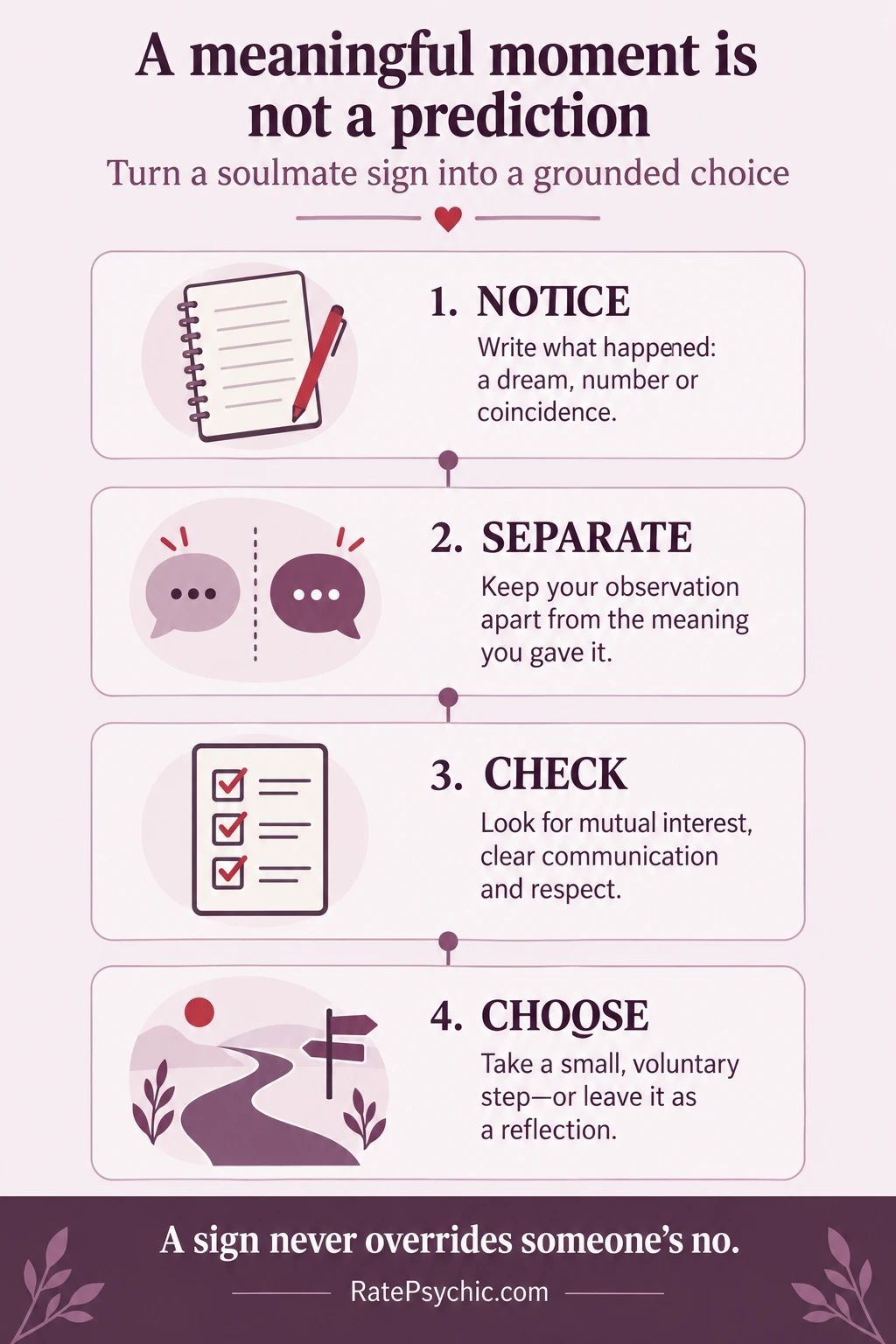
Notice. Write what happened in plain language: “I dreamed about a café,” rather than “The universe told me to meet someone there.”
Separate. Add the meaning you gave it in a different sentence. A chosen interpretation does not become a fact because it feels strong.
Check. Consider ordinary information: have you actually met, is interest mutual, and are communication and boundaries respected?
Choose. Take a small voluntary step if it suits you, or leave the experience as a reflection. You do not have to act.
What is more useful than a destiny checklist?
A relationship develops through choices by both people. Instead of collecting signs, ask questions that can be answered in the relationship:
Can we each say no without punishment?
Do we communicate about what we want rather than assuming?
Are plans and promises followed through?
Can we keep our own friendships, interests and privacy?
Do our expectations about commitment and daily life fit?
For an outside resource, love is respect emphasizes communication, boundaries and mutual respect. Those qualities matter whether or not you describe someone as a soulmate.
A sign never overrides someone’s no
A dream, reading or repeated number does not justify contacting someone after they have asked you to stop, waiting outside their home or workplace, or insisting they have forgotten a destined connection. Their actual answer matters.
Likewise, a label such as “karmic lesson” does not require you to stay with someone who mistreats you. If you feel unsafe, prioritize appropriate support rather than trying to complete a spiritual lesson. Safety-planning resources can help you consider options without requiring confrontation.
You do not have to become perfectly “healed” to deserve connection
Old grief, anxiety or disappointment does not mean your energy is blocking love. You are not responsible for someone else’s choices because you failed to stay positive or raise a vibration.
You may decide to take time for yourself, or you may want to meet people while still working through difficult experiences. Either choice can be yours. For optional reflection without blame, read difficult thoughts without forced positivity.
If you choose a psychic reading
Ask about your own reflection rather than requesting certainty about a stranger’s identity, a partner’s hidden thoughts or a guaranteed date. For example: “What qualities do I want to prioritize in a relationship?” is a question you can consider without accepting a prediction.
Check the price and scope before paying, and do not share someone else’s private messages or identifying details. A paid reading is not necessary for this exercise. Use the privacy guide if you later post about the experience.
A practical next step
If meeting people is something you want, choose an ordinary activity you would enjoy even without a romantic outcome. If you already know someone you like, make one low-pressure invitation and respect the reply. Neither step guarantees a partner; both keep your choice connected to real life.
People use it for different kinds of meaningful bonds. It can be a personal or spiritual label, not a measurable category or a guarantee that a relationship will last.
2. Do psychic signs prove that a soulmate is near?
No. Dreams, coincidences and strong feelings do not establish a future relationship or a reliable timeline.
3. Does seeing 11:11 predict a romantic meeting?
No reliable relationship date follows from a repeated number. You may choose a symbolic meaning without treating it as a forecast.
4. Can a dream identify my future partner?
A dream does not verify a person’s identity or feelings. Reflect on the dream without assuming a later resemblance proves a prediction.
5. Does instant familiarity mean we are meant to be together?
Not necessarily. Familiarity or chemistry does not replace learning about someone’s behavior, intentions and compatibility over time.
6. Can a soulmate be a friend rather than a partner?
Some people use the word that way. You can choose language for a meaningful friendship without claiming that the label proves a supernatural bond.
7. Do I have only one possible soulmate?
There is no verified rule establishing a single predetermined partner. You do not need that belief to value a relationship.
8. Does feeling calm prove that my intuition is correct?
No. The emotional tone of a feeling does not verify its interpretation. Compare it with observations and information you can check.
9. What should I write in a signs journal?
Separate the event from the meaning you assigned to it. If recording a prediction, preserve its wording and date and include details that did not fit.
10. Why is a coincidence not enough evidence?
A personally striking match does not establish its cause or show that the same method reliably predicts other events. Consider alternative explanations and non-matches.
11. Should I move or change jobs because of a soulmate reading?
Do not treat a reading as a sufficient basis for a major commitment. Evaluate practical reasons, costs and risks independently.
12. Does unresolved heartbreak block new love?
It does not prove that your energy is blocking a relationship. You can seek support or take time for yourself without blaming yourself for another person’s choices.
13. Can I meet people while I am still working through difficult feelings?
You do not have to reach a perfect emotional state to deserve connection. Choose a pace and boundaries that work for you.
14. Can tarot guarantee when I will meet a partner?
No. A tarot interpretation cannot guarantee a meeting date or another person’s interest. You can use it for optional reflection instead.
15. What if a psychic calls someone my destined partner?
The label does not establish their feelings or consent. Pay attention to what the person actually says and does.
16. What if the person has said no?
Respect the answer. A dream, sign or reading does not justify continued pressure or unwanted contact.
17. Must I stay in a difficult relationship to learn a karmic lesson?
No spiritual label requires you to remain in a relationship you do not want. Take mistreatment or fear seriously and prioritize appropriate support.
18. Do I need a paid reading to understand these experiences?
No. You can reflect, journal, talk with someone you trust and consider practical choices without buying a reading.
19. What is a useful question for a relationship reading?
Ask about your own reflection, such as the qualities you want to prioritize. Do not treat an answer as verification of another person’s hidden thoughts.
20. What practical step can I take instead of chasing signs?
Choose an activity you would enjoy or make one respectful invitation to someone you know. Keep the step voluntary and accept that it may not lead to romance.
Manifestation can describe anything from a spiritual ritual to ordinary goal-setting. If you enjoy the language, use it to clarify a wish and choose an action—not as a promise that thoughts, numbers or a particular frequency control outside events.
These 27 options are a menu, not a daily checklist. Start with one or two that fit your situation. None guarantees health, money, a job or another person’s affection.
Intention is not control
You can influence some choices and conditions. You cannot control every opportunity, another person’s decision or an unexpected setback. Difficult experiences do not mean you attracted them by thinking negatively.
Clarify what you want
Name one goal
Choose something specific enough to discuss or work on. “Apply for two suitable roles” is clearer than “Become successful.”
Separate a wish from an action
Getting an offer is not entirely yours to control. Preparing an application is an action you can take.
Define what enough would look like
Write how you would recognize useful progress. Avoid a goal that moves every time you reach it.
Check why the goal matters
Ask whether you want it for your own reasons or mainly because someone else expects it.
List the facts you still need
Write questions about cost, eligibility, timing or other practical constraints before committing.
Name the limits
Time, health, caregiving, money and other people’s choices matter. They are not evidence of a bad vibration.
Choose a small first step
Pick an action that fits the resources you actually have rather than waiting for a perfect mindset.
Turn an intention into a plan
Put a step on the calendar
Choose a realistic time and place. A reminder is a planning aid, not a message to the universe.
Prepare the materials
Gather the information or tools you need in advance. Do not buy equipment simply because a ritual calls for it.
Make an if–then backup
For example: “If I cannot work on this Thursday, I will use Saturday morning.” Keep the backup realistic.
Remove one practical obstacle
A template, saved link or quieter time slot may make a task easier to begin.
Ask for specific help
Request a clear kind of support, such as feedback on a draft, rather than expecting someone to guess.
Rehearse the process
Imagine or practice the steps you need to take. Include the difficult parts and how you might handle them.
Set a spending limit
Keep essential bills and commitments separate from optional courses, readings or ritual supplies.
Use reflection only if it helps
Write a short journal entry
Record what you want, what you know and the next action. A journal does not have to be positive or polished.
Make a practical vision board
Pair each image or phrase with an actual step. The board can be a reminder, not proof that an outcome is on its way.
Choose a believable affirmation
Try “I can prepare one part today,” instead of claiming a guaranteed result or denying a real difficulty.
Notice something you appreciate
Gratitude is optional and can coexist with disappointment. It is not a fee you must pay to receive good things.
Use scripting as an imagined scenario
Writing an ideal day may clarify preferences. Label it as an exercise, not a future event you have already secured.
Take an optional quiet pause
You can sit comfortably, look around or listen to ordinary sounds. You do not need to close your eyes or force a breathing pattern.
Use a symbolic reminder
A stone, note or familiar object can stand for an intention you choose. It does not transmit power that guarantees a result.
Review, adapt and keep your boundaries
Track actions separately from results
Note what you did and what happened. That helps you see effort without claiming every outcome was caused by your thoughts.
Include the non-matches
If you are evaluating a prediction or ritual, record what did not happen as well as the apparent successes.
Review at a chosen time
A short weekly check may be enough. Constantly looking for signs is not required.
Revise a plan that does not fit
Change the task, timing or goal when new information arrives. Adaptation is not a spiritual failure.
Respect other people’s choices
You cannot manifest consent, a reply or a relationship from someone who does not want one.
Stop a practice that becomes costly or distressing
You do not owe a technique endless repetition. Seek appropriate support for a practical or health problem instead of buying a promised energetic fix.
What about 369, 55×5 and other popular methods?
Methods that prescribe a number of repetitions are optional writing rituals. The repetition count does not establish a special power or guarantee a result. You can write an intention once and spend the remaining time on a practical step.
Whisper and “specific person” methods
Imagining a request does not transmit it into someone else’s mind. If contact is appropriate, make an ordinary respectful request. If someone has said no, respect it.
Two-cup, pillow and manifestation-box rituals
These can be symbolic reminders if you enjoy them. Moving an object or placing a note somewhere does not move you into a guaranteed reality. Ordinary journaling is enough.
Numbers, moon phases and luck slogans
You may assign a personal meaning or use a recurring date as a reminder. Neither a number nor a lunar phase establishes that a desired outcome is near. “Everything always works out” is not a fact you must believe.
Assuming success
Preparing seriously is different from pretending you already have money, a contract or consent. Keep spending and commitments grounded in what is actually available.
Keep health claims separate
Crystals, special-frequency audio, subliminal tracks and tapping routines should not be presented as guaranteed ways to heal a condition, remove a hidden block or create wealth. An enjoyable experience does not establish the advertised mechanism.
If meditation appeals to you, it is optional. NCCIH’s guidance describes evidence limits, possible negative experiences and the importance of not replacing or delaying conventional care. Stop an exercise that feels distressing and consider qualified support when needed.
This list is not a self-treatment plan or a recommendation to purchase hypnotherapy, tapping sessions or “reprogramming” packages. Read symbolic stone meanings and clear limits if you want to use an object for reflection without a medical claim.
A one-week example: from wish to action
Wish: “I want work that fits my schedule.”
Information: Write the hours, location and minimum pay you need, then check actual role requirements.
Action: Set aside a realistic time to compare two roles and prepare one application.
Review: Note what you completed, what you learned and what remains outside your control. If the plan was too large, adjust it.
The plan does not promise an offer. It gives you something useful to do and a record you can review.
When a manifestation promise deserves a pause
It guarantees an outcome if you believe strongly enough.
It blames illness, abuse or financial difficulty on your thoughts.
It asks you to ignore evidence, professional advice or another person’s refusal.
It demands escalating payments to remove a supposed block.
A disappointing result is not proof that you need a more expensive ritual. You can stop, reconsider or ask for practical help.
Promises such as “Type 222 and receive money in the next few hours” deserve a pause. Posting a number does not establish a payment, opportunity or reliable way to predict what happens next. A hopeful message is different from a supported claim.
People use manifestation to mean different things: a spiritual belief, a reflection ritual or ordinary goal-setting. Separate those meanings before evaluating a promise. A useful planning exercise does not prove that thoughts control external events.
Wanting a windfall is different from having a plan for an action you can take. Some results remain outside your control even when you prepare carefully. A more grounded approach asks what is possible, what information is missing and what small step fits your circumstances.
Manifestation Isn’t Just Thinking, It’s Doing
Real manifestation isn’t about repeating phrases and hoping the universe picks up the signal. It’s more like planting a seed—you’ve got to water it, tend to it, and be willing to wait.
Words can set intentions, yes. But without action? They’re just background noise. A statement such as “I want a new role” becomes more actionable when paired with a task such as checking requirements or preparing an application.
Manifestation Requires Clarity and Movement
Manifestation asks: What do you really want? And more importantly, what are you willing to do to move toward it? The shift doesn’t come from wishing harder—it comes from conscious decisions that back up your words. That means:
Learning new skills
Making uncomfortable changes
Facing your personal roadblocks
That’s what manifestation really looks like—unsexy, honest effort.
It Takes Time, and That’s Okay
One of the biggest lies floating around online is that manifestation is instant. That you can “tap into abundance” and watch your bank account flood or your soulmate show up tomorrow. That’s not how life works. And honestly, that’s a good thing.
Progress Does Not Have a Guaranteed Schedule
Some tasks take time, and some plans do not produce the hoped-for result. A delay is not proof that the universe is preparing a reward, nor that you have failed spiritually. Set a review date and decide what to continue, change or stop.
If things aren’t happening right away, you’re not doing it wrong. You’re just living a human life. Be patient with yourself—that’s part of the process, too.
Your Energy Matters, but So Do Your Choices
“Vibration” and “frequency” are often used as spiritual metaphors. They should not be presented as measurements proving that an attitude attracts a particular outcome.
Attitude Affects Your Direction
You can plan while feeling uncertain, disappointed or anxious. You do not need to eliminate difficult emotions before taking a small step or asking for support.
A quiet pause or reflective exercise is optional, not a requirement. It also does not remove practical constraints.
You still have to show up. You still have to do the work. Income and opportunities depend on more than attitude or effort. Circumstances, access and other people’s decisions matter too.
Record what you did and what happened separately so you can review the plan without claiming that mindset caused every outcome.
It’s Not About “Deserving,” It’s About Alignment
Another trap people fall into is thinking that if you’re not manifesting something, it must be because you’re not spiritual or worthy enough. That’s a toxic belief system.
You Don’t Need to Earn a Good Life
Manifestation isn’t a reward system. You don’t have to be perfectly positive or spiritually polished to attract good things. You don’t need to fake happiness or hide your pain to receive love or success.
Real alignment is about honesty. It’s about taking care of yourself—mentally, emotionally, physically, spiritually—in ways that feel real.
When your thoughts, actions, and goals point in the same direction, that’s alignment. It can make a plan more coherent; it does not guarantee that the outside world will match your intention.
Final Thoughts
Manifestation isn’t magic. It’s self-awareness with follow-through. It’s about knowing what you want, asking yourself why you want it, and moving toward it—intentionally, patiently, and honestly.
You don’t need to chant your way into a better life. You don’t need to comment “222” on someone’s Instagram post. You don’t need to pretend to be happy to receive what you desire.
You just need to get real with yourself. Take responsibility. And be willing to grow, even when it’s messy or uncomfortable.
You can choose a next step without pretending that every barrier is yours to solve. If a plan does not fit the resources or support available, revising it can be the useful decision.
That’s where manifestation actually lives—not in fantasy, but in truth.
Check the promise before the practice
What is being promised?
Distinguish “This helps me reflect” from “This guarantees a payment or partner.” Ask for a clear claim rather than an inspiring slogan.
What could show it was wrong?
If every success counts as proof and every failure is blamed on your belief, the claim has no useful test. Keep a record of non-matches too.
What would acting on it cost?
Consider time, money, privacy and commitments. Do not treat a predicted outcome as already secured.
Is there a simpler option?
A free reminder, written plan or direct question may serve the same practical purpose without a paid ritual.
An intention you can actually review
Wish: “I want to learn a new skill.”
Action: Compare two suitable resources and try one short lesson at a time that fits your schedule.
Review: Did the resource fit? What did you complete? What would make the next session more workable?
No. You can clarify a goal, choose an action and review progress without a spiritual explanation.
2. What is the difference between a ritual and a plan?
A ritual can carry personal meaning. A plan specifies an action, resources and a review point. A ritual does not guarantee the plan’s result.
3. Does commenting a number bring money?
Posting a number does not establish a payment or reliable mechanism for attracting money. Treat such a promise as a claim, not a secured outcome.
4. How should I evaluate a success story?
Ask what was predicted before the event, what actually happened and what did not fit. A single impressive story does not establish reliable results.
5. What if failure is blamed on my lack of belief?
That explanation does not show that the method works. A claim that counts every success and dismisses every failure has no useful test.
6. Can I take action while anxious or uncertain?
Yes. You do not need perfect confidence or constant positivity to prepare a small step or ask for support.
7. Does effort guarantee success?
No. Access, circumstances, other people’s choices and chance can affect outcomes even when you act carefully.
8. Is patience proof that a reward is coming?
No. Waiting does not establish a future reward. Choose a review date and reconsider the plan with the information available.
9. What should I track?
Record actions and outcomes separately, including non-matches and obstacles. That gives you a clearer basis for adapting the plan.
10. When should I revise a goal?
Consider revising when the information, resources or priorities change, or when the plan no longer fits. Revision is not a spiritual failure.
11. Does a high vibration explain my results?
A spiritual metaphor is not a measurement proving the cause of an outcome. Keep the metaphor separate from factual claims.
12. Should I buy a ritual that guarantees a result?
A guarantee of an outside event deserves scrutiny. Check the actual terms and costs, and consider a simpler free planning option.
13. Can manifestation replace professional help?
No. Do not use a spiritual routine to delay qualified help for a health, legal, financial or safety issue.
14. Is meditation required?
No. It is optional and can have negative experiences for some people. You can use a different reflective or planning activity.
15. What is a useful first step for a skeptic?
Name one goal, list the information you need and choose a small action that fits your circumstances. Set a time to review rather than waiting for signs.