Home Blog Page 10

Spiritual Advisors and Clairvoyants: Compare the Service, Not the Stereotype

Crystals, a singing bowl and candles arranged beside a garden waterfall.

A spiritual advisor and a clairvoyant reader may offer different kinds of conversation, but their titles alone do not tell you what happens in a session. Ask about the purpose, methods, training, fees and limits instead of assuming one group is selfless and another is commercial.

What might each label describe?

Spiritual advisor or companion

Possible focus: exploring beliefs, values, meaning, religious practice or a spiritual path. “Mystical advisor” may be someone’s chosen description, so ask what they mean by it.

Methods to clarify: conversation, listening, prayer, reflection or practices from a particular tradition. Do not assume that all advisors follow the same religion or approach.

Training to check: the person’s specific education, experience, supervision and ethical commitments. The title itself does not establish professional healthcare qualifications.

Clairvoyant reader

Possible focus: interpretations based on claimed images, impressions or visions, sometimes alongside cards or other tools.

Methods to clarify: what information the reader asks for, how they describe an impression and what response or session you would receive.

Claims to check: a reported image is not independently verified information about someone else or the future. The title does not guarantee accuracy or establish counseling qualifications.

Spiritual Directors International describes spiritual companionship in terms of deep listening and exploration, welcoming different spiritual orientations, including no tradition. That is the organization’s account of its practice, not a universal definition of every person calling themselves an advisor.

The APA Dictionary of Psychology includes clairvoyance among extrasensory-perception claims. A label for such a claim is not evidence that the claimed ability has been demonstrated. To explore reader terminology further, see psychics, mediums and spiritual reading services.

Fees and personality do not establish the difference

Do not assume that a spiritual advisor always works for free or that someone charging a fee is less caring. Ask the individual provider what they charge, what the fee covers and whether there are other arrangements. A free service can still have unclear boundaries; a paid service can still be described clearly.

Likewise, religious affiliation does not guarantee honesty, and sensitivity, kindness or confidence does not establish psychic ability. Judge observable conduct: are questions answered plainly, limits respected and promises kept? Do not rank someone’s integrity from the label alone.

Five questions that clarify either service

  1. “What would we do in a session?” Ask for a concrete explanation, not just “guidance” or “healing.”
  2. “What beliefs or methods inform your work?” Decide whether that approach is something you want to explore; you are free to disagree.
  3. “What relevant training and accountability do you have?” Ask about qualifications, supervision, ethical standards and how concerns are handled.
  4. “What does it cost, and how do privacy and cancellation work?” Check the full terms before sharing sensitive information or paying.
  5. “What is outside the scope of this service?” Seek a clear distinction between personal reflection, extraordinary claims and professional care.

Choose support for your actual need

  • Exploring meaning or beliefs: consider whether the advisor’s approach respects your own perspective and freedom to choose.
  • Considering a reading: use the clairvoyant claim-check questions and practical service shortlist.
  • A health or mental-health concern: seek an appropriately qualified healthcare professional. A spiritual or clairvoyant title does not replace that role.
  • A serious factual decision: check relevant information independently. Neither a spiritual interpretation nor a claimed vision establishes the facts for you.

Some people hold more than one role. If an advisor also claims psychic ability or professional credentials, ask which role applies to the specific session and verify the relevant credentials separately. You do not have to accept a bundle of services you did not request.

You can leave a conversation that pressures you to surrender decisions, tolerate harmful behavior or keep paying to solve a supposed spiritual problem. For broader evaluation, read service trust versus evidence of accuracy. The most useful distinction is what the provider actually offers and how they respect your choices—not a stereotype about who they are.


Getting More From a Psychic Reading: Ten Practical Checks Without Pressure

Woman using a laptop in a sunlit bedroom.

If you decide to have a psychic reading, practical preparation can help you understand the service and keep control of your choices. It cannot guarantee accurate predictions or spirit contact. You do not need to suppress nerves, suspend skepticism or agree with the reader to deserve respectful treatment.

Before the session: define what you are buying

1. Choose the format, not a promised outcome

Confirm whether the offer is phone, chat, video, email, card interpretation or a claimed mediumship service. A mediumship listing does not guarantee contact with a deceased person. Choose a format you are comfortable using, and read what is included.

2. Prepare one or two focused questions

Ask about your own perspective or next steps instead of demanding certainty about the future or someone else’s hidden thoughts. You can ask a direct question and still accept that the answer may not be known. Explore five useful question prompts.

3. Check the full price and ending point

Review fixed versus per-minute fees, introductory eligibility, minimum charges and follow-up costs. Decide your total limit and how you will end a live session. A higher fee does not establish greater accuracy.

4. Check privacy and recording arrangements

Ask whether the provider records sessions and how recordings or messages are handled. If you want to make your own recording, obtain permission and check applicable rules rather than assuming it is allowed. You can take appropriate private notes instead.

5. Choose a workable time and space

Use a reasonably private place and reduce avoidable interruptions. You do not need a perfect room or spiritual state. Avoid using alcohol or other intoxicants to prepare. If you need to cancel or reschedule, follow the provider’s actual terms.

During the session: stay free to question and stop

6. Keep personal detail proportionate

Brief context may help explain a question, but you can decline unnecessary details. Do not send passwords, payment-card information through reading messages, medical records or someone else’s private correspondence. Information you supply can influence the reply.

7. Ask for plain wording

If an interpretation is unclear, ask what the reader means. Separate an impression or symbolic suggestion from a specific factual statement. You do not have to agree merely because something sounds emotionally powerful.

8. Record what was actually said

Note the wording of important claims, including uncertainty and details that do not fit. Keep later interpretations separate. A record of only statements that “resonate” can miss contradictions or unsuccessful claims.

9. Respect your own stopping point

You can decline a topic, end at your agreed limit or stop an uncomfortable session. Pause if someone promises a guaranteed reunion or says you must buy a curse removal. You do not owe enthusiasm, trust or another payment to prove openness.

Afterwards: give yourself room to decide

10. Separate reflection from facts

A suggestion can prompt a useful question without proving psychic accuracy. Review claims independently, note what remains unknown and choose a practical next step. Do not replace qualified health, legal or financial advice with a reading.

Use the prediction-assessment guide if a statement appears to come true. You can decide that a session was personally meaningful while remaining uncertain about its explanation.

Preparation is not a promise—or an obligation

A reader’s job is to describe the service honestly and respect your boundaries. Your job is not to create the right energy, make every statement fit or recover a disappointing reading by buying more. If the service was not delivered as advertised, refer to the provider’s complaint and refund terms; an automatic refund should not be assumed.

For a complete before/during/after checklist and FAQs, read the first-reading guide. If you are still comparing providers, use our small reader shortlist and review-verification checks. You may also choose not to book: reflection does not require a paid reading.

After a Psychic Reading: Separate Reflection from Facts

A person reviews notes after a card reading, separating reflection from facts to check.

Updated

The useful question after a psychic reading is not only “Did it feel true?” but “What kind of statement was made, and what can I check?” A conversation can feel meaningful while containing guesses, broad descriptions or claims that remain unverified.

Put the statements into three groups

1. Reflection

An idea to consider: “Does my workload feel sustainable?”

Use it: Review your actual tasks, hours and priorities. A useful prompt does not need to be a prediction.

2. A checkable claim

A factual statement with enough detail to assess against an independent record or outcome.

Check it: Keep the exact wording, date, conditions and information already supplied. Record misses as well as matches.

3. An unverifiable interpretation

A statement about invisible energy, a spirit’s intention or another person’s private feelings that you cannot independently establish.

Keep the limit: Do not treat its emotional impact as proof of the claimed explanation or as an obligation to act.

You do not need to discard a useful reflection because it is not a prediction. You do need to avoid treating a moving interpretation as proof of a fact. The categories help you decide what weight to give each statement.

Write down what was said before adding meaning

Keep your notes, transcript or a recording made with appropriate permission. Include questions you answered and details you provided. If a reader’s statement changed during the conversation, preserve the earlier wording as well.

A claim about “someone with an M” is different from a full name given without prompts. “A change may come” is different from a dated, specific event. Our guide to evaluating a prediction that seems to come true explains why specificity, timing and missed claims matter.

Use a short review sheet

Review the statement before deciding what to do
Question Your note
What were the original words? Keep the wording, including any uncertainty.
What information had I already shared? Include profile details, answers and public information.
Can I check it independently? Name a source, outcome or deadline.
What did not fit? Record misses and unclear statements too.
What action makes sense on its own? Choose a step that does not require believing the prediction.

Translate a useful idea into a modest next step

If the reading raises a concern about work, review your actual tasks, options and constraints. If it prompts a relationship question, consider a direct conversation where appropriate. The reading cannot establish infidelity or substitute for another person’s answer.

Prefer a reversible action, such as making a list or asking for information, before an expensive or consequential commitment. Health symptoms, legal disputes and financial decisions need the relevant qualified support and evidence.

Assess the service as well as the content

Was the price clear? Did the reader respect a refusal? Could you stop without pressure? These are observable aspects of the service, separate from whether an interpretation resonated. You can describe them accurately in feedback without claiming to have proved or disproved a supernatural ability.

When comparing other people’s experiences, use our guide to checking psychic reviews and ratings. A collection of positive comments is not a guarantee that your experience will match.

Allow an answer to remain unknown

You do not have to buy another session to resolve every ambiguity. Take time to consider what was helpful, what remains uncertain and what you would do regardless. A reading can be one optional perspective while the decision stays yours.

Are Psychic Readers Real or Fake? Separate Claims, Conduct and Evidence

Reader's ringed hands holding a card beside a tarot spread on a wooden table.

“Real or fake?” combines several different questions: Does the service exist? Does the reader behave honestly? Was a particular statement accurate? Was it obtained through an extraordinary source? An answer to one does not settle the others.

Five assumptions that can mislead the comparison

1. “They cannot read minds, so they read energy instead.”

Replacing one extraordinary claim with another does not verify either. Ask what the reader says they can do and what evidence supports the specific statement. A confident description of energy is not a factual assessment of your health or another person’s thoughts.

2. “A sincere reader must be accurate.”

Sincerity, friendliness and accuracy are separate questions. Someone can believe an interpretation and be mistaken. Conversely, a correct statement alone does not demonstrate a supernatural mechanism or prove everything else the reader says.

3. “Every failed prediction means my choices changed it.”

Your choices affect your life, but that does not explain away every wrong prediction. Preserve the original wording, deadline and conditions. Adding new explanations after the outcome makes a claim harder to assess fairly.

4. “Training and tools prove the gift.”

Experience with tarot, astrology or another system may help someone describe that system. It does not independently verify psychic ability. Ask what training covers rather than treating a credential or years in business as proof of extraordinary accuracy.

5. “A medium is guaranteed to contact my loved one.”

Mediumship is a service label for claimed communication with deceased people or spirits. It does not guarantee contact or establish a message’s source. Other psychic-reading labels can describe different methods; ask the provider directly.

The APA Dictionary of Psychology describes extrasensory perception as alleged awareness beyond known sensory channels, including telepathy, clairvoyance and precognition. A definition names the claims; it does not certify a reader. See our reading-service terminology guide for practical questions about labels.

Evaluate the conduct you can observe

Check whether the full price and service scope are clear, privacy terms are available, refusals are respected and you can stop without pressure. Do not assume that a comforting conversation guarantees accuracy. Use the five-check reader shortlist to compare actual arrangements.

Pause if a provider threatens a curse, guarantees a reunion, tells you to stop qualified care or insists that more payments are necessary to prevent harm. You do not have to settle a debate about psychic ability before declining a pressured purchase.

Reviews may help describe service experiences, but a collection of favorable ratings is not scientific verification. The FTC’s review guidance recommends considering multiple sources, recency and incentives, and warns that deceptive reviews are not always obvious. Our review-verification guide offers a detailed checklist.

Review a specific claim before drawing a broad conclusion

  1. Keep the original wording. Include uncertainty, prompts and conditions.
  2. Record prior information. Note details you provided and ordinary information that may have been available.
  3. Check the outcome independently. Do not stretch a general statement into a precise hit after an event.
  4. Include the full record. Misses and ambiguous claims matter alongside apparent matches.

A failed claim does not automatically establish deliberate deception. A match does not automatically establish extraordinary ability. Describe the evidence you have without claiming to know motives or mechanisms that it does not establish. Use the prediction-assessment guide and after-reading review sheet.

If you believe the service was deceptive

Keep the offer, transaction details, messages and relevant claim records. If you think you were scammed, the FTC advises promptly contacting the company used to send the money to ask about possible recovery steps. Options depend on the payment method, and recovery is not guaranteed.

When leaving feedback, describe specific service events and outcomes rather than unverified accusations. Our review-writing guide also helps protect private details. You can choose not to book again; another session is not required to resolve every uncertainty.

Frequently asked questions

1. Can a profile prove that a reader has psychic abilities?

No. A profile describes a service and its claims. It is not independent verification of an extraordinary ability.

2. Does using tarot or a crystal ball prove accuracy?

No. A physical tool or an interpretation does not establish that a factual claim is correct or obtained supernaturally.

3. Is sincerity the same as accuracy?

No. A person may sincerely believe an interpretation and still be mistaken. Check factual claims separately.

4. Can I tell whether someone is dishonest from one failed prediction?

Not necessarily. A wrong claim does not, by itself, establish the person’s intention. You can still describe the claim and outcome accurately.

5. Does a correct statement establish a supernatural source?

No. Consider what information was available, how specific the statement was and other possible explanations. Include misses too.

6. Should I trust every statement that resonates?

No. Emotional impact and factual accuracy are different. Note what was said and check what can be checked.

7. Do readers have to know everything for a service to be useful?

No. You can find a reflection useful without accepting a claim of extraordinary knowledge. Clear limits are important.

8. Does changing my choices explain away every wrong prediction?

No. Preserve the original wording and any stated conditions. Do not add new conditions afterwards to make every outcome fit.

9. Are psychics and mediums identical labels?

No. Mediumship generally describes a claimed communication with deceased people or spirits, while psychic services use other claim descriptions too. Ask what the individual service offers.

10. Does a mediumship session guarantee contact with a loved one?

No. A session does not guarantee contact or independently verify a message’s source.

11. Does an expensive reader have better abilities?

Price alone does not establish accuracy. Compare the full terms and assess claims independently.

12. Can positive reviews guarantee my experience?

No. Reviews can be incomplete or manipulated and describe individual experiences. Look at specific service details and several sources.

13. Should I pay to remove a curse or secure a guaranteed reunion?

Pause before paying. A threat or guaranteed outcome is not evidence, and pressure to keep paying is a reason to stop and reassess.

14. Can I describe a bad service without calling someone a fraud?

Yes. Describe concrete events, advertised terms, charges, statements and outcomes without making claims about motives you cannot establish.

15. What should I do if I think I was scammed?

Keep relevant records and promptly contact the company used to send the money to ask about recovery options. Recovery is not guaranteed; use the linked FTC guidance for steps appropriate to the payment method.


How Much Do Psychic Readings Cost? Compare the Full Written Offer

Notebook, pen, closed wallet and screen-down phone on a small home table.

Compare the full cost of a psychic reading before starting—not just a headline rate or promotional badge. The useful price is the one attached to the current written offer for your chosen format, with its included time, questions, eligibility and extra charges.

Three ways an offer might be priced

All dollar amounts below are illustrative examples, not current provider quotes or market averages. Replace them with the actual rate, currency and terms you are considering.

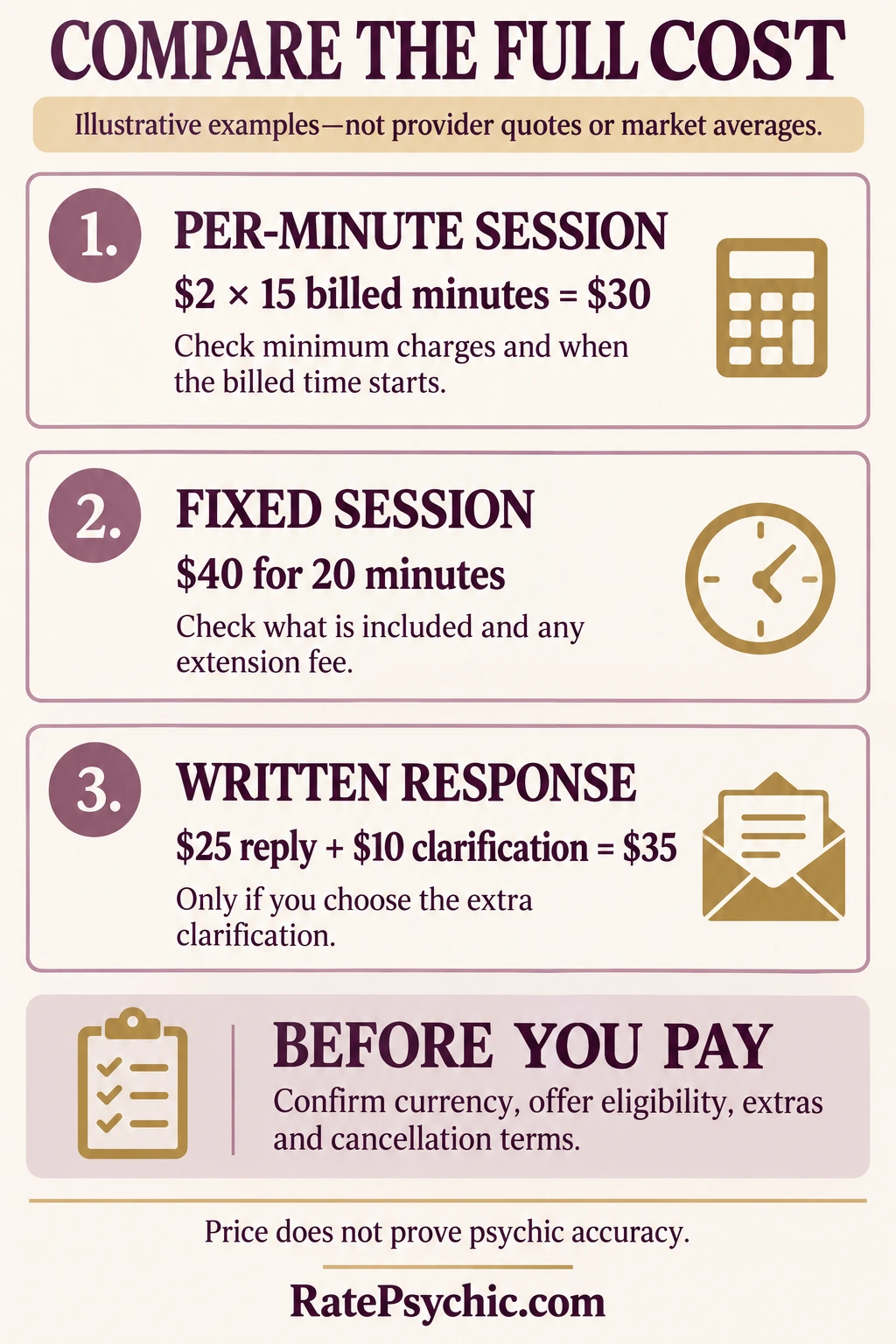
1. Per-minute session

Example: $2 × 15 billed minutes = $30 before any separate charges.

Check when billing starts, whether time is rounded, any minimum charge and whether a promotional rate changes during or after the session. Know how to stop before reaching your limit.

2. Fixed session

Example: $40 for 20 minutes, if that is what the written offer includes.

Check the session scope, included duration, any deposit arrangement and extension fee. A fixed price does not necessarily mean unlimited questions or an unlimited appointment.

3. Written response

Example: $25 reply + $10 clarification = $35, only if you choose the extra clarification.

Check question limits, expected reply length, delivery window and follow-up charges. A phone or chat promotion may not apply to email. Do not assume every unclear point requires another paid message.

Three hypothetical reading-cost examples, not provider quotes or averages: $2 times 15 billed minutes equals $30; $40 fixed session for 20 minutes; $25 written reply plus optional $10 clarification equals $35.
Example calculations only. Confirm actual currency, eligibility, extras and cancellation terms. Open the larger cost-comparison infographic.

Confirm the terms that change the total

  1. Currency and additional charges: note the billing currency and any stated taxes, service charges or conversion costs that apply.
  2. Offer eligibility: confirm whether the promotion is for new customers, a specific reader or one format.
  3. Included scope: record minutes, questions, reply limits and clarification arrangements.
  4. Ending or cancellation: find out how to stop a live session, cancel an appointment or decline later services.
  5. Refunds and complaints: read the actual policy; do not assume a refund is automatic.

A free or introductory offer needs the same scrutiny

A free service is not automatically unreliable, and a paid service is not automatically better. Ask what happens after the initial offer. If an arrangement includes a subscription or automatic renewal, check the later charge and cancellation process explicitly; do not assume that every reading service uses recurring billing.

The FTC’s free-trial guidance emphasizes knowing what you agree to, when a trial ends and how to cancel before later charges. Save the relevant offer and terms before signing up.

Set a total limit, not an accuracy target

Choose an amount you are comfortable spending for an optional service and keep essentials outside that budget. You do not need to pay more because a reading feels incomplete or someone promises a more accurate result at the next level.

For example, if you are considering a per-minute offer, decide in advance how long you would use it and check whether the platform supports a clear stopping point. If the billing terms are unclear, ask for clarification before starting or choose not to purchase.

Tipping, deposits and service charges should be understood from the provider’s actual terms, not assumed from a universal custom. You remain free to decline additional purchases or a pressured request for more money.

If the bill does not match the offer

Keep the receipt, advertised terms, relevant messages and billed duration where available. Contact the provider through a verified channel and explain the concrete discrepancy. If you think you were scammed, use the FTC’s payment-method recovery guidance; act promptly, and do not assume recovery is guaranteed.

For the rest of your comparison, use our reader-service shortlist and review-verification guide. If a provider promises a guaranteed reunion or threatens harm unless you buy a ritual, pause and read claims, conduct and evidence before paying again.

Frequently asked questions

1. Is there one going rate I should expect every reader to charge?

Use the provider’s current written offer rather than treating a single unsourced average as the right price. Compare format, included time or questions and any additional charges.

2. Does a higher price prove greater psychic accuracy?

No. A price or reputation does not independently verify a factual claim or extraordinary ability.

3. Are the dollar amounts in this article current provider prices?

No. They are hypothetical calculation examples, not provider quotes, recommendations or market averages.

4. How do I estimate a per-minute session?

Multiply the applicable rate by billed minutes, then check minimums, rounding, rate changes and any separate charges in the actual terms.

5. Does a fixed fee include unlimited time?

Not necessarily. Confirm the included duration and the price of any extension before booking.

6. How should I compare email-reading costs?

Check the number of questions, expected reply and delivery window, and whether clarification or follow-up messages cost extra.

7. Is a trial offer necessarily free?

No. Check what the offer actually includes, whether you qualify and whether charges begin afterwards. Do not assume the word trial means zero cost.

8. Does a phone promotion also apply to email?

Do not assume it does. Confirm eligibility for the exact format you intend to purchase.

9. Should I include possible follow-up fees in my comparison?

Yes. Note what is included and what costs extra. Do not purchase extra services merely to resolve every uncertainty.

10. Can a free reading still have unclear terms?

Yes. Check privacy, scope and later charges even when the initial service is advertised as free.

11. Does an in-person reading have to cost more?

No price should be assumed from the format alone. Check the actual offer, including travel or other charges that apply.

12. Do I have to tip?

Check the provider’s stated terms and any service charge before booking. Do not let pressure or an accuracy claim make you spend beyond your chosen limit.

13. Can I assume a disappointing reading will be refunded?

No. Read the refund and complaint terms before paying. A refund is not automatically guaranteed by dissatisfaction.

14. What should I save if a charge differs from the offer?

Keep the advertised terms, receipt, relevant messages, billed duration where available and notes about what was delivered.

15. Should I pay more to secure a prediction or remove a curse?

Pause. A guaranteed outcome or threat does not establish accuracy. You can stop and seek appropriate support without buying further sessions.


After a Disappointing Psychic Reading: Decide Whether to Try Again

Hands around an ordinary clear glass ball on a small metal stand at a home table.

A disappointing psychic reading does not mean you failed to relax, ask perfectly or open your energy. Before paying for another session, identify what was unsatisfactory and whether a practical change would address it. Trying again is optional—not the required next step.

What actually went wrong?

Write a short description before browsing another profile. “I received no reply within the advertised delivery window” identifies a service issue. “I hoped for a certain answer and remained uncertain” describes a different problem. Neither should be turned into a demand that you spend more to make a reading work.

The service did not match the offer

Compare the advertised format, duration, question allowance or delivery window with what happened. Save the relevant terms and receipt. Use the provider’s complaint process for a concrete discrepancy; another reading does not fix an unexplained charge or missed delivery.

The wording was vague or confusing

You can ask what a statement meant, while checking whether clarification is included or charged separately. Do not fill in missing details yourself and call the result accurate. Keep the original wording and any later explanation separate.

A claim did not fit or come true

Record the mismatch rather than explaining it away as your closed energy or changed attitude. A factual claim should be assessed against the original wording, conditions and outcome. Use the prediction-assessment guide for apparent hits and misses.

You felt blamed or pressured

You do not have to pay to remove a supposed curse, secure a reunion or prove that you trust the reader. You can stop a pressured conversation. Review claims, conduct and evidence without accepting an accusation about your spiritual state.

There are options besides buying another reading

  • Pause: give yourself time rather than immediately seeking a second answer.
  • Clarify the service: ask a concrete question about an unclear charge, delivery or included follow-up.
  • Check a fact independently: use an actual record or relevant source instead of paying someone else to repeat a claim.
  • Take a practical next step: request information, review your own priorities or seek qualified support for a serious concern.
  • Do not continue: you can decide that the service is not useful for you.

The after-reading review sheet helps separate personal reflection, checkable statements and unverifiable interpretations. You do not have to resolve every uncertainty before choosing not to book again.

If you choose another session, change something concrete

  1. Define one topic. Choose a question about your own options. For example, “What should I consider before reconnecting?” does not demand certainty about another person’s private feelings.
  2. Confirm the offer. Ask what format, duration or written reply is included. Mediumship is a claimed service, not guaranteed contact with a deceased person.
  3. Check the total. Use the full-cost comparison guide, including any clarification charges. Stay within a limit you chose beforehand.
  4. Plan a workable setting. Reduce interruptions if you can, but do not turn calmness or meditation into an obligation. Nervousness does not forfeit your boundaries.
  5. Keep a useful record. Note important wording, uncertainty and details you supplied. If recording is proposed, establish permission and applicable arrangements first.

Be honest when something does not fit: “That does not match what I know” is enough. You need not invent a match, reveal more private information or agree that an unclear message came from a spirit.

You are not responsible for guaranteeing the result

Preparation can help organize a conversation. It does not demonstrate psychic accuracy, make a provider’s claims true or obligate you to feel hopeful afterwards. You can value a suggestion while checking the facts separately.

For broader preparation and FAQs, use the first-reading guide and ten practical session checks. If leaving feedback, describe the concrete experience and protect personal details with our review-writing guide. Your next step can be ordinary information, support or rest—not another paid session.

Finding a Psychic Reader When You Feel Vulnerable: Limits and Warning Signs

Ringed hands holding a small glass globe.

When you feel overwhelmed, a promise of certainty or a miracle can be especially tempting. A psychic reading is an optional service—not a substitute for trusted support, healthcare or verified information. You can pause the search before making a purchase.

Before you search, name the kind of help you need

“I want a reflective conversation about my priorities” is different from “I need someone to guarantee that everything will be all right.” A reader cannot guarantee a reunion, a health outcome or a deceased person’s message. Decide whether a paid reading addresses your actual need or simply offers a temporary promise of certainty.

If you want practical support for a health or mental-health concern, seek an appropriately qualified professional. The National Institute of Mental Health describes psychotherapy as treatment for troubling emotions, thoughts and behaviors, usually with a licensed mental-health professional. A psychic or spiritual title does not establish those qualifications.

For an optional reading, choose a total spending limit, topics you prefer to leave out and a point at which you would stop. You do not have to disclose painful details to establish a connection.

Five forms of pressure worth pausing for

1. “You must decide or pay now.”

A claim of spiritual urgency is not evidence. You can take time to read the offer, ask a trusted person for perspective or decide not to buy. Do not confuse a deadline imposed by a seller with an emergency established by facts.

2. A threat or frightening prediction

A prediction of death, an accident or a curse is not a medical finding or verified warning. You do not have to buy another session or protection ritual because of it. Address real safety or health concerns through appropriate factual information and qualified help.

3. A promise to control someone else

No provider can guarantee another person’s love, consent or return. A claim that more money will secure a reunion does not establish that it will happen. The other person’s choices remain theirs.

4. Pressure to abandon support

Do not stop medication, healthcare or mental-health care because a reader says it blocks a gift. You can keep trusted connections and seek another perspective; secrecy and dependence are not conditions you must accept for a reading.

5. Unclear charges or unnecessary disclosure

Ask what is included, what costs extra and how messages are handled. Do not send passwords, card details in a reading message, medical records or someone else’s private correspondence. If essential terms remain unclear, you can walk away.

Judge the offer and conduct—not advertising or appearance

Advertising, an unusual style, word of mouth or a religious label does not establish whether someone is honest or accurate. A recommendation may start a search, but you still need to check the current terms. Avoid assuming that all readers are fraudulent or that an appealing profile proves a gift.

Use the five-check service shortlist and full-cost guide if you choose to compare offers. For evaluating claims separately from conduct, read “real or fake?” and what the evidence can show.

Keep support outside the reading available

You can talk to someone you trust or a qualified professional without purchasing a reading first. If a previous session upset you, use the disappointing-reading guide to consider options besides another purchase. The after-reading worksheet can help separate reflection from claims that remain unverified.

If you are in crisis in the United States, you can call or text 988 for crisis support, as listed in NIMH’s support resources. For immediate danger, contact local emergency services. Elsewhere, use a local crisis or healthcare service.

If you believe you were scammed, keep the offer, messages and transaction details and consult the FTC’s payment-method recovery guidance. Recovery is not guaranteed, and paying someone to “unlock” a refund can create another pressured purchase.

You do not need a prediction to justify getting help, setting a boundary or taking time. A useful next step can be ordinary support and information, with the decision still yours.

Seven Responsible Habits for Psychic Readers: Clear Terms, Consent and Limits

Reader's ringed hand with green nail polish pointing to a playing card on a home table.

Responsible service habits are things clients can observe: clear terms, respectful communication, privacy and honest limits. They do not prove psychic ability or guarantee that a reading will be accurate, healing or helpful for every person.

Seven habits that make the service clearer

1. Describe the offer before taking payment

State the format, duration or reply scope, full pricing method, included questions and extra charges. Explain how a client can stop or cancel and where complaints go. A client should not have to start a paid session to learn essential terms.

Observable example: A written explanation of the fee and clarification allowance. Our cost-comparison guide shows the details that change a total.

2. Respect disagreement, refusal and consent

Ask before discussing sensitive topics or using touch in an in-person session. Accept a refusal without blaming the client’s energy. A client can say that something does not fit, decline a topic or choose not to return.

Observable example: “We can leave that topic out” rather than “Your resistance is blocking the message.” Kindness does not require agreement.

3. Keep interpretations separate from verified facts

Describe a symbolic reading or impression as an interpretation. Do not present a claimed spirit message, future event or another person’s hidden feelings as an established fact. A vivid experience or personal belief does not remove the need to check a factual statement.

Observable example: The reader acknowledges uncertainty and does not promise a guaranteed reunion, cure or outcome.

4. Handle personal information carefully

Explain the provider’s privacy and recording arrangements and request only relevant context. Do not encourage clients to send passwords, payment details in reading messages, sensitive records or private information about others. Do not publish a client’s story or testimonial without permission.

Observable example: The client can understand who handles their messages and what sharing or recording is proposed.

5. Recognize the limits of the role

A reading is not medical treatment, psychotherapy or professional legal or financial advice. Do not use a psychic title to imply those qualifications or tell a client to abandon professional care. If a person holds multiple roles, the specific role and relevant credentials should be clear.

Observable example: A health question is directed to an appropriately qualified professional rather than answered with an energy diagnosis. NIMH explains the role of psychotherapy and licensed mental-health professionals.

6. Acknowledge mistakes without rewriting the claim

If a statement does not match, do not pressure the client to find a connection or add new conditions afterwards to make it seem right. Preserve uncertainty and distinguish useful reflection from checkable claims. Good and bad news are not measures of authenticity.

Observable example: “That did not fit” can remain the result. Use the after-reading review sheet and prediction-assessment guide for a fair record.

7. Manage workload and wellbeing without supernatural diagnoses

Set realistic working hours, take breaks and avoid making availability promises you cannot keep. A private spiritual practice can be personally meaningful, but it does not certify accuracy or treat distress caused by an invisible contamination.

Observable example: A reader reschedules transparently when unable to deliver rather than promising constant access. Persistent health or mental-health concerns deserve qualified support; a cleansing ritual is not a required solution.

A practical self-check before and after a session

  1. Before: Are the scope, price, privacy and stopping arrangements clear?
  2. During: Can the client disagree, decline and ask for clarification without pressure?
  3. After: Are claims recorded accurately, complaints handled through the stated process and professional limits respected?

This checks service conduct, not extraordinary ability. Daily spiritual practice, friendliness, confidence, clothing or tools cannot independently establish that an interpretation is true. The useful standard is what actually happens in the service.

What clients can ask

Try: “What is included?” “What happens if something does not fit?” “How are my messages handled?” and “Can I leave that topic out?” Clear answers give you concrete information for a choice. Vague promises of healing or instructions to pay for protection do not.

Use service trust versus evidence of accuracy and the reader shortlist when comparing offers. If a conversation feels pressured, read limits and warning signs when you feel vulnerable. You do not have to accept a claim or buy another session to be treated respectfully.

Catholic Faith and Psychic Readings: Church Teaching, Personal Belief and Limits

Woman with hands together in prayer outdoors in warm sunlight.

A reader may describe their work as Catholic, Christian or inspired by prayer. That personal description is not the same as official Church teaching, verification of a psychic claim or authority over your choices. Keep those questions separate before deciding how to respond.

What the official Catholic source says

In the Catechism of the Catholic Church, paragraphs 2115–2117, paragraph 2115 discusses prophetic revelation within Catholic belief. Paragraph 2116 rejects divination, explicitly listing clairvoyance and recourse to mediums among the practices it addresses. Paragraph 2117 also rejects attempts to place occult powers at one’s service.

These passages do not make a commercial psychic reading interchangeable with Catholic prophecy or spiritual guidance. If the compatibility of a practice matters to your faith, read the primary text and discuss your question with a trusted priest or appropriately trained pastoral advisor. This article does not make a personal pastoral judgment about you.

Three distinctions that prevent confusion

1. Official religious teaching

A teaching should be attributed to its actual source. Do not assume that a provider’s description speaks for the Catholic Church or for every Christian denomination. For a different tradition, consult that tradition’s own resources.

2. Personal faith or testimony

Someone can sincerely describe a meaningful experience. That does not make the account an official religious teaching or independently establish its explanation. Respect for a person does not require agreement with every claim.

3. A psychic-service claim

A claimed vision, spirit message or prediction still needs to be distinguished from verified information. Prayer, religious symbols, confidence or a loving intention does not establish the source of a factual statement.

Where ordinary intuition fits

A gut feeling can prompt you to notice something, ask a question or take a sensible precaution. It does not, by itself, establish a message from God or a supernatural ability. Nor does calling an experience clairvoyance, clairaudience or clairsentience establish a Catholic credential.

For practical decisions, consider facts, stakes and context alongside intuition. An experience can remain meaningful to you while its explanation remains uncertain. You do not need to turn every feeling or coincidence into a spiritual instruction.

Respond to a claim without surrendering your choice

  1. Ask what is actually being claimed. Is it a personal belief, a symbolic interpretation or a factual statement about an event?
  2. Check the appropriate source. Use an official religious source for doctrine and independent information for factual claims.
  3. Keep the boundaries of the service clear. You can decline a topic, disagree or choose not to buy a reading.
  4. Seek the right kind of support. A pastoral question, a health concern and a practical decision may need different qualified perspectives.

A respectful response can be: “I understand that this is your belief, but I do not accept it as an instruction for my life.” You do not need to argue about someone’s identity to decline a service.

If a message predicts harm or says you must pay to avoid a curse, pause. A frightening claim is not a verified emergency or a reason to buy protection. Use limits and warning signs when you feel vulnerable, and seek qualified help for a real health or safety concern.

Spiritual support is not a guaranteed prediction

A conversation about faith, values or meaning has a different purpose from claiming to know hidden facts or guarantee future events. Ask a provider to explain the role, training and limits of the actual session. Our spiritual-advisor and clairvoyant comparison helps clarify those differences without stereotypes.

For a specific psychic claim, use claims, conduct and evidence or the after-reading worksheet. You can explore faith and seek support without paying for a reading, accepting a prediction as divine authority or setting aside your own judgment.

Frequently asked questions

1. What does the Catholic Catechism say about divination?

Paragraph 2116 rejects divination and explicitly includes clairvoyance and recourse to mediums. Read the linked official text rather than relying on a provider’s summary.

2. Does the Catechism treat prophecy and paid psychic readings as interchangeable?

No. Paragraph 2115 discusses prophetic revelation within Catholic belief, while paragraph 2116 rejects divination. A service’s use of religious language does not make those categories interchangeable.

3. Does a reader calling themselves Catholic prove Church approval?

No. A personal identity claim is not official approval of the service or verification of its factual claims.

4. Does praying before a reading prove the message comes from God?

No. The act of prayer does not independently establish the source or accuracy of a reader’s statement.

5. Should I obey a reader who says God wants me to do something?

Do not treat that statement as automatic authority. Pause, check relevant facts and seek a trusted pastoral or qualified professional perspective as appropriate.

6. Does this article describe every Christian denomination’s teaching?

No. It identifies a specific Catholic source. For another tradition, consult its own authoritative resources and a trusted representative.

7. Is a strong intuition proof of a divine message?

No. You can notice an impression and take a sensible precaution while remaining uncertain about its source.

8. Are clairvoyance and clairaudience labels Catholic credentials?

No. Such labels describe claimed experiences or methods; they do not establish Catholic authorization or professional qualifications.

9. Can I disagree without insulting the reader’s faith?

Yes. You can decline a service or question a claim while treating the person respectfully.

10. Do good intentions establish prediction accuracy?

No. Sincerity and accuracy are different questions. Check specific factual claims independently.

11. Can a religious label guarantee a reunion or healing?

No. A label does not guarantee another person’s choices or a health outcome.

12. What if a message frightens me?

You can stop and seek support. A prediction is not an established emergency, medical finding or reason to buy protection.

13. Who can help with a question about my own Catholic practice?

Consider a trusted priest or appropriately trained pastoral advisor, and ask directly about the official teaching and your question. This article does not make personal pastoral judgments.

14. Should spiritual advice replace healthcare or other qualified help?

No. Health, mental-health, legal and financial concerns require the relevant qualified support and factual information.

15. Do I have to buy a reading to explore faith or meaning?

No. You can use prayer, reflection, community or a trusted pastoral conversation without purchasing a psychic service.


Psychic Reading Payment Pressure: Warning Signs and What to Save

Woman speaking on a phone at a modest home table with tarot cards and a small glass ball.

If a reading turns into repeated requests for money, pause and examine the actual offer, claims and payment record. You do not need to prove or disprove psychic ability before refusing a pressured purchase.

The cover is an illustrative reading-service scene, not a depiction of a provider in the historical case discussed below.

Three forms of payment pressure

Fear used as a sales tool

A curse, impending disaster or supposed spiritual threat is not established by the reader’s assertion. Do not let a frightening statement become the reason to buy a protection ritual or repeated “cleansing.” Address a real health or safety concern through appropriate qualified support.

A guaranteed relationship outcome

No fee can guarantee another person’s love, consent or return. A refund promise does not make the outcome possible or ensure that money will be returned. Read the actual conditions before paying, and do not keep spending merely to preserve the promise.

A growing bill without clear scope

If each explanation requires another paid step, ask what was included in the original offer and what the extra service actually is. You can decline. Unclear charges should not be treated as a spiritual test or proof that you lack faith.

Questions alone do not prove fraud, and claims about “vibrations” do not establish authenticity. Separate the information you supplied, the statements made and the conduct you can observe. Our claims, conduct and evidence guide explains those distinctions.

Keep a concrete record

  1. The offer: save the service description, price, promotion conditions and date.
  2. The terms: keep the cancellation, refund, privacy and follow-up arrangements that applied.
  3. The payment: record amount, currency, date, method and receipt.
  4. The provider: keep the business identity and verified contact details used for the transaction.
  5. The conversation: preserve relevant messages and original claim wording, including details you supplied and statements that did not fit.
  6. The response: note what happened when you asked about a discrepancy, declined an extra purchase or requested a refund.

These records help describe events; they do not automatically establish a person’s motives or a legal conclusion. Keep sensitive details private. If you leave public feedback, use the review-writing privacy guide rather than posting financial information or unverified accusations.

A documented historical case—not a current industry estimate

In November 2002, the FTC announced a settlement with Access Resource Services and Psychic Readers Network, promoters of the “Miss Cleo” lines. The FTC alleged deceptive advertising, billing and collection practices. The settlement required a $5 million payment to the FTC and forgiveness of an estimated $500 million in outstanding consumer charges.

That historical enforcement record concerns specific businesses and practices. It does not establish what any current provider charges, how many readers are dishonest or whether a present-day psychic claim is accurate. Evaluate the actual offer and evidence rather than using an old case as a blanket accusation.

If you believe you paid a scammer

Act promptly and contact the company used to send the money through a verified channel. The FTC’s recovery guidance sets out steps by payment method. Ask what options apply; recovery is not guaranteed. Keep the relevant records instead of paying for another reading to clarify the situation.

Before another purchase

Use the full-cost comparison guide and service shortlist to understand terms. If the prior reading left you worried or pressured, consider support and boundaries outside a reading. You are free to stop, and a threat or promised miracle does not create an obligation to pay.

Frequently asked questions

1. Does asking questions prove that a reader is fraudulent?

No. Questions alone do not establish deception. Note what you supplied and assess specific claims and service conduct separately.

2. Do claims about vibrations prove that a reader is genuine?

No. Describing a supposed energy mechanism does not independently establish its existence or accuracy.

3. What if I am told that a curse requires an expensive removal?

Pause before paying. A curse claim is not established by the provider’s assertion, and pressure to buy protection is a reason to stop and reassess.

4. Can a payment guarantee that someone will return to me?

No. A provider cannot guarantee another person’s love, consent or choices.

5. Does a refund promise make an offer safe?

Not by itself. Read the actual written terms, conditions and complaint process before paying.

6. What should I save from the original offer?

Keep the advertised service, full pricing terms, promotion conditions, cancellation and refund information, and the date you saw them.

7. What payment records are useful?

Keep receipts, transaction dates, amounts and currency, the payment method and the relevant provider identity or verified contact details.

8. Should I include failed claims and contradictions in my notes?

Yes. A fair record includes uncertainty, details you supplied, misses and conflicting statements—not only apparent hits.

9. Do records automatically prove a legal conclusion?

No. Records help describe what happened. They do not automatically establish motive or every element of a legal claim.

10. What can I do if I think I paid a scammer?

Act promptly and contact the company used to send the money to ask about recovery options. Use the linked FTC payment-method guidance; recovery is not guaranteed.

11. Should I pay an unexpected caller to recover my money?

No. The FTC warns about recovery scams that demand an upfront fee. Verify any organization independently rather than using only the caller’s supplied contact details.

12. Should I send bank details to an unsolicited refund contact?

Do not provide sensitive financial details to an unexpected contact promising recovery. Use independently verified channels for legitimate payment support.

13. Does the 2002 FTC case describe all current psychic services?

No. It is a documented historical settlement concerning specific companies and practices, not an estimate of current industry conduct or prices.

14. Can I warn others without publishing private records?

Yes. Describe concrete events and protect personal or financial details. Do not publish account numbers, private messages about others or unverified accusations.

15. Do I need another paid session to decide whether to stop?

No. You can stop purchases, review the records and seek appropriate support without buying another reading.