

Home Blog Page 9

Before Your First Psychic Reading: Questions, Privacy and Your Choices

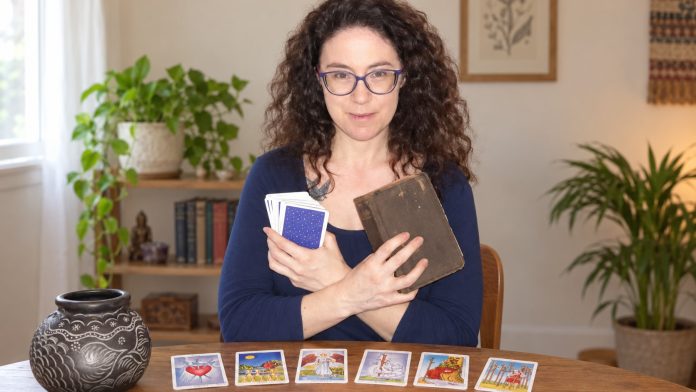
Woman with glasses holding cards and a closed book at a home reading table.

Before your first psychic reading, focus on practical preparation: understand the format and full price, choose a question and decide what you prefer to keep private. You do not need a perfect mood, a pure heart or a special ritual to deserve respectful treatment. A reading offers an interpretation—not guaranteed accuracy or professional care.

Your reading, your choices
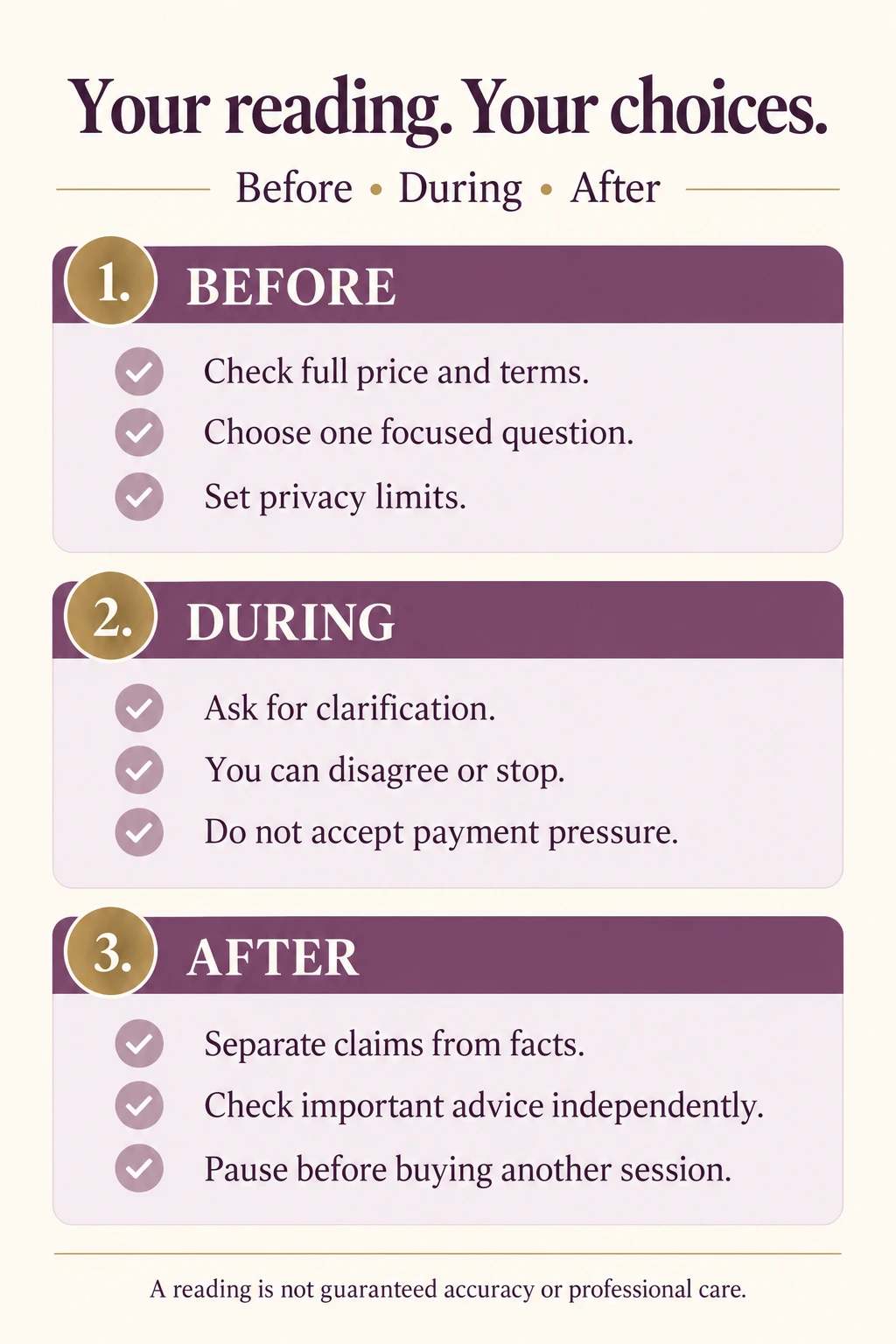
Before, during and after a reading: check terms and privacy, ask questions or stop, then separate claims from facts.
A practical checklist, not a promise of results. Open the larger reading checklist.
  1. Before: check full price and terms, choose one focused question and set privacy limits.
  2. During: ask for clarification, remember you can disagree or stop and do not accept payment pressure.
  3. After: separate claims from facts, check important advice independently and pause before buying another session.

Before booking: confirm the service, not an imagined setting

Readings may be offered by phone, chat, email, video, in person or in a group. Do not assume that every session provides a quiet private room or that only the reader can access your information.

Price and scope

Confirm duration, included questions, ongoing rates, minimum charges and add-ons. Read the cancellation and refund terms. An introductory offer may not describe the full purchase.

Privacy and recording

Ask whether a session is recorded, who can access it and how the information is handled. Share only the context you want to disclose; do not bring passwords, sensitive records or another person’s private messages.

One focused question

“What can I consider before making this choice?” leaves room for reflection. “Tell me exactly what someone secretly feels” asks for knowledge that a reading cannot independently verify.

Your practical comfort

Choose a time and setting that suit your access and privacy needs. You can take an ordinary pause before starting, but meditation, visualization and purchased tools are not prerequisites.

Use our service-trust guide to compare practical checks. If your question concerns romance, our love-reading preparation guide offers question examples without reunion promises.

During the session: keep the right to question

Ask for plain language when a statement is unclear. You can say “That does not fit my situation” without searching for a way to make it true. A reader’s confidence is not a reason to abandon your own judgment.

You can decline a topic, request a pause or stop participating. Billing rules may still apply, which is why checking them beforehand matters. Anxiety, disagreement or an unanswered question should not be reframed as proof that you blocked an otherwise accurate message.

Afterward: review before acting

Write down what was actually said, what information you had already supplied and which claims remain uncertain. Include statements that did not fit as well as apparent matches. Feeling comforted is a personal experience; it does not verify a prediction or guarantee another customer’s results.

A reading is not medical care, psychotherapy or qualified legal or financial advice. Check important decisions independently. You can also decide that the session was not useful and that you do not want another one.

If sharing feedback, our review-privacy guide helps describe the service without disclosing sensitive details. For interpreting a strong feeling after a session, see facts, stakes and context.

No compulsory preparation routine

Do not change prescribed care or buy supplements to become more “receptive.” An optional comfortable pause can help organize your question, but it is not an accuracy test. Our mindfulness guide includes alternatives and limits; no special state is required to ask a practical question.

Frequently asked questions

1. Do I need special spiritual preparation before a reading?

No special ritual, cleanse or purchase is required to prepare a question. You can simply review the service terms and decide what you want to discuss.

2. Must I be completely calm for a reading to work?

No. Anxiety is not a reason to blame you for an inaccurate or unhelpful response. You can request a pause, postpone or choose not to proceed.

3. How many questions should I bring?

Check the service’s actual allowance and available time. Starting with one focused topic may be easier than asking many unrelated questions.

4. What makes a useful question?

Ask about your own choices and perspective rather than demanding certainty about another person’s hidden thoughts or a guaranteed future.

5. Should I share everything about my life?

No. Share only context you want to disclose. Avoid passwords, payment credentials, sensitive records and another person’s private messages.

6. Will the reading automatically be private?

Do not assume that. Ask who will be present, whether the session is recorded and how information is stored or used.

7. Are readings always held in a quiet room?

No. They may be offered by phone, chat, email, video, in person or in a group. Confirm the format and practical arrangements.

8. Can I disagree with the reader?

Yes. You can say that a statement does not fit, ask what it means or decline a topic. You do not need to invent a connection to make a message work.

9. Can I stop the session?

You can choose to stop participating. Check the service’s billing and cancellation terms beforehand so you understand possible charges.

10. Does a detailed message prove psychic accuracy?

Not by itself. Consider what information was already available, whether claims are specific and what can be independently checked.

11. Should I buy extra work to remove a curse or block?

Do not accept urgent payment pressure or guarantees that an additional purchase will control another person or prevent an invisible threat.

12. Can a reading replace professional advice?

No. It is not medical care, psychotherapy or qualified legal or financial advice. Check high-stakes decisions independently.

13. What should I write down afterward?

Record what was actually said, what was useful, what did not fit and which claims remain uncertain. Separate personal comfort from verified predictions.

14. Do I need another session immediately?

No. You can pause, review the response and decide whether further spending serves any clear purpose. You can also choose not to return.

15. What if I suspect a payment was fraudulent?

Keep relevant receipts and messages and contact the company used to send the money promptly. The FTC provides recovery guidance; refunds are not guaranteed.


Past Karma and Present Choices: Belief, Responsibility and Boundaries

Wooden boardwalk crossing a pond toward a leafy tree on a grassy bank.

Karma is interpreted within different religious and spiritual traditions. It is not a reliable way to diagnose why a particular person suffered, prove a pre-birth agreement or conclude that a relationship must continue. You can reflect on your own conduct without blaming yourself for someone else’s harmful actions.

“Memory of the soul” is not one universal definition

The Vedanta Society of Southern California’s account connects karma with actions, their results and mental impressions across lives. In Study Buddhism’s explanation, Alexander Berzin and Matt Lindén discuss impulses and habits and reject karma as fixed fate. These are attributed teachings, not interchangeable definitions or scientific proof of a specific past-life cause.

When exploring a tradition, learn its context rather than assuming a slogan covers every belief. Our reincarnation and reflection guide explains additional differences.

A repeating problem does not identify a past-life debt

Similar experiences can prompt useful questions about circumstances and choices. They do not establish that you must settle an invisible obligation. A claim that a parent was once your child, or that a stranger harmed you in another life, needs more than a strong feeling or a reader’s confidence.

Being stolen from does not prove that you stole in an earlier life. Likewise, experiencing coercion does not establish consent before birth. Support and accountability in the present should not depend on accepting a story about why the harm happened.

Separate responsibility from blame

A choice you made

If you made a promise you cannot keep, consider an honest update and what repair is appropriate. You can address a current action without declaring yourself a bad soul or buying karmic cleansing.

Another person’s conduct

You are not responsible for another person’s threats, manipulation or abuse. Changing your thoughts or accepting a lesson does not guarantee that their behavior will improve.

Circumstances outside your control

Not every loss or difficulty can be solved by introspection. Practical resources, other people’s decisions and wider conditions matter. Uncertainty is not evidence of a hidden debt.

A boundary you can choose

Personal spiritual meaning does not oblige contact, forgiveness or reconciliation. Make decisions based on current circumstances, safety and what you are willing to accept.

If a relationship feels compulsory because of a spiritual explanation, our relationship-pattern and safety guide centers choice and support. For limiting obligations more broadly, see reconsidering “soul contract” patterns.

A present-day exercise without a destiny claim

  1. Name one observable pattern. For example: “I agree to extra tasks without checking my available time.”
  2. Separate your choice from the rest. Note what you can influence and what depends on others or circumstances.
  3. Choose one manageable adjustment. You might ask for time to review a request instead of agreeing immediately.
  4. Review what happened. Look at the practical result. An imperfect outcome does not mean you failed to clear karma.

This is an ordinary planning example for a situation where a request can be considered safely. It is not a demand to confront a threatening person or a treatment for distress. Appropriate individual support may be the more useful next step.

Leave unverified stories open

If karma offers personal meaning, keep the interpretation distinct from what you can establish. You do not need to identify every person’s supposed role or predict consequences across lifetimes. Our past-life curiosity guide separates meaning, memory and checkable claims.

Your next useful question can be simpler: “What would be a respectful, realistic action now?” That question remains available whether or not you believe in karma or rebirth.

What Does Enlightenment Mean? Selected Perspectives and Practical Limits

Open book and two closed books on a sunlit wooden table beside a plant.

“Enlightenment” can refer to different spiritual goals or, more loosely, to a moment of clearer understanding. Ask whose teaching is being described before treating the word as a single universal state. A metaphor about light is not proof that a body has changed, illness has disappeared or everything is literally made of light.

Two named accounts—not a complete map of traditions

A Buddhist account

In Study Buddhism’s explanation, Alexander Berzin and Matt Lindén describe enlightenment as becoming a Buddha and connect the path with ethics, concentration, wisdom and compassion. This is an attributed religious teaching, not a synonym for any pleasant meditation experience.

A Vedanta account of oneness

The Vedanta Society of Southern California describes oneness through the shared divine Self, or Atman. That provides context for its understanding of spiritual realization; it should not be substituted for every other tradition’s account.

These examples do not imply that every Buddhist or Hindu school uses identical explanations. They also do not represent all spiritual traditions. A teacher, text or community deserves to be identified specifically rather than absorbed into a generic “divine source” description.

Nor is enlightenment exclusively a Western spiritual concept. When the word is used in a religious setting, the relevant tradition and translation matter. Avoid statements about what all witches, Wiccans or other broad groups believe without a specific source and context.

Separate four kinds of statement

  1. A religious teaching: “This community describes realization in this way.” Learn what it means within that tradition.
  2. A personal experience: “I felt clear, connected or peaceful.” The feeling can matter without proving a permanent achievement.
  3. A metaphor: “I saw something in a new light.” This need not be a claim about photons, anatomy or invisible energy.
  4. A factual or health claim: “This practice cures an illness or guarantees a bodily change.” That requires appropriate independent evidence, not spiritual language alone.

Body size, fatigue or illness should not be used to rank a person’s spiritual worth. You do not need to become physically “light” to deserve respect. Similarly, a serious mood or difficult emotion does not prove that you are less spiritually developed.

For another example of keeping symbolism separate from anatomy, see third-eye language and the pineal gland. Our karma and present-choice guide also distinguishes beliefs from explanations imposed on someone’s life.

A practical reflection without a spiritual score

Instead of deciding whether you have reached a final state, choose one ordinary question: “What am I assuming?” “How might my action affect someone else?” or “What would a respectful next step look like?” Write a brief answer and leave room to revise it.

For example, if you are sure a friend’s delayed reply means rejection, separate the delay you observed from the interpretation you added. You can wait, ask a simple question when appropriate or focus on another task. That exercise is not a test of enlightenment; it is a way to keep uncertainty visible.

If you want to try a comfortable pause, use our mindfulness guide. Quiet sitting is optional, and no glow, vision or unusual sensation is required.

Meaning does not require certainty

You can study a tradition seriously while acknowledging what you do not know. Keep a brief note of the source, its intended meaning and which statements are personal interpretations rather than established facts.

If spiritual change feels difficult, our guide to pace, support and clear limits avoids treating distress as compulsory progress. A useful exploration can leave room for ordinary care, relationships and questions—not a verdict that you have succeeded or failed as a person.

Distance Energy Healing: Claims, Consent and Practical Support

Close-up of empty open hands in front of a white garment.

You can care about someone from far away without claiming to transmit a medical treatment. Distance energy healing is a spiritual belief-based practice—not a reason to delay care or blame a person for being ill.

Three things to keep separate

  • Spiritual meaning: prayer, intention or a ritual may matter personally.
  • Remote support: calls, messages and practical help can connect people across distance.
  • Medical treatment: diagnosis and treatment belong with qualified healthcare professionals.

What practitioners mean by distance healing

Some spiritual practitioners describe sending energy to someone who is elsewhere, sometimes at an agreed time. Others use prayer, visualization or Reiki language. These descriptions explain what people believe or offer; they do not establish that a force travels between people or changes a diagnosis.

The distinction matters when the recipient is frightened or unwell. Kind intentions do not justify promising recovery, claiming to know the cause of an illness or telling someone that their doubt is preventing help.

What the evidence actually supports

NCCIH’s Reiki overview says Reiki has not been clearly shown effective for health-related purposes and that evidence does not support the proposed energy field. That overview is not a finding that every form of comfort is useless; it is a boundary on health and energy claims.

Do not generalize a peaceful experience into a claim that an infection, injury or other condition has healed. A symptom change after a session does not identify what caused it, particularly when medical care or other changes occurred at the same time.

For help separating an experience from evidence, read the after-reading reflection guide. It is possible to say “I appreciated the conversation” without saying “the session cured me.”

A supportive description

“We agreed on a brief call. I felt cared for and appreciated the check-in.”

A claim that needs evidence

“Energy travelled to me and changed my medical diagnosis.” A comforting session alone cannot establish that conclusion.

Consent is part of support

Ask what the other person wants rather than assuming a healing ritual is welcome. They may prefer practical help, quiet companionship, prayer within their own tradition or no spiritual activity at all. Accept the answer without suggesting that refusal blocks recovery.

Do not request another person’s medical records or intimate history for an uninvited ritual. If a friend shares something privately, that is not permission to publish it as a healing testimonial.

Check a paid service before booking

  1. Define the offer. Is this a conversation, an appointment or a ritual performed without contact? Ask what you will receive.
  2. Get the total cost. Include repeat-session expectations and any cancellation terms.
  3. Ask about privacy. Find out who receives your information and whether notes are retained.
  4. Reject cure guarantees. A spiritual title is not a medical credential.
  5. Keep the decision yours. You can stop without proving that you believe enough.

Use the booking-terms checklist and review-verification guide when testimonials or discounts influence the offer.

Support from a distance that does not need an energy claim

Start with a simple question: “Would a check-in, help organizing something, or space be useful?” Agree on a manageable time and do not expect an immediate reply from someone who is recovering or overwhelmed.

  • Coordinate a practical task only with permission.
  • Help someone find the official contact details for appropriate local support.
  • Offer to listen without explaining their illness as karma or blocked energy.
  • Respect privacy when updating other friends or relatives.
  • Follow up on what was requested rather than making the person report a spiritual result.

A phone call with a qualified healthcare professional is also remote, but it is not “distance energy healing.” Clinical qualifications, assessment and care are the important differences.

No blame and no delay

You do not need stronger belief to deserve support. Avoid practitioners who say poor results prove you resisted, failed to open yourself or must purchase an urgent cleansing. If you have a health concern, seek appropriate medical help; do not wait for a ritual to work.

For an optional spiritual framework that makes its limits clear, see chakra reflection after trauma. Personal meaning can coexist with qualified care without competing with it.

Frequently asked questions

1. What is distance energy healing?

It is a spiritual practice in which someone claims to direct healing energy without being physically present. The claim should be distinguished from ordinary remote support.

2. Has sending energy been established as a medical treatment?

Do not rely on it to treat illness or injury. Claims about transmitted healing energy do not establish a clinical benefit.

3. Is a video appointment the same thing?

No. A remote appointment with a qualified clinician uses communication and clinical care. It does not depend on a claim of nonphysical energy transfer.

4. Does feeling calmer prove energy reached me?

No. A feeling of comfort can be genuine without demonstrating the proposed mechanism or a change in a medical condition.

5. Can disbelief prevent recovery?

Do not blame a person’s illness or recovery on skepticism. A spiritual practitioner cannot establish that doubt blocked healing.

6. Should I stop medication before a session?

No. Do not stop or change treatment because of a spiritual session. Discuss care decisions with your qualified clinician.

7. Can I request prayer or a quiet spiritual ritual?

Yes, if it is meaningful to you and respects your care and boundaries. It need not be described as a medical treatment.

8. Do I need to agree to a friend’s healing ritual?

No. You can decline without explanation. Friends should ask what kind of support you actually want.

9. What if a practitioner guarantees a cure?

Treat that as a reason to step back. Request clear terms and seek qualified medical advice rather than relying on a guarantee.

10. Can a testimonial prove distance healing works?

No. A story does not control for other care, natural changes, expectations or timing. It cannot by itself establish cause.

11. What information should I share?

Only what is necessary for the agreed activity. Avoid unnecessary medical records, payment information or private details about other people.

12. Should I buy repeated sessions because nothing happened?

You are not obliged to keep paying. Lack of a result is not evidence that you need a more expensive session or have failed spiritually.

13. What should I ask before paying?

Ask what the session includes, the total cost, cancellation terms, privacy arrangements and whether any health claims are being made.

14. How can I help someone who is far away?

Ask what would be useful: a check-in, practical coordination or help connecting with local support. Respect their choice and availability.

15. How should I handle urgent health concerns?

Use appropriate medical or emergency services. Do not wait for a spiritual session or an energy practitioner’s assessment.

Five Useful Questions for a Psychic Reading: Focus on Choices, Not Guarantees

Hooded person seen from behind looking toward the sea.

A useful reading question can invite reflection without asking someone to guarantee the future or reveal another person’s private thoughts. These five examples keep the focus on your choices. You can also use them on your own without buying a session.

Start with one topic and a clear limit

Check how much time and how many questions the service includes. Write your main question and a short description of the decision you face. Share only relevant context you want to disclose, not passwords, sensitive records or someone else’s private messages.

A clear question may make an interpretation easier to assess; it does not create reliable psychic accuracy. Our first-reading checklist covers price, privacy and the right to disagree or stop.

1. What qualities matter to me in a mutually chosen relationship?

This keeps the question on values and current conduct rather than “Who secretly loves me?” or “When will my soulmate arrive?” You might consider respect, honesty, compatible plans and freedom to set limits.

Useful follow-up: “Which examples from my situation support that interpretation?” Compare the answer with what you actually know. A reader cannot secure another person’s consent. See observable relationship values.

2. What can I consider as I prepare for a change already in view?

Name a real change, such as a move you are considering, rather than asking for a guaranteed date and location of a future event. List your options, practical constraints and missing information.

Useful follow-up: “What would be a small next step, and what should I check independently?” You can act on ordinary planning without treating a forecast as a deadline. Our intention-to-action guide offers manageable options.

3. Which parts of my work fit my interests, skills and circumstances?

Ask about tasks and conditions rather than a predetermined career path or guaranteed promotion. A reading cannot certify an employer’s plans, your aptitude or a future income.

Useful follow-up: “What information about this role do I still need?” Use practical resources such as My Next Move to explore occupations and preparation. Our career-purpose planning guide separates values from job guarantees.

4. What support or manageable step would help me with this difficult period?

You can reflect on what would be welcome now without asking a reader to diagnose a problem, prescribe care or promise healing. Spiritual meaning is not a substitute for appropriate professional support.

Useful follow-up: “Is this a reflection suggestion or something that needs qualified advice?” The NIMH psychotherapy guide explains professional care. You do not need to buy a reading to seek help.

5. What does a respectful, reciprocal friendship look like to me?

Focus on your preferences and observable conduct rather than asking a reader to identify a “true friend” through hidden motives. You can consider whether contact is welcome, promises are kept and limits are respected.

Useful follow-up: “What am I observing, and what am I assuming?” Our guide to feeling in sync distinguishes connection from mind-reading, while conversation-boundary options avoid labeling people from one interaction.

After a response, keep your judgment

Note what was actually said, what the reader already knew, what did not fit and which claims remain uncertain. A vague answer should not become specific only after you supply a matching story. If a claim concerns health, money, legal issues or another high-stakes decision, check it through appropriate independent sources.

You can ask for clarification, decline a topic or decide not to return. An unhelpful response is not proof that you asked badly, lacked faith or blocked a message. Do not accept urgent payment demands to change another person’s feelings or avoid an invisible threat. See service-trust checks before further spending.

If you want to describe the session publicly, use the privacy-aware review guide. A factual account of the service is more useful than declaring that a moving experience guarantees results for everyone.

Psychic Power Blocks? Five Practical Checks for a Difficult Reflection Practice

Close-up of closed eyes carved in natural wood.

If meditation, journaling or an intuitive exercise feels difficult, start with the conditions around the practice. A distracted or disappointing session does not establish that psychic powers are blocked, that your hormones are imbalanced or that a spiritual organ is damaged.

Five checks before you call it a psychic block

1. Are you expecting a definite answer?

A practice becomes frustrating when success means predicting a precise event, sensing someone else’s thoughts or producing a vivid experience on command. A feeling, image or coincidence does not verify a supernatural source. You can instead use a session to identify one concern or write down a question that needs ordinary information.

Try: Replace “I must receive a sign” with “What am I considering, and what information would help?” For decisions, use facts, stakes and context alongside your gut feeling.

2. Does this moment leave room for attention?

A busy household, tiredness or an unfinished task can make it difficult to focus. You do not have to defeat stress or achieve perfect calm before taking a break. Choose a time that is workable rather than imposing another daily obligation.

Try: Shorten the exercise to two comfortable minutes, postpone it or skip it. A flexible rest-and-routine plan can be more useful than insisting on a breakthrough.

3. Is the setting helping or distracting you?

You do not need a professional studio, a special energy field or an elaborate ritual. A familiar chair, ordinary light and fewer interruptions may be enough. If you prefer being outside, choose a safe, accessible place and suitable footwear; walking barefoot is not a requirement.

Try: Put your phone out of reach for a brief session, adjust uncomfortable light or sound and tell others when you would prefer not to be interrupted. For screens, see a practical media-boundary experiment.

4. Does the method actually suit you?

Not everyone enjoys visualization, closed eyes or stillness. Disliking a technique does not prove that you lack a gift. You can reflect while looking at an ordinary object, writing one sentence or taking a comfortable walk. Tarot cards or another symbolic tool can offer prompts without proving the answer is true.

Try: Notice something you can see or hear without forcing your breathing, posture or concentration. Stop if the exercise is uncomfortable. Our mindfulness guide offers comfortable options and limits.

5. Would a boundary or another kind of support help?

If a conversation repeatedly leaves you upset, describe what is happening rather than labeling someone an “energy vampire.” You can limit the topic, shorten the conversation or decline it. You do not have to surrender sensible boundaries to restore supposed psychic powers.

Try: Say, “I’m not available to discuss this tonight.” Use practical responses to draining conversations. For a health concern or persistent distress, seek qualified support rather than a diagnosis of spiritual blockage.

Keep the experiment small and observable

Choose just one adjustment for your next session. For example, try a shorter exercise without your phone nearby. Afterwards, record three things:

  1. What changed? “I practiced for two minutes instead of twenty.”
  2. What did I notice? “I was less distracted, but still unsure about my decision.”
  3. What remains to check? “I need the actual cost and schedule before choosing.”

This record can help you decide whether a habit is useful. It does not test psychic accuracy, demonstrate an opened third eye or require you to interpret every feeling as a message. If nothing improves, you are free to try another approach or stop.

When to pause rather than push harder

The National Center for Complementary and Integrative Health’s meditation guidance notes that unwanted experiences can occur and that meditation should not replace or delay conventional care. There is no need to continue an exercise that increases your distress.

Do not change medication, restrict foods, buy supplements or pay for a “block removal” because a session felt unproductive. Concerns about hormones, sleep or other symptoms belong with a qualified healthcare professional, not an interpretation of psychic ability.

If you want to understand the language behind these practices, read third-eye symbolism and pineal-gland facts. You can value a reflective ritual while keeping its symbolism separate from anatomy and evidence.

Am I Psychic? Four Experiences to Examine Without Jumping to Conclusions

Two women talking together over takeaway coffee.

A striking gut feeling, a vivid dream or a strong association with a color can make you wonder, “Am I psychic?” None of these experiences, by itself, establishes that you can obtain information through a supernatural source. Start by describing what happened before deciding what it means.

Four experiences—and the limits of each

1. An idea arrives when you relax

A solution that appears during a break may be worth considering. Its sudden arrival does not establish that you received private information about someone else. Write it down, then ask what you already knew and how you could check it.

Do not use wine or other substances to try to activate a gift. The National Institute on Alcohol Abuse and Alcoholism explains that alcohol interferes with brain communication and can affect thinking and behavior. Feeling more certain is not the same as judging accurately.

2. You associate people or sounds with colors

A color can be a metaphor, an imaginative association or part of a sensory experience. Cleveland Clinic describes synesthesia as sensory crossover, such as colors associated with sounds, letters or numbers. An online checklist cannot tell you whether that describes your experience.

In any case, “blue” does not establish that someone is a healer, and “red” does not establish that they are angry or dangerous. Assess a person through their conduct, not your color associations.

3. A gut feeling seems to work

A remembered discount, a useful hunch or a changed travel route can feel impressive. Ask whether ordinary cues were available and how often similar feelings did not lead to the expected result. A single success does not establish reliable foresight.

You may take a sensible precaution without proving why a feeling arose. Use facts, stakes and context when deciding how much weight to give intuition, especially when consequences are substantial.

4. A dream resembles something later

A dream about an old acquaintance followed by an encounter can feel meaningful. Compare the actual dated dream record with the event, not a version reconstructed after it happened. What matches specifically? What does not? What was already possible or known?

A match does not prove a future-predicting ability or contact with a deceased person. Our guide to evaluating a prediction that appears to come true offers a more careful comparison.

Keep a fair record, not just a collection of hits

If you want to examine impressions, make the record before checking an outcome. Keep it private if it contains personal details, and do not collect information about others without their permission.

  1. Date and exact wording: Record the impression without expanding it later.
  2. Known information: Note relevant conversations, plans, messages or observations already available to you.
  3. Outcome criteria: Define what would count as a match and by when. If a claim is too vague to assess, say so.
  4. Whole result: Include misses, contradictions and inconclusive outcomes alongside apparent hits.

For example, “Something good will happen soon” is too broad to meaningfully assess. A more specific record is easier to compare, but even a specific match does not rule out ordinary explanations or establish a supernatural mechanism. This is a reflection record, not a validated scientific test.

Respect other people’s privacy and your own limits

Instead of saying, “I know you’re hiding something,” ask, “Would you like to talk about how you’re doing?” Someone can decline, and you should not pressure them to confirm an impression. You can acknowledge a feeling without turning it into an accusation.

If sensory changes are new, sudden, distressing or disruptive, discuss them with a qualified healthcare professional. Do not delay care because someone calls the experience an awakening. If a reflection habit feels unproductive, try five practical checks for the conditions around your practice; you do not have to adopt a psychic identity or buy a reading.

Frequently asked questions

1. Does this checklist establish that I’m psychic?

No. The experiences discussed here do not establish an ability to obtain information through a supernatural source.

2. Should I drink alcohol to become more intuitive?

No. Alcohol is not a recommended way to explore intuition, and it can impair judgment. Revisit ideas when sober rather than treating intoxicated confidence as evidence.

3. Can an idea that appears while relaxing still be useful?

Yes. You can write it down and assess it later. Being useful does not establish where the idea came from or that it is accurate.

4. Does associating a person with a color mean I see their aura?

A personal color association does not establish an aura or reveal someone’s health, motives or character.

5. Is every color association synesthesia?

No. Synesthesia is a specific sensory phenomenon; an imaginative description or metaphor is not enough to identify it.

6. Can synesthesia tell me whether someone is a healer?

No. A sensory association is not a professional credential or a reliable assessment of someone else.

7. What if my sensory experiences change suddenly?

Seek advice from a qualified healthcare professional rather than assuming a new psychic ability. This article cannot diagnose the cause.

8. Does a gut feeling that worked once prove psychic accuracy?

No. One remembered success does not account for misses, ordinary information, chance or other possible explanations.

9. Should I ignore an uneasy feeling?

You do not need to ignore it. You can take a practical precaution without treating the feeling as proof of a prediction or another person’s intentions.

10. Does a dream that resembles a later event prove prediction?

No. Consider how specific the original record was, what does not match and what ordinary information was available beforehand.

11. Should I tell someone that I know their hidden thoughts?

No. Ask respectfully rather than presenting an impression as established private knowledge. The other person can decline to discuss it.

12. How can I keep a useful impression record?

Record the date, exact impression, information already available and a clear outcome before reviewing later events. Include misses and unclear results.

13. Can I rewrite a prediction after seeing the outcome?

You can add a separate note, but retain the original wording. Rewriting the original makes the later comparison misleading.

14. Should I make a major decision from an impression alone?

No. Check relevant facts, costs and consequences, and get qualified advice when the decision concerns health, money or legal matters.

15. Do I need to choose a psychic identity?

No. You can enjoy reflection and acknowledge an unusual experience without adopting a label or making claims about your abilities.


Finding a Psychic Reader: A Practical Shortlist, Not an Accuracy Guarantee

Red-haired woman smiling while seated at a café.

If you choose to book a psychic reading, compare the service you would actually receive: format, price, privacy, boundaries and complaint terms. A friendly conversation, convincing profile or favorable review does not establish psychic accuracy. You can also decide not to book.

Start with a question and a spending limit

Write down what you want to discuss before browsing profiles. A focused question about your own choices is more useful than asking someone to guarantee a future event or reveal another person’s private thoughts. Try our five choice-focused reading questions if you need a starting point.

Decide how much you are comfortable spending in total, not just per minute. A trial offer may have eligibility conditions or lead into a paid session. Do not assume you can speak with several readers for free. Check the provider’s current written terms before starting.

Five checks for each candidate

1. Does the format suit you?

Phone, live chat, written email, tarot and chart-based readings are different arrangements. Confirm what is included, whether questions or follow-ups are limited and whether the reader currently offers your preferred format.

A chart or written reading may remove live visual cues, but it does not rule out ordinary information, general statements or information you supplied. No format proves a supernatural source.

2. Is the full cost clear?

Check currency, per-minute versus fixed fees, minimum charges, introductory eligibility and what happens when the offer ends. Ask how you can end a live session. If the answer is unclear, do not start simply to discover the price.

For a written service, confirm the number of questions, expected response window and whether clarification costs extra.

3. Can you understand the privacy terms?

Find out how messages, recordings and account details are handled by the provider. Share only the context needed for your question. A warm manner or claim of confidentiality is not a substitute for clear written information.

Do not send passwords, payment-card details in a reading message, medical records or someone else’s private correspondence.

4. Are boundaries respected?

You should be able to decline a topic, disagree with an interpretation or end the conversation. A reader should not pressure you to disclose more, stop professional care or pay to remove a supposed curse.

“Master,” “gifted” or “highly accurate” are profile claims, not healthcare qualifications or independent proof. See service trust versus evidence of accuracy.

5. What happens if there is a problem?

Read cancellation, refund and complaint procedures before paying. Check where a complaint goes, what records you should retain and whether time limits apply. Do not assume a dissatisfied customer automatically receives a refund.

Keep the offer and transaction details so you can describe the actual issue, such as an unexpected charge or missed delivery.

Read reviews as reports, not proof

A testimonial can describe an experience but does not establish prediction accuracy or guarantee that your experience will match. A mix of positive and negative reviews is not, by itself, proof that a site is reliable.

The Federal Trade Commission advises comparing review sources and considering recency and incentives. It also warns that fake reviews can be positive or negative and may be difficult to identify by appearance alone. Use our review-verification checklist to examine specific claims instead of relying on a star average.

Decide without pressure—and review afterwards

If an important term is missing, ask for it in writing or leave that option off your shortlist. You do not need a reading to make every choice, and a disappointing session does not mean you failed to be sufficiently open or found the wrong spiritual match.

During a session, note what was actually said. Afterwards, separate suggestions that you found useful from factual statements that remain unverified. Consider practical next steps independently, especially for health, money, safety or legal decisions.

Before booking, use the first-reading checklist. If you later write a review, explain concrete service details without exposing private information; our useful-review guide shows how.

Reiki and Relationships: Personal Reflection, Consent and Realistic Limits

Open hands catching raindrops outdoors in sunlight.

You may find a Reiki ritual personally meaningful, but it cannot guarantee reconciliation or change another person’s behavior. Relationship repair is about what people actually choose and do: respecting consent, addressing specific problems and following through over time.

Separate the ritual from claims about what it changes

Reiki is a complementary approach based on a belief in healing energy. Practitioners may place their hands lightly on or above a person. The National Center for Complementary and Integrative Health states that Reiki has not been clearly shown effective for health-related purposes and that its proposed energy field lacks scientific evidence.

That does not prevent someone from valuing a quiet personal ritual. It does mean that feeling calmer should not be presented as proof of energy transfer, a healed relationship or a change in someone else’s intentions. No symbol, visualization or distant session can substitute for another person’s freely given agreement.

Your own reflection

You can notice your feelings, decide what matters to you and choose a boundary. Those are your actions, not proof that another person has changed.

The other person’s choices

They decide whether to communicate, apologize, change their behavior or continue a relationship. A ritual does not give you control over those decisions.

Observable repair

Look for specific changes: an agreement kept, respectful communication or a repeated pattern addressed. Promises and spiritual labels are not the same as follow-through.

Professional care

Reiki is not a replacement for medical or mental-health care. A Reiki qualification alone does not establish the qualifications of a therapist or healthcare professional.

If a ritual helps you pause, give it a practical purpose

You can use an object you already own as a reminder, or use no object at all. A photograph or stone does not need special powers, and buying a new item is not necessary. Rather than promising to direct energy into a relationship, try this optional reflection:

  1. Name the issue plainly. “Our agreed plans often change without notice,” rather than “Our energy is blocked.”
  2. Separate your part from theirs. You can make a request or change your availability. You cannot guarantee their response.
  3. Choose one next step. When it is safe, ask for a concrete agreement. Otherwise seek individual support and consider your boundaries.
  4. Review conduct, not a sensation. Did the agreed change happen? Did you feel free to decline? Keep the answer separate from how meaningful the ritual felt.

For example: “When our plans change at the last minute, I lose the time I set aside. Can we agree to confirm by the evening before?” This asks for an observable change without diagnosing hidden motives. The other person can answer honestly, and you can decide what to do with that response.

Explore communication and consent in a sensitive relationship or boundaries after draining conversations for more examples.

Ask before touch—and respect a refusal

If a session includes touch, establish the arrangement beforehand and ask for consent. You can decline touch, a topic or the whole session. Do not treat a partner’s hesitation as an energy blockage to overcome. Love is respect’s consent guidance emphasizes freely given agreement and the right to withdraw it; previous consent is not blanket permission.

Safety takes priority over reconciliation

Threats, coercion, monitoring or abuse are not spiritual growth assignments. You do not need to heal the person harming you before seeking help. A shared ritual does not make an unsafe conversation safe.

In the United States, the National Domestic Violence Hotline offers individualized safety-planning support. Internet use can be monitored; consider a safer device if that is a concern. If you are in immediate danger, contact local emergency services. Outside the United States, seek an appropriate local support organization.

If a provider promises to heal a relationship, restore a partner’s love or remove a block for repeated fees, pause before paying. Use our service shortlist and full-cost checks. You are free to stop, and you do not need a ritual to justify a boundary.

Frequently asked questions

1. Can Reiki guarantee that a relationship will heal?

No. Reiki does not guarantee reconciliation, changed behavior or a lasting relationship. Repair requires choices and conduct from the people involved.

2. What is Reiki in this context?

Reiki is a complementary practice based on an energy-healing belief. Some people use it as a personal ritual; its proposed energy field is not scientifically established.

3. Does feeling calmer prove that energy healing occurred?

No. A calmer experience can feel valuable without demonstrating the proposed energy mechanism or a change in another person.

4. Can I use a meaningful object for reflection?

Yes, if you want to. Treat it as a personal reminder, not a device that controls a relationship or another person’s feelings.

5. Does the object need to be a crystal?

No. No purchase is required. You can reflect without any object or use something you already own.

6. Should I interpret a controlling relationship as a lesson I attracted?

No. Someone else’s abusive actions are not your fault or a spiritual assignment that you must complete.

7. Does a past relationship give permission for touch today?

No. Past consent does not establish current permission. Ask, respect a refusal and stop if consent is withdrawn.

8. What if my partner does not want Reiki?

Respect that choice. Do not pressure them, claim they are blocking healing or treat a private ritual as changing their feelings.

9. Should Reiki replace medical or mental-health care?

No. Do not stop, change or delay professional care because of a Reiki claim. Discuss health concerns with a qualified professional.

10. Can a Reiki qualification establish counseling expertise?

Not by itself. Ask separately about relevant professional credentials when you need mental-health or relationship services.

11. How can I turn reflection into a practical request?

Identify a specific issue, describe its effect on you and ask for a concrete change when it is safe to have that conversation.

12. What if the other person will not repair the relationship?

You cannot make that choice for them. Consider your own boundaries and support rather than buying repeated promises of reunion.

13. What should I check before paying for a Reiki session?

Check the scope, full cost, touch and consent arrangements, cancellation terms and privacy information. No provider can guarantee another person’s behavior.

14. Is a joint ritual a suitable response to threats or abuse?

No. Prioritize individualized safety support. A ritual does not stop coercion or make a threatening situation safe.

15. Can I stop a ritual or session that feels uncomfortable?

Yes. You are free to stop, decline touch, change the subject or choose not to continue. You do not owe anyone a healing performance.


How to Choose a Clairvoyant Reader: Clarify the Claim Before Booking

Pendulum, closed wooden card box and tarot cards on a home table.

“Clairvoyant” describes a claimed way of receiving information; it is not a guarantee of accurate predictions or a professional healthcare credential. If you are considering a reader, ask what the label means in their service and what you would actually receive before paying.

What does the reader mean by clairvoyance?

Readers may use the term for claimed images, impressions or visions. Some combine those claims with tarot, astrology or other tools. Ask them to explain their approach plainly rather than assuming every profile uses the word in the same way.

The APA Dictionary of Psychology places clairvoyance within extrasensory-perception claims—awareness purportedly obtained beyond known sensory channels. The dictionary describes the existence of these proposed abilities as controversial. A service label, a card deck or a reported vision does not independently establish the claim.

Four questions to ask before booking

1. “What will you do during this reading?”

Ask whether the session uses cards, a chart, questions, visual impressions or another method. Confirm whether the format is phone, live chat, video or a written response. If the explanation remains vague, you can decline.

Tools and a comfortable conversation do not make factual claims accurate. A method should not be presented as a guaranteed way to find a future date or reveal someone else’s private thoughts.

2. “What information do you need from me?”

Ask what is necessary and why. You can give brief context while leaving out unnecessary identifying details and sensitive records. Do not send passwords, card numbers in reading messages or another person’s private correspondence.

Information supplied before a session can influence the reply. A statement that draws on that information is not evidence that it was obtained clairvoyantly.

3. “What are the limits of this service?”

Look for a clear distinction between a symbolic interpretation and a verified fact. You should remain free to disagree, decline a topic or end a session without being blamed for blocking the reader’s ability.

Ask separately about professional qualifications if you need healthcare, mental-health, legal or financial assistance. A clairvoyant title does not establish those qualifications.

4. “What are the full terms and cost?”

Confirm currency, pricing method, session or reply length, follow-up charges, introductory eligibility and cancellation/refund terms. Check privacy arrangements and where a complaint would go.

A preliminary conversation may itself cost money. Do not assume a trial is free or necessary just because someone says you must “feel the connection.”

Assess the answer, not just the impression

A useful answer tells you what happens, what it costs and where the limits are. For example, “The fixed fee covers one written response to one question; clarification is charged separately” gives you something concrete to compare. “You will understand once you pay” does not.

If a provider says only a paid ritual can remove a curse, promises an exact outcome or pressures you to keep paying, pause. Do not treat urgency as evidence of insight. You can choose not to book and seek qualified help for a serious concern.

Recommendations can start a search, but they do not finish it

A trusted friend’s recommendation may help you find a profile. It does not guarantee that the service will suit you or establish psychic accuracy. Likewise, reviews deserve examination rather than being ignored or accepted as proof. Check specific service details, current terms and possible incentives.

Use the five-check reader shortlist for a practical comparison, and our review-verification guide to evaluate testimonials. You do not need to purchase readings from several people simply to learn what each offers.

Keep the factual review separate from personal meaning

After a session, record what was said and distinguish interpretations from claims that can be checked independently. Do not rewrite a vague statement into a specific prediction after an event. If a claim appears to come true, use the prediction-assessment guide before concluding that clairvoyance was demonstrated.

For broader questions about trust, read service reliability versus proof of accuracy. For preparation, use the first-reading checklist. A personally meaningful experience can remain meaningful without controlling your decisions or proving a supernatural explanation.