

A relationship can feel intense, familiar or spiritually meaningful without being destined. “Karmic twin flame” is a personal or spiritual interpretation—not proof of a permanent bond, a hidden wish or a future reunion. Consent and current behavior matter more than the label.
Keep personal meaning separate from prediction
People use “twin flame,” “soulmate,” “karmic relationship” and “soul contract” in different ways. These labels do not provide a dependable hierarchy of love or a timetable for reunion. Feeling that an encounter changed you is different from knowing that the other person is meant to remain in your life.
Claims that someone will always choose you, secretly wants you while dating another person or communicates consent telepathically cannot replace their actual choices. Terms such as “runner” and “chaser” should not turn a boundary into a challenge. If someone asks you not to contact them, respect that request.
For broader distinctions, see soulmate signs, meaning and evidence. You can value an experience without proving a supernatural source.
Four checks when a connection feels intense
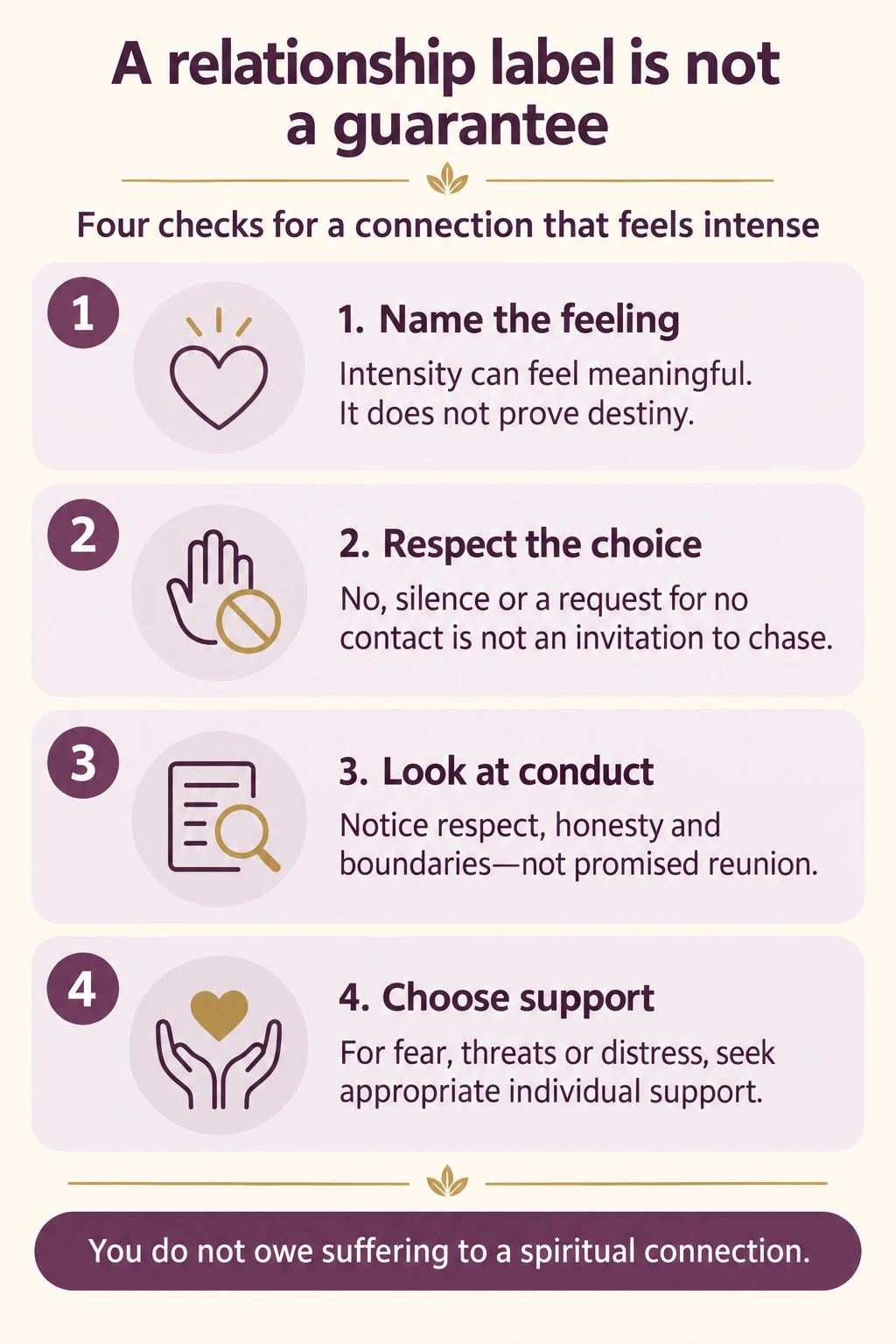
- Name the feeling. Intensity can feel meaningful; it does not prove destiny. Describe your own experience without assigning the other person a spiritual role they have not accepted.
- Respect the choice. No, silence or a request for no contact is not an invitation to chase. Neither a forecast nor a feeling overrides another person’s autonomy.
- Look at conduct. Notice respect, honesty and boundaries—not promised reunion. A warm moment does not cancel repeated pressure, threats or disregard.
- Choose support. For fear, threats or distress, seek appropriate individual support. You do not owe suffering to a spiritual connection.
The love is respect boundary guide distinguishes a personal limit from control and identifies fear of a partner’s angry or violent reaction as a warning sign. It is more useful to assess concrete behavior than to explain it as purging karma.
Support does not require a reunion
You do not need to forgive, contact someone or complete paid spiritual work before seeking help. If thoughts about the connection are interfering with everyday life, consider a qualified professional. The NIMH psychotherapy guide describes professional care; a psychic service is not trauma treatment.
If you feel unsafe, the National Domestic Violence Hotline’s safety resources offer U.S. individual support. If browsing may be monitored, consider an appropriate safer way to seek help. For immediate danger, use local emergency services rather than a reading.
A reading cannot secure another person’s consent
A paid interpretation should not be treated as confirmation of secret love or permission to pursue. Be cautious about guaranteed-reunion promises, urgent payment demands or claims that a failed outcome means your vibration is wrong. Our service-trust guide focuses on checks you can actually make.
You can choose a different next step
A relationship that does not happen is not evidence that you failed a soul lesson. You can direct attention to routines, friendships, practical responsibilities and support without waiting for a promised ending. Our relationship-pattern guide centers safety and choice, while reconsidering limiting “soul contract” ideas offers present-day reflection without spiritual obligations.
Frequently asked questions
1. What does “karmic twin flame” mean?
People use it as a spiritual relationship label, often for a connection they consider intense or meaningful. Its meaning varies; it is not a verified category that establishes destiny or compatibility.
2. Can I prove someone is my twin flame?
A strong feeling, repeated number, dream or reading does not independently verify that identity. You can acknowledge the meaning you feel without treating the label as a fact.
3. Does the universe guarantee that we will reunite?
No such guarantee can be established from this label. The other person’s choices and present circumstances still matter.
4. Should I chase someone who says they do not want contact?
No. Respect their stated boundary. A twin-flame interpretation does not create permission to contact, follow or pressure someone.
5. Is silence a sign that someone secretly wants me?
Silence does not establish consent, interest or a hidden spiritual message. Do not turn it into permission to pursue.
6. What if the person is in another relationship?
Do not assume that they secretly choose you or will leave their partner. Respect their actual commitments and choices rather than a predicted outcome.
7. Does pain prove that our bond is special?
No. Pain is not proof of destiny, and harm does not become necessary because a connection feels meaningful.
8. Must I forgive or reconnect to clear karma?
No. A spiritual interpretation does not oblige forgiveness, contact or reconciliation. You can make choices based on your circumstances and needs.
9. Are “runner” and “chaser” labels helpful?
They can obscure a straightforward boundary or lack of mutual interest. Describe actual communication and choices rather than treating distance as a stage that must be overcome.
10. Can a psychic know the other person’s private feelings?
A reading is not independent confirmation of someone’s thoughts. Do not treat claims of hidden love as more authoritative than that person’s words and actions.
11. Can twin-flame connection heal trauma?
It is not an established treatment. If distress or past experiences are affecting daily life, consider appropriate qualified support.
12. What should I assess instead of a relationship label?
Notice whether care is mutual, communication is honest, consent is respected and you can set limits without fear. Look at specific conduct over time.
13. Is it my fault if the relationship does not happen?
No. You cannot guarantee another person’s choice by changing your vibration, thoughts or spiritual practice. A relationship outcome is not a measure of your worth.
14. What if a service sells guaranteed reunion?
Treat that promise cautiously. Do not assume payment can secure another person’s consent, change their feelings or force a reunion.
15. Where can I get support if I feel afraid?
A relationship-safety advocate can help consider your situation individually. The National Domestic Violence Hotline offers U.S. support; seek local emergency help for immediate danger.