Home Blog Page 6

When Spiritual Change Feels Difficult: Pace, Support and Clear Limits

Woman with strawberry-blond hair resting her chin on her hand while seated on a blue sofa by a window.

A change in beliefs or priorities can feel unsettling. If you call it a spiritual awakening, that meaning may matter to you—but suffering is not proof that you are progressing, and you do not need to be “broken down” to become worthy or grow.

This page offers reflection and practical service checks, not a diagnosis or a universal account of enlightenment. You can slow down, keep familiar supports and seek healthcare without abandoning your beliefs.

Start with what is happening, not a stage label

A belief is changing

Name the specific question: “I am unsure about an idea I used to accept.” You can examine one question without deciding your entire identity today.

A relationship feels different

Look at actual interactions and what you need. A difference in beliefs does not automatically mean a person must leave your life.

A practice feels overwhelming

You are allowed to pause. Discomfort is not a credential, and a teacher should not require you to surrender your ability to stop.

Daily functioning is affected

Seek qualified assessment for persistent or worsening distress, disrupted sleep, confusion or unusual perceptions. Do not assume those changes are simply an awakening.

When to seek help instead of pushing through

The NIMH guide to psychosis describes changes involving perception, sleep, clear thinking and everyday functioning that warrant healthcare attention. This does not mean spiritual belief itself is an illness; it means a spiritual label cannot replace an assessment of concerning changes.

If you are experiencing these changes, especially if they persist or intensify, contact a healthcare professional promptly. Do not rely on a psychic reader to decide whether you need care.

In the United States, call or text 988 for suicide or emotional-crisis support. Call 911 in a life-threatening situation. Outside the United States, use your local crisis and emergency services.

You do not need to erase your life

Reconsidering a belief need not involve abandoning possessions, ending every relationship or dismissing your earlier self as false. You can keep what is useful and examine what no longer fits. Ordinary responsibilities, affordability and other people’s consent remain relevant.

Similarly, reflecting on a mistake is different from concluding you are dirty, inadequate or required to suffer. If a practical repair is appropriate, consider what you can actually do. Do not use spiritual language to minimize abuse, prejudice or the help someone needs.

The five-pattern reflection guide offers specific choices without attributing distress to hidden obligations. For trauma-related concerns, see the distinction between spiritual practices and trauma care.

A manageable way to review a change

  1. Name one question. Describe what you want to understand rather than announce that everything must change.
  2. Keep ordinary support available. Stay connected with people you trust and appropriate healthcare. A group should not be your only permitted source of advice.
  3. Choose a small action. Read a source, ask a thoughtful question or write down a preference. Delay major commitments while you seek clarity.
  4. Review the effect. Note what became clearer and what became harder. You can stop an activity that is not suitable.

For example, “I want more time for reflection” might lead to declining one optional commitment—not quitting your job, making an expensive retreat booking or ending a relationship on impulse. Use the small-step decision worksheet to compare an impression with practical information.

Meditation is optional, not a test of endurance

NCCIH’s meditation overview notes that negative experiences can occur and says not to substitute meditation for conventional care. More intensive practice is not automatically better. If a practice increases distress, pause and seek appropriate advice rather than label the distress purification.

The comfortable mindfulness guide describes optional alternatives. You do not need to meditate to prove your sincerity.

Check the boundaries of a teacher or service

  • Can you decline an exercise or touch without punishment?
  • Are prices and cancellation terms clear before payment?
  • Does the person distinguish spiritual teaching from medical qualifications?
  • Can you keep outside relationships, information and professional care?
  • Are you free to pause or leave without threats about your future?

A promise of inevitable transformation does not make a costly service necessary. Do not change prescribed care based on a teacher’s or reader’s spiritual advice; discuss treatment with your healthcare provider. The reading preparation guide provides additional cost and privacy checks.

Frequently asked questions

1. What does spiritual awakening mean here?

It is a personal description of changing beliefs or meaning, not a medical diagnosis or a required stage everyone must complete.

2. Must I suffer to grow spiritually?

No. Pain is not proof of progress, and you do not have to endure harmful practices to deserve growth.

3. Does feeling worse prove a practice is working?

No. Worsening distress is a reason to pause and consider support, not automatic evidence of purification.

4. Do I have to abandon my old identity?

You can reconsider one belief or preference without discarding every relationship, responsibility or familiar part of your life.

5. Is there a fixed awakening timeline?

This guide does not assign stages or a completion deadline. People use the term in different ways.

6. Must I cut people off to become more spiritual?

No blanket separation rule applies. Consider actual behavior, boundaries, support and safety.

7. Can I seek mental-health care and keep spiritual beliefs?

Yes. Seeking qualified care does not require giving up personal spiritual meaning.

8. Can this article diagnose what I am experiencing?

No. A qualified healthcare professional can assess symptoms and discuss appropriate care.

9. What changes should prompt professional assessment?

Persistent or worsening distress, disrupted sleep, confusion, unusual perceptions or difficulty managing daily life deserve qualified assessment.

10. What if there is immediate danger?

Use emergency services. In the United States, call 911 for a life-threatening situation.

11. Where is United States crisis support available?

Call or text 988 for suicide or emotional-crisis support. Use local crisis or emergency services if outside the United States.

12. Should I intensify meditation when it makes me distressed?

Do not treat distress as a requirement to push harder. Pause and discuss concerns with an appropriate professional.

13. Should I stop prescribed care because a spiritual teacher says so?

Do not change prescribed treatment based on spiritual advice. Discuss treatment decisions with your healthcare provider.

14. How can I review a group or teacher?

Ask about consent, privacy, costs, qualifications and freedom to stop. Be cautious about secrecy, isolation or guaranteed transformation.

15. What is one ordinary next step?

Name a specific question and choose a manageable, reversible action. You can leave larger decisions open while seeking support.

Interested in Psychic Arts? Reading Types, Questions and Practical Limits

Woman in a blue shirt with eyes closed and hands together, seated in a softly lit home living room.

An interest in psychic arts does not by itself establish that you have psychic abilities or need a reading. You can explore symbols, stories and spiritual ideas while checking factual claims and keeping your decisions independent.

Start by identifying what you want to understand: a card system, an astrology tradition, a personal question or the terms of a paid service. Those are different purposes, and no purchase is required just to learn about them.

Five descriptions you may encounter

Providers use these labels differently. Ask what the actual session includes rather than assume a name describes a standardized service or qualification.

Tarot reading

A reader interprets cards and their arrangement. You may choose to use the imagery for reflection; a card does not verify another person’s thoughts or guarantee an event.

Astrology reading

A service may interpret a chart or zodiac symbolism. Clarify which information it requests and how it handles privacy. Symbolic categories are not medical or personality diagnoses.

Explore zodiac symbolism and emotional communication.

Mediumship reading

A provider may claim contact with someone who died. A meaningful or comforting statement does not independently prove that contact. You are free to decline details or stop.

See remembrance, personal meaning and contact claims.

Love or career reading

These labels describe a topic, not necessarily a method. Ask about your own choices rather than expect a guaranteed reunion, job offer or access to another person’s private feelings.

Use the love-reading assessment guide.

Past-life reading

A reader may provide a story about a supposed previous identity. Detail or confidence does not make it a verified historical record.

Read past-life claims and memory limits.

Turn broad curiosity into a useful question

“Tell me everything about my future” leaves the purpose unclear. A smaller question makes a response easier to assess, even if you decide not to purchase a reading.

  • Learning a system: “What does this symbol mean in the source I am reading?”
  • Exploring a choice: “Which parts of this decision do I still need to investigate?”
  • Reflecting on a relationship: “What would I like to communicate or clarify myself?”
  • Checking a service: “What exactly is included, and what does it cost?”

For example, if you are curious about changing work, list the practical uncertainties—hours, skills, costs or application requirements. A reader’s interpretation cannot confirm an offer that an employer has not made. The small-step decision worksheet helps organize those questions without buying anything.

A psychic reader is not automatically a therapist

A spiritual service and psychotherapy are not interchangeable. The NIMH psychotherapy overview describes treatment involving licensed mental-health professionals. A reading label or an encouraging conversation does not establish those qualifications.

Do not use a reading to diagnose illness, decide treatment or replace qualified legal or financial advice. If anxiety or distress affects daily life, seek appropriate healthcare rather than a promise that spiritual advising will remove it.

Before paying, confirm the basics

  • The format: phone, live chat, video, in person or a written reply.
  • The full price, included time or questions and any follow-up charges.
  • Privacy and how your message or session information is handled.
  • Cancellation, refund and complaint terms.
  • Your freedom to decline a subject, disagree or stop.

Use the reading preparation and service-check guide before committing. Do not assume a promotion for one format applies to another.

Keep curiosity separate from urgency

There is no requirement to prove your interest by spending money, uncovering a hidden gift or accepting a prediction. Pause if someone says only an urgent reading or cleansing purchase can prevent harm. A confident delivery, a detailed story or a favorable rating is not independent evidence of accuracy.

You can read, compare ideas and leave a question open. An interest can remain an interest; it does not have to become a paid service or a claim about who you are.

How to Make a Gratitude Stone: A Simple Craft and Optional Reminder

Smooth gray and beige stones decorated with words including Gratitude, Hope and Friends.

A gratitude stone is a small decorated object you choose to associate with appreciation. Making one can be an enjoyable craft. It is not a cure, an energy-clearing tool or a requirement to feel positive when life is difficult.

You can use a stone you already have permission to use, a suitable craft stone or a paper card instead. Keep the project simple; no special crystal, ritual or expensive kit is needed.

What you need

  • An intact, smooth stone intended for crafting, without sharp edges or loose pieces.
  • A marker or paint labeled for the surface and intended user.
  • A protected work surface and any cleaning materials the supplier recommends.
  • A place where the decorated stone can dry undisturbed.

Follow the material labels, including ventilation, cleanup, age guidance and drying instructions. The Health Canada craft-safety guide emphasizes reading labels and following instructions. If children participate, choose materials specifically suitable for them and supervise the activity.

This is a display craft, not a food-contact item or a toy to put in the mouth. Keep small stones and supplies out of reach of young children and pets. Do not take stones from a place where collecting is prohibited or from someone else’s property without permission.

Four steps to make your stone

1. Choose

Pick an intact stone with enough room for a short word or simple design. It does not need to feel “chosen” by intuition or have a spiritual property. Check that it is appropriate for the craft materials you plan to use.

2. Prepare

Clean and dry it as the supplier advises. Preparation is for the surface, not removal of negative energy. Do not assume every mineral can be soaked or treated the same way.

3. Decorate

Add one word, a small heart, dots or another simple pattern. Follow the marker or paint label and let the design dry fully before handling. No sunlight “charging” step is required.

4. Place and notice

Display the finished stone somewhere suitable. When you notice it, name one specific thing you appreciate if you want to. You can also leave it as decoration.

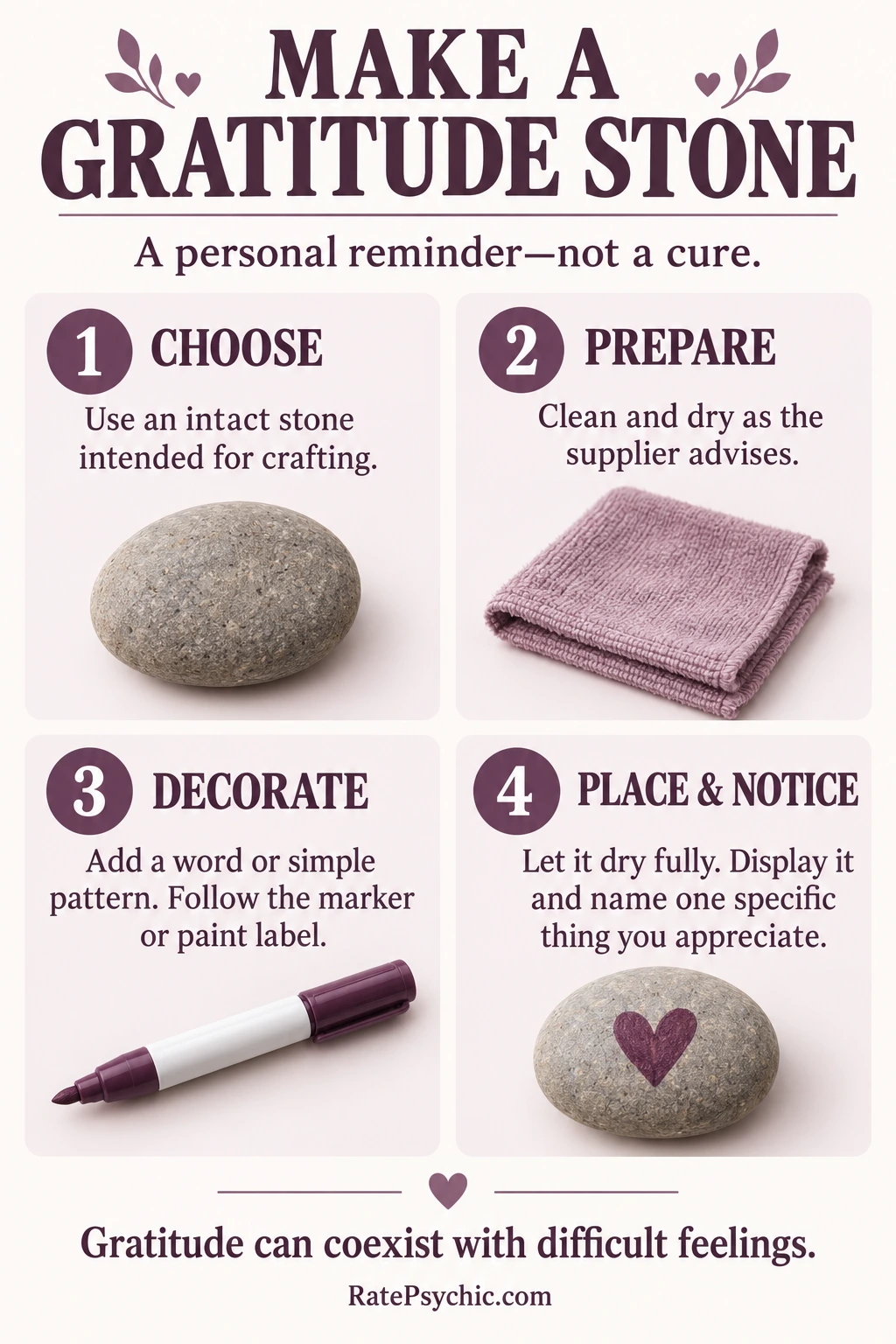
Four-step gratitude-stone craft guide: choose, prepare, decorate, then place and notice.
Keep this visual reference nearby; all four steps are also written above. Open the image for a larger view.

Make the reminder specific

Instead of requiring yourself to say “Everything is good,” choose something concrete:

  • “I appreciated the person who checked in today.”
  • “I enjoyed a small part of my meal.”
  • “I am glad I had time for this craft.”

You may appreciate one moment and still feel sad, angry or overwhelmed about something else. The stone does not require you to deny those feelings, excuse harm or take responsibility for circumstances outside your control.

Gratitude is not an obligation

If the exercise feels forced, skip it or use a different reminder: “What support would be useful?” You do not owe anyone a cheerful response. A craft object does not replace appropriate help when you need it.

A simple way to revisit it

You might keep the stone near a notebook and write one sentence when you feel like it. Do not turn missed days into a failure score. If the word no longer fits, choose another reminder or set the stone aside.

For another optional reflective use of an object, see crystals and life-purpose questions. If you prefer an attention exercise without an object, browse comfortable mindfulness options.

Keep decoration separate from a spiritual claim

You can give the design personal significance without claiming the stone balances chakras, guarantees calm or stores protective energy. A pattern can simply be something you enjoy making. If it belongs to a specific spiritual tradition, learn about that context rather than label every circular decoration a sacred practice.

The useful part is your chosen reminder and what, if anything, you do with it. A stone is not a requirement for appreciation or a test of how well you are living.

Chakra Reflection After Trauma: Meaning, Boundaries and Support

Woman seated quietly in a grassy field at sunset

You do not need to “unblock” an energy center to deserve help after trauma. Chakra language may offer a framework for spiritual reflection, but it is not a diagnosis or an established treatment for PTSD.

If the ideas matter to you, use them gently and by choice. This guide keeps symbolic prompts separate from clinical care and focuses on boundaries, present-day support and permission to stop.

The most important distinction

Spiritual reflection: exploring what safety, connection or expression means to you.

Clinical care: assessment and treatment with a qualified professional. The National Institute of Mental Health’s PTSD guide describes treatments including psychotherapy and medication. A spiritual session is not a substitute.

What chakra language can—and cannot—tell you

Chakras are part of spiritual frameworks, not medically established structures that determine whether you can recover from trauma. In the familiar seven-chakra model, themes such as security, creativity and communication are associated with different centers. Traditions and interpretations vary.

Those themes can prompt a useful question: “What would help me feel more supported today?” They cannot establish that abuse blocked a particular chakra, that difficulty trusting is an energy defect or that a sensation reveals a hidden memory.

Trauma is not a failure of your beliefs, positivity or spiritual worth. You do not have to accept someone else’s interpretation of your experience.

Seven optional prompts, not seven diagnoses

Use the themes below as journaling language only. Choose one, shorten it or skip the exercise. You are not required to describe what happened to you.

1. Root: practical safety

What would make my current surroundings a little more comfortable? A boundary, a trusted contact or a predictable routine may matter more than a ritual.

2. Sacral: choice and comfort

What activity do I actually want to do today? You can focus on creativity or ordinary enjoyment without exploring intimate experiences.

3. Solar plexus: agency

What is one small choice I can make for myself? It might be saying no, asking a question or deciding to postpone something.

4. Heart: support

Who treats my boundaries with respect? Connection can mean accepting help; it does not require forgiveness or reconnection with someone who hurt you.

5. Throat: expression

How would I prefer to communicate? A short message, a private note or choosing not to speak can all be valid.

6. Third eye: perspective

What do I know now, and what am I unsure about? A feeling or image is not proof of a prediction or a recovered memory.

7. Crown: meaning

What values or beliefs feel supportive to me? It is fine to feel uncertain or to find meaning outside spiritual practice.

Try a gentler pause if inward focus feels uncomfortable

You do not need a long meditation, closed eyes or a body scan. If you choose to pause, keep it brief and stay free to move.

  1. Notice your surroundings. Look around and name where you are.
  2. Choose an ordinary action. You might take a sip of water, stand up or contact someone you trust.
  3. Check whether to continue. Stop if the activity increases distress; there is no benefit in forcing it.

The VA’s coping guide describes present-focused actions after trauma. These are coping ideas, not a diagnosis or a promise of relief.

NCCIH’s meditation safety information notes that unpleasant experiences can occur and advises against replacing conventional care with meditation. If a practice repeatedly leaves you worse, discuss it with a qualified professional.

Set boundaries before any spiritual session

  • Ask what will happen, how long it lasts and the complete price.
  • Specify whether touch is welcome. You can refuse it.
  • Ask about privacy before sharing personal history.
  • Agree that you can pause, decline a question or end the session.
  • Check qualifications for any health-related advice rather than relying on spiritual titles.

Promises that deserve caution

Be wary of guaranteed trauma cures, demands to stop therapy or medication, pressure to relive painful events, or claims that you must pay repeatedly to remove a blockage. Distress is not evidence that a ritual is “working” or that you need a more expensive service.

Keep reflection separate from evidence

You may find a session calming or meaningful without it demonstrating an energy cure. Note what you chose, what felt useful and what you would not repeat. Our after-reading reflection guide explains how to separate personal meaning from factual claims.

For support, start with a licensed clinician, your regular healthcare provider or another qualified local service. Seek help when symptoms persist, worsen or interfere with daily life. Spiritual interests need not be abandoned, but treatment decisions should not depend on an energy interpretation.

Frequently asked questions

1. Can chakra healing treat trauma or PTSD?

Chakra practices are not an established treatment for trauma or PTSD. A licensed mental-health professional can assess symptoms and discuss appropriate care. Spiritual reflection can be a personal choice, but it should not replace treatment.

2. Does distress mean one of my chakras is blocked?

No. Distress does not establish an energy blockage. Chakra language can be used symbolically, but it cannot diagnose the cause of an emotion or symptom.

3. Is trauma a sign that I am spiritually damaged?

No. Experiencing trauma does not make you spiritually defective, unworthy or responsible for what happened to you.

4. Can I keep spiritual beliefs while seeking therapy?

Yes. You can discuss beliefs and preferences with a therapist and ask for care that respects them. You do not have to give up a meaningful practice to seek qualified support.

5. Do I need to use all seven chakra prompts?

No. Choose a prompt that feels useful, skip any that do not, or use ordinary language instead. There is no required sequence or spiritual test to pass.

6. Do I have to close my eyes to reflect?

No. You can keep your eyes open and notice the room around you. If inward attention feels uncomfortable, stop or choose a different activity.

7. What if meditation makes me more anxious?

Stop the practice rather than pushing through. Meditation can cause unpleasant experiences for some people. Discuss persistent or worsening distress with a qualified professional.

8. Should I try to uncover hidden trauma during a chakra session?

Do not treat sensations, imagery or a practitioner’s interpretation as proof of a forgotten event. You do not need to search for hidden memories to use a gentle reflection prompt.

9. Must I forgive someone to heal?

No. Forgiveness is a personal choice, not a requirement imposed by a spiritual practitioner. You can focus on safety, support and boundaries without excusing harm.

10. Do I need crystals or a paid session?

No. A quiet place, a brief pause or a supportive conversation may be enough for personal reflection. Buying an object or service is not a prerequisite.

11. What should I ask a spiritual practitioner before a session?

Ask about the activity, price, duration, touch, privacy and how to stop. Ask what qualifications support any health-related claims; an energy-healing title alone is not a clinical credential.

12. Can I refuse touch or leave a session?

Yes. Make your preferences clear before starting. Do not continue with a practitioner who ignores your boundaries or pressures you to disclose painful details.

13. Is a strong emotion proof that a session worked?

No. A strong feeling does not by itself show that trauma was treated or that an energy blockage was removed. Consider how you feel afterward and whether your boundaries were respected.

14. When is professional help worth seeking?

Seek help when distress persists, worsens or interferes with daily life. You do not need to wait for a crisis or prove that symptoms are severe enough to deserve support.

15. How can I reflect without oversharing?

Keep notes private, leave out identifying details about other people and share only what you choose. Before sending a message to a service, check who can read it and how it is stored.

For broader service checks, read how to assess psychic reviews before relying on a testimonial about healing.

Six Ways to Respond When a Conversation Leaves You Drained

A smartphone, ceramic mug and closed notebook on a wooden table beside a sofa in window light.

Feeling tired or frustrated after an interaction is worth noticing, but it does not diagnose the other person or prove they have taken your energy. Look at specific behavior and your circumstances before deciding what you need.

The phrase “emotional parasite” is a label, not a clinical assessment. This guide uses concrete descriptions instead: repeated interruptions, unwanted late-night calls, pressure to keep listening or disregard for a stated limit. You can care about someone and still consider your own capacity.

Safety before a communication exercise

If you fear threats, retaliation or violence, the examples below are not instructions to confront someone or announce a breakup. Seek individualized support. The National Domestic Violence Hotline’s safety-planning resources can help you consider your situation; internet activity may be monitored.

You are not responsible for another person’s harmful behavior, and you cannot guarantee their response by choosing better words.

Six options, not a required escalation ladder

Choose what fits your circumstances. You do not have to complete every step, and ending a relationship is not a universal final stage.

1. Describe the interaction

Write what happened before interpreting it: “The call continued for an hour after I said I had to go.” A specific description is more useful than “They are a narcissist.”

Question: Was this a one-off difficult moment or a repeated pattern?

2. Check your available capacity

Decide what you are willing and able to offer now. You may have time for a short call, a reply later or no conversation today.

Example: “I have ten minutes to talk, then I need to finish my plans.”

3. Consider the relationship in context

Look beyond one tiring interaction. Can you disagree? Is your time respected? Are requests reciprocal? Do you feel safe stating an ordinary preference?

Question: What actual pattern do I want to address, and what support do I need?

4. State a clear request when appropriate

Keep it about the behavior and your participation, without an amateur diagnosis or attack on character.

Example: “I cannot take late-night calls. Please message first, and I will reply when I am available.”

5. Change the timing or format

If suitable, arrange shorter conversations, a different time or a written exchange. A pause can give you room to consider what fits; it is not a tactic to make someone chase you.

Example: “I will not be available this weekend. I can check in next week if we both want to.”

6. Consider longer-term limits

You may decide to reduce optional contact or reconsider a relationship. Include safety, shared responsibilities and practical support; a blog cannot choose the outcome for you.

Question: What arrangement is workable, and who can help me assess my options?

A boundary is not control over someone else

Love is respect’s boundary guide distinguishes limits that protect your needs from demands intended to control another person. “I cannot stay on this call” describes your participation. It does not guarantee that someone will approve, stop feeling upset or change.

Someone can be going through a difficult time without being a harmful person. You can acknowledge that difficulty while declining a request you cannot take on. If you want to offer an alternative, keep it specific and genuine rather than promise unlimited support.

One ordinary example

A friend repeatedly sends long messages during your working hours. You might say: “I cannot keep up with messages while working. I can read a short update this evening.”

Then review whether that arrangement suits both of you. Do not interpret every delayed reply as punishment, or assume a clear message will resolve every problem.

Review the response without blaming yourself

Notice what happened after the request. Was it acknowledged? Was it repeatedly ignored? Did you feel able to keep the limit? If things remain difficult, consider appropriate outside support rather than conclude that you failed to protect your energy.

Persistent distress or difficulty coping deserves qualified help. A psychic reading or energy explanation is not a substitute for mental-health care. The NIMH psychotherapy overview explains that care involves appropriately licensed professionals.

For related practical ideas, see shared effort and speaking up, five patterns without hidden spiritual obligations and optional reminders for everyday boundaries.

You do not need a diagnosis of the other person to consider your limits. Describe the behavior, consider your safety and choose proportionate support and next steps.

Soul Profiling Readings: Claims, Questions and Practical Limits

Decorative gray stone face carving with closed eyes and water droplets in a garden.

A “soul profile” or “soul blueprint” may be presented as a spiritual interpretation of purpose and recurring patterns. It is not a verified map of your health, finances or future, and it does not establish your spiritual rank or worth.

If you are considering this service, start with what the provider actually offers, how they describe their claims and whether the cost and boundaries are clear. You can explore personal meaning without accepting every statement as a fact.

Four kinds of statement to keep separate

A reflection theme

“Consider how much time you spend helping others” can be a prompt you choose to examine. It does not prove a hidden cause or an obligation.

A claim about a blueprint

Descriptions of soul levels, guides, lights or “Akashic Records” are spiritual claims in this context. They are not independently accessible records or clinical measurements.

A promise about an outcome

Claims that alignment guarantees money, a good job, health or a relationship need more than a persuasive reading. Check actual circumstances and qualified advice.

A frightening explanation

Claims about curses, attachments or foreign energy do not establish that a threat exists. Pause if the explanation leads directly to an urgent paid remedy.

Difficulty is not evidence of a defective soul

Grief, illness, financial strain and relationship problems are not proof that your soul is split, misaligned or failing a lesson. You do not need to accept blame or buy spiritual correction to deserve support.

The NIMH psychotherapy overview describes care from appropriately licensed mental-health professionals. A spiritual reader’s title does not establish those qualifications. Symptoms and treatment decisions belong with qualified healthcare.

Questions to ask before booking

  • What does “soul profiling” mean in your service?
  • Is the response framed as interpretation, or are you claiming to establish facts?
  • What format, duration or written length is included?
  • What is the full fee, including clarifications or further sessions?
  • What personal information do you need, and how is it handled?
  • Where are the cancellation, refund and complaint terms?
  • Can I decline a subject or stop without pressure?

Do not assume a profile takes a fixed number of hours or uses a particular method. Get the actual offer in writing. The reading preparation guide covers general cost, privacy and service checks.

Keep private information limited. A reader does not need your passwords or payment credentials inside a personal story. Do not forward someone else’s private messages to support a claim about their soul or intentions.

Review specific claims, including misses

If a profile includes a factual statement, record its exact wording and what the reader could already know. Note errors, vague descriptions and alternatives, not only apparent matches. A familiar personality description does not by itself verify a supernatural source.

For similar distinctions, see assessing impressions without a signs checklist and past-life claims and memory limits.

Turn a theme into an ordinary question

Suppose a reading says you are “blocked from your purpose.” You can decline that label and ask something more workable: “Which activity would I like to explore, and what prevents me from trying it now?”

A practical example

You want to learn a creative skill but have limited time. Instead of buying a clearing package, identify one introductory task, check its cost and set a small time limit. Review whether you enjoyed it and whether a next step fits your circumstances.

The result gives you information about that activity. It is not a test of whether your soul has reached a higher level.

The life-purpose reflection guide and small-step worksheet can be used without a reading or any purchase.

Keep the decision yours

You can reject a description, leave a question open or choose a different source of support. A claimed soul blueprint does not justify controlling someone else, abandoning responsibilities or overriding consent. For repeated patterns, explore five practical areas to reconsider without hidden obligations.

Be cautious about a reading that makes you feel unsafe, defective or dependent on the provider’s next purchase. An interpretation is something you may consider, not an authority over your life.

Frequently asked questions

1. What is a soul-profiling reading?

Here it means a spiritual service described as interpreting a soul’s purpose, patterns or blueprint. Ask the provider what their particular service includes.

2. Is it a clinical assessment?

Do not treat it as a medical, psychological or diagnostic assessment. A spiritual label does not establish professional healthcare qualifications.

3. Can it verify my soul’s level?

A reader’s ranking is an interpretation, not an independently verified measure of your worth or development.

4. Do health or money problems prove misalignment?

No. This guide does not treat illness, financial difficulty or relationship problems as evidence of a defective soul.

5. Can a reader guarantee abundance or a better job?

A reading cannot establish a guaranteed income or employment outcome. Check real offers, costs and requirements independently.

6. Are Akashic Records the same as historical records?

In this context the term refers to a spiritual claim. It is not a substitute for independently checkable documents or evidence.

7. Does a detailed profile prove it is accurate?

Detail and confidence are not independent verification. Review specific claims, errors and ordinary information sources.

8. Can repeated difficulty prove I failed a karmic lesson?

No. Repetition does not establish a past-life explanation or mean you deserved the difficulty.

9. Should I pay to remove a curse named in a reading?

Do not assume the curse claim is true. Pause rather than purchase urgent removal work because of fear or pressure.

10. Can a soul reading diagnose symptoms?

No. Seek qualified healthcare for symptoms instead of an energy or soul diagnosis.

11. Do I need to share private records?

Keep disclosure minimal. Do not send passwords, payment credentials, medical files or another person’s private messages.

12. What should I ask about the price?

Confirm the full fee, time or response length, included questions and any follow-up costs before paying.

13. How can I use a profile as reflection?

Choose one theme you want to consider, mark it as an interpretation and connect it to a small practical question.

14. Must I follow the reader’s advice?

You can disagree, decline a subject or stop. A claimed blueprint does not remove your decision-making or other people’s consent.

15. Do I need a reading to explore purpose?

No. You can reflect on values, actual circumstances and small next steps without buying a service.

How to Assess a Psychic Reader: Service Trust Is Not Proof of Accuracy

Woman with dark curly hair seated at a home table with a clear crystal sphere, card deck and unlit candles.

A reader can have clear prices and respectful conduct without demonstrating psychic accuracy. Before booking, separate two questions: “Is this service being offered responsibly?” and “What evidence supports the specific claim?”

This guide cannot certify that a person has paranormal powers. It helps you inspect an offer, recognize pressure and assess statements without relying on appearance, stereotypes or a single impressive detail.

What a service check can—and cannot—tell you

Clear pricing

Can help you check: Whether you understand the full charge, ongoing rate and included time.

Does not establish: That a prediction or spirit-contact claim is accurate.

Written policies

Can help you check: Cancellation, privacy, complaints and how the provider describes refunds.

Does not establish: That a reader has a verified supernatural ability.

Customer reviews

Can help you check: Reported experiences with timing, conduct or charges, subject to the reviews’ reliability.

Does not establish: Independent evidence for every factual claim or forecast.

Respectful communication

Can help you check: Whether your limits and ability to stop are respected.

Does not establish: Access to another person’s thoughts or information from a spirit.

Use the review-verification guide when reading ratings. A calm voice, expensive setting or attractive website does not replace either kind of check.

Before booking: inspect the actual offer

  • Confirm who is providing the service and how to contact support.
  • Check the format: live phone/chat, written reply or in-person session.
  • Read the full price and any minimum, continuing rate or follow-up charge.
  • Find privacy, cancellation, refund and complaint terms before paying.
  • Ask what is included and whether you can decline topics or stop.

A phone format, home-based setting or a reader’s age or other occupation does not independently tell you whether a claim is true. Do not infer competence from a fashionable neighborhood or dismiss someone because they also study, care for a family or have another job.

For an in-person meeting, consider ordinary personal-safety arrangements separately from the reader’s claims. The reading preparation guide covers costs, scope and privacy; the communication-style guide helps you state preferences.

During a reading: track information without performing a test

You do not need to hide every reaction or suppress normal feelings. You can ask questions, disagree or end the interaction. If you want to assess a factual statement afterward, keep its exact wording and distinguish what you supplied from what the reader claimed to know independently.

One apparently correct detail is not enough by itself. Ask whether it was specific, already available, prompted by a question or one match among many errors. A favorable feeling after a conversation is also different from confirming a prediction.

The prediction-hit assessment guide considers timing, misses and alternative explanations. Do not treat a wrong answer as a failure of your energy or cooperation.

Pause at fear, guarantees or pressure

Be cautious about guaranteed cures, guaranteed reunions, urgent curses or claims that only the next purchase can prevent harm. Such statements do not establish a threat or a reliable outcome. You can decline without proving the claim false.

A reader’s interpretation should not replace qualified healthcare, legal or financial advice, and it does not override another person’s consent. For relationship-specific claims, see the love-reading assessment guide.

If the service or payment becomes a concern

Preserve the advertisement, terms, relevant messages, receipts and dates. Describe the issue specifically—for example, an unexpected charge or an undelivered service—rather than make unsupported allegations. Keep other people’s private information out of a public review.

If you believe you paid a scammer, the FTC’s payment-specific guidance recommends contacting the company used to send the payment promptly and asking about recovery options. Getting money back is not guaranteed. You can report suspected fraud through the FTC’s linked reporting service.

The useful-review privacy guide helps you write an account that distinguishes your experience from a broader claim about psychic ability.

You remain free not to book. Passing ordinary service checks does not make a reading necessary or certify its accuracy.

Frequently asked questions

1. What does legitimate mean in this guide?

It separates ordinary service checks—such as clear terms and respectful conduct—from evidence for a psychic claim. One does not establish the other.

2. Does a professional website prove psychic ability?

No. A website can help you inspect an offer, but its appearance does not verify a supernatural claim.

3. Does a nice neighborhood make an in-person reader reliable?

No. An address or attractive setting is not evidence of accuracy, qualifications or safe conduct.

4. Are phone readings inherently less legitimate?

Format alone does not establish reliability. Check the actual offer and claims whether the service is remote or in person.

5. Does the reader’s age, job or background prove ability?

No. Avoid stereotypes and evaluate the service and specific claims instead.

6. Do ratings prove predictions are accurate?

A favorable rating records a review, not independent proof of the prediction or its source.

7. What should I check in the terms?

Confirm full price, format, included time or questions, privacy, cancellation, refund and complaint procedures.

8. Is one correct personal detail enough to prove ability?

No. Consider what information was available, specificity, timing, errors and alternative explanations.

9. Must I hide every reaction during a reading?

You do not need to perform a test or suppress ordinary emotions. You can disagree, ask questions and stop.

10. Is a reader asking a question always suspicious?

No. Clarifying a service or topic is different from claiming independently obtained information. Keep track of what you supplied.

11. Should I accept a guaranteed reunion or cure?

Do not treat those promises as established outcomes. Keep health decisions with qualified care and respect other people’s choices.

12. What if a reader claims I need urgent curse removal?

Pause rather than buy because of fear. The claim does not establish that a curse exists or that paid removal is necessary.

13. What should I save if I have a service complaint?

Keep the offer, relevant messages, dates, receipts and a clear description of what happened, while protecting private information.

14. What if I think a payment was part of a scam?

Contact the company used to send the payment promptly and ask about available recovery options. The FTC provides payment-specific guidance; recovery is not guaranteed.

15. Can I decide not to book even if the terms look clear?

Yes. Clear terms do not create a duty to purchase or prove the reading will be useful or accurate.

Lightworker as a Personal Identity: Helpful Actions, Consent and Limits

Woman planning a community-help activity at a home table beside a box of folded towels.

If “lightworker” is a personal spiritual identity you use for wanting to help others, turn that intention into an action someone actually welcomes. The label does not establish reincarnation, psychic ability or qualifications to provide professional care.

You can contribute without adopting the term at all. What matters in a practical offer of help is the recipient’s choice, the task, your capacity and any requirements of the role.

Four ways to make an intention concrete

Ask what is wanted

Offer a specific task rather than decide what another person needs. “Would it help if I brought that item on Thursday?” leaves room for a yes, no or different request.

Choose a manageable contribution

Use a realistic time, cost and energy limit. A small reliable offer can be more workable than a promise to help with everything.

Match the actual role

Check an organization’s application, training, supervision and task requirements. Being motivated to help does not mean every role is suitable or available.

Review what was useful

Ask for feedback where appropriate and respect it. If the offer did not fit, adapt or stop rather than assume the other person cannot receive your “light.”

For a concrete example of an organization describing different volunteering opportunities, see the American Red Cross volunteering page. Read the requirements of the specific role before applying. This is not a guarantee of acceptance or a recommendation that every listed activity fits you.

Helping is not a professional credential

The previous idea that a caring occupation identifies someone as a lightworker is not a qualification test. A doctor, therapist, teacher or volunteer has an actual role; a spiritual label neither supplies its requirements nor measures the person’s character.

Do not offer diagnosis, treatment or advice outside your qualifications simply because you feel called. For mental-health care, the NIMH psychotherapy overview explains the role of licensed professionals. You can support someone in finding appropriate care without becoming their clinician.

Respect a refusal and protect privacy

A person does not owe you acceptance of a spiritual explanation, a conversation or a photograph. Ask before discussing beliefs or offering a spiritual practice. Do not share someone’s story online to demonstrate how helpful you were.

If you are volunteering, follow the organization’s confidentiality and safeguarding requirements. Ask the coordinator when you are unsure rather than improvise an exception.

Make room for your own needs

Helping does not require permanent availability or self-sacrifice. You may need to decline, shorten a commitment or refer a request to someone appropriately qualified. Rest or limited capacity does not prove a failure of your spiritual identity.

The conversation-boundary guide offers practical wording without stigmatizing labels. The five-pattern reflection guide considers overcommitting without hidden obligations.

Example: preparing an accepted donation

You want to help a local organization and have usable items at home. First check its current requested items and condition requirements. Ask whether it can accept what you have and how delivery works before preparing a box.

Then set a manageable task: sort only the accepted items, arrange the agreed delivery and follow the instructions. If the organization does not need them, respect that answer and consider another appropriate option. An intention to help does not make an unsolicited delivery useful.

This example involves ordinary communication and follow-through. It does not demonstrate a supernatural gift or require a special identity.

You can leave the identity question open

There is no need to prove a cosmic origin before making a considerate contribution. You can enjoy art, music, community work or a quiet practical task without ranking anyone’s spiritual development.

If you want to explore meaning in your own life, use the life-purpose reflection questions and a small-step decision worksheet. Neither requires a reading or a purchase.

Keep the offer grounded in consent and actual needs. A useful contribution is not always dramatic, and you do not need to turn it into proof of who you are.

Psychic Protection: Spiritual Imagery, Everyday Boundaries and Real Safety

Woman in a black top seated with palms together on a mat in a modest green backyard.

“Psychic protection” can describe an imagined shield, a spiritual ritual or a personal reminder about boundaries. Those meanings are different from physical protection. An image of light, a crystal or a candle cannot replace practical safety, qualified care or another person’s consent.

If the idea is meaningful to you, keep it optional and separate from claims that you must stay positive to be safe. Feeling tired, upset or uncertain does not prove that someone has taken your energy or that a protective ritual failed.

Match the response to the actual concern

Time and conversation limits

If requests are exceeding your capacity, consider a specific limit on when or how long you are available. A clear message is more concrete than trying to strengthen an invisible shield.

Persistent tiredness or symptoms

Do not use an energy explanation as a diagnosis. The NHS fatigue guide advises healthcare assessment when tiredness is unexplained, persists or affects daily life.

A real safety concern

Threats, unsafe surroundings or an immediate emergency require appropriate practical help. A ritual does not determine whether a situation is safe.

An optional reflective pause

You might prefer a quiet moment, a comfortable attention exercise or a meaningful object. You can choose one without claiming it prevents harm.

The conversation-boundary guide offers specific options without labeling other people. If a relationship raises fear or retaliation concerns, seek individualized support rather than treat spiritual imagery as a safety plan.

If you like visualization, make its limits explicit

You may imagine a color or a quiet place as a personal prompt to pause. Call it an image, not evidence that a barrier surrounds your body or home. You do not need to force the experience, assign meaning to sensations or keep going when it feels unsuitable.

For example, an imagined boundary might remind you of an actual choice: “I am not available for another call tonight.” Then communicate or act on that ordinary limit where appropriate. The image does not guarantee anyone else’s reaction.

Do not substitute practice for care

The NCCIH meditation overview notes that negative experiences can occur and advises against using meditation instead of conventional care. If an exercise increases distress, pause and discuss concerns with an appropriate professional.

You can use the comfortable mindfulness options without visualizing a shield. No special color, daily streak or altered state is required.

Tools are optional objects, not barriers

A crystal can carry personal meaning or remind you of a question. It does not establish protection from injury, illness, a threat or another person’s actions. See crystal reminders and practical boundaries for a non-compulsory approach.

No candle or smoke is needed. The U.S. Fire Administration recommends considering flameless candles. If you use a flame, keep it in a stable holder at least 12 inches from things that can burn, and extinguish it before leaving or sleeping. A spiritual intention does not remove fire risk.

Do not describe someone as dark, dangerous or low-vibration merely because of a feeling. Look at actual behavior, keep uncertainty visible and avoid imposing spiritual explanations on other people.

A brief practical check

  1. Name the concern. Is it a repeated request, tiredness, a symptom, an actual threat or a desire for reflection?
  2. Choose the appropriate support. A boundary, healthcare, emergency help or a voluntary pause serves different purposes.
  3. Keep any ritual optional. It should not delay the practical response or require spending money.
  4. Review the real outcome. Ask whether the request changed or whether you received appropriate help, not whether your aura felt brighter.

Be cautious about fear-based protection sales

Pause if someone says you, your children or your pets will be unsafe unless you buy a clearing or protection package. A frightening claim does not establish a supernatural threat. You can decline a purchase and seek appropriate support for any actual concern.

The reader-assessment guide separates service checks from proof of accuracy. The reading preparation guide covers costs, privacy and the freedom to stop.

Frequently asked questions

1. What does psychic protection mean in this guide?

It refers to spiritual imagery or personal reminders people may choose to use. It does not establish an invisible barrier against harm.

2. Does imagining white light make me physically safe?

No. Treat imagery as optional reflection, not a replacement for real safety measures or emergency help.

3. Does tiredness prove my energy is unprotected?

No. Tiredness does not establish a psychic threat. Seek healthcare for persistent unexplained fatigue or symptoms affecting daily life.

4. Can I tell someone has a dark heart from a feeling?

A feeling is not a diagnosis of another person’s character. Look at actual conduct and respect uncertainty.

5. Does a spiritual practice guarantee I will not feel stressed?

No. Stress or difficult feelings do not prove that you failed to protect yourself.

6. Must I go barefoot outside to be grounded?

No. You can choose a comfortable ordinary pause. Avoid treating a specific pose or contact with the ground as required protection.

7. Are candles required for protection?

No. Open flames are not protective barriers; consider flameless alternatives and follow fire-safety guidance if using candles.

8. Do I need to burn herbs or smoke indoors?

No. This guide does not require smoke or burning materials for reflection or safety.

9. Can crystals protect me from harm?

A meaningful stone can be a reminder, not a substitute for physical safety, healthcare or practical boundaries.

10. Can visualization protect children or pets?

Do not use a visualization instead of appropriate supervision, care or safety measures.

11. Do I have to visualize a shield every morning?

No. There is no compulsory ritual or failure score. You can skip imagery entirely.

12. Can I perform an energy practice on another person without asking?

Ask before involving someone in a spiritual practice. Do not impose an explanation or ignore a refusal.

13. Should I buy an urgent protection package?

Pause if fear or a threat claim is being used to press for a purchase. The claim does not establish that paid protection is necessary.

14. What if meditation increases distress?

Pause the practice and seek appropriate advice. Meditation should not replace or delay qualified healthcare.

15. What if I face an immediate real threat?

Use appropriate emergency help or local safety services. Do not rely on a ritual or paid reading to assess or remove immediate danger.

Manifesting a Soulmate: Relationship Values Without Outcome Guarantees

A smiling couple embracing outdoors in warm sunlight.

If “manifesting a soulmate” is language you use for hoping for a meaningful relationship, make it a prompt to clarify what you want—not a promise that thoughts or vibrations will bring a particular person to you. A relationship requires mutual interest and choices you cannot control.

You do not need perfect confidence, constant happiness or complete self-love to be worthy of care. Being single or disappointed is not evidence that you blocked love.

Write values you can recognize in behavior

Words such as “kind,” “dependable” or “emotionally available” become more useful when you describe what they would look like. The examples below are starting points, not a checklist that certifies a soulmate.

Respect

We can disagree without threats or pressure. A no is accepted, and neither person uses a destiny claim to bypass consent.

Reliability

We make plans clearly, discuss changes and avoid promises we cannot keep. Consider a pattern over time rather than one impressive gesture.

Shared effort

Both people have opportunities to initiate, speak and influence plans. Effort does not mean an identical message count or permanent availability.

Practical compatibility

We can discuss everyday expectations, schedules and priorities. A meaningful feeling does not remove differences we still need to understand.

Love is respect’s boundary guide distinguishes personal limits from controlling someone else. Write what you are comfortable with and what you want to communicate, while leaving room for the other person’s own choices.

Keep preferences separate from non-negotiable limits

A preferred hobby or meeting place is different from your need for consent and safety. You can remain open to an unexpected connection without accepting harmful behavior or ignoring an important difference.

Describe what you bring without grading your worth

You might write: “I enjoy making plans, listening and sharing creative interests.” Use real examples, not a list of traits you must perfect before anyone can love you. You can also name something you are still learning, such as asking directly for time or stating a preference.

Do not pretend you are already in a relationship to prove an intention. You can enjoy your current life and still want companionship. You do not need to hide loneliness or act blissful to earn a future partner.

Choose a small step you genuinely want

Consider one manageable action: join an activity that interests you, accept a wanted social invitation or make a clear invitation to someone who has shown reciprocal interest. A step can also be taking a break from dating.

A simple planning note

  • Value: I want shared effort rather than doing all the planning.
  • Action: I will make one clear invitation if I genuinely want to.
  • Boundary: I will respect a decline or lack of interest rather than keep pursuing a predicted destiny.
  • Review: I will notice the actual response, not search for a sign that overrides it.

The small-step worksheet helps separate a wish, an impression and checkable information. An ordinary action creates an opportunity, not a guarantee of a relationship.

Check readiness without inventing endless prerequisites

Practical circumstances may matter: current commitments, available time, consent and what you want to offer. But “I must never feel insecure” is not an attainable entry requirement for love. If distress is affecting your life, appropriate qualified support is different from a manifestation task.

Review the person and relationship, not only the idea

Pay attention to what is communicated and done over time. A feeling of recognition, a repeated number or a reader’s soulmate label does not outweigh actual boundaries or an unwilling response. The soulmate-sign assessment guide considers meaning alongside ordinary relationship evidence.

If connection feels one-sided, use the shared-effort guide. It is not your task to make someone choose you, and a declined invitation does not establish low vibrations or personal failure.

Keep paid predictions optional

Be cautious about a promise that the universe will provide a relationship on a deadline, or that paid energy work is required first. A reader cannot establish another person’s private feelings or guarantee a reunion.

Use the love-reading assessment guide if you choose to consider such a service. You can decline, leave a prediction unanswered and make choices from actual communication.

Clarify your values, protect your limits and leave room for mutual choice. Hope can be meaningful without becoming a guarantee or a reason to blame yourself.